
When the process of producing custom-branded packaging is planned correctly—with a clear brief, a suitable production model, and a realistic quantity–budget balance—it is often possible to bring all components such as boxes, bags, labels, cards, and dividers to life together within a single project. As a result, you end up with a packaging system whose dimensions, printing, and materials are entirely designed for your brand; on premium and printed cardboard boxes, the unit cost in most projects starts from a few liras and can rise to double-digit figures depending on the chosen materials and finishes. In a typical project, the design, physical sample, and mass production stages progress within a few business weeks depending on production capacity. In this guide, we explain step by step how to produce custom-branded packaging—from preliminary preparation to mass production, from a realistic cost framework to common mistakes.
Contents
Before starting the project: time and cost framework
Custom-branded packaging, unlike standard stock products, is a service whose dimensions, printing, materials, and finishes are designed entirely according to your brand. For this reason, the project's duration and cost depend not on a fixed catalog price, but on a combination of several variables: packaging type (rigid box, folding cardboard box, corrugated e-commerce box, paper bag, label, fabric bag), material quality and grammage, printing technique and special effects, order quantity, and logistics model.
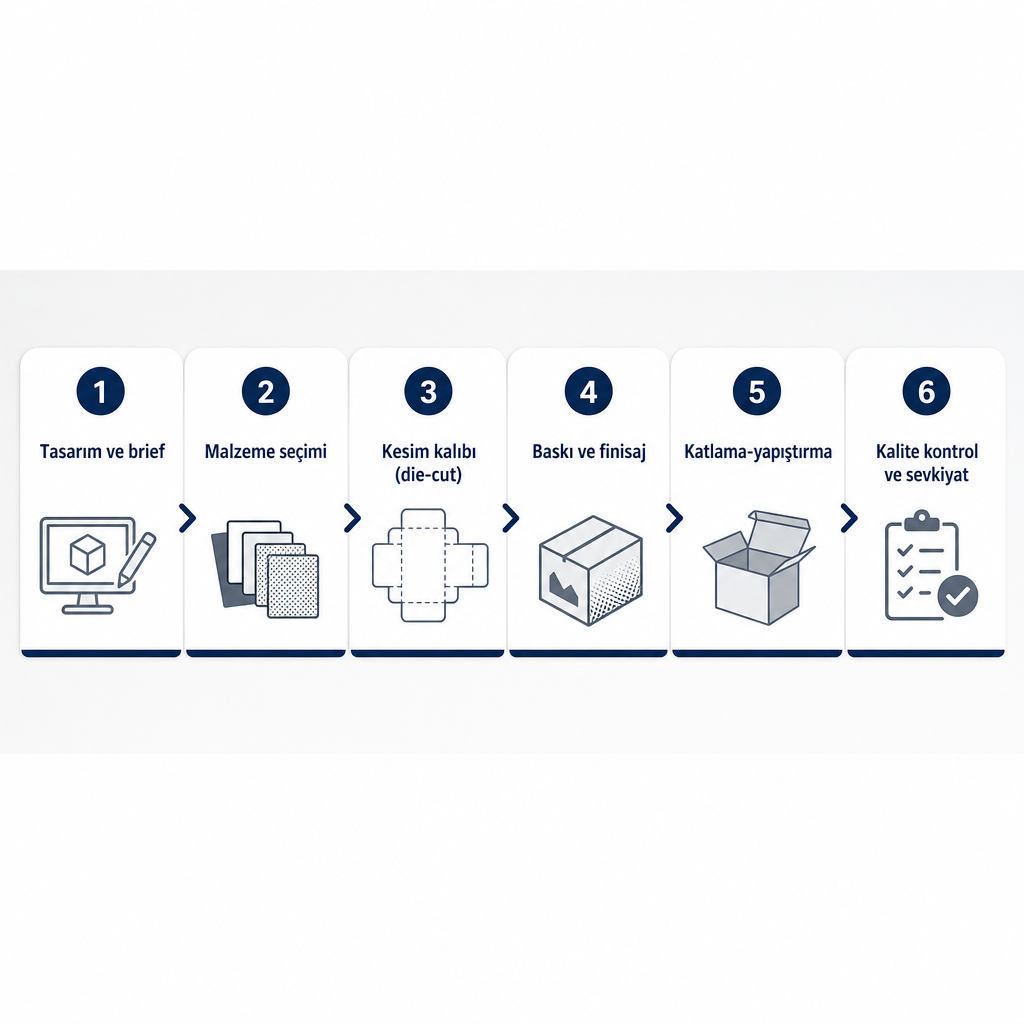
In cardboard and paperboard boxes, the production chain typically consists of the steps of design, material selection, die-cut, printing, fluting, folding–gluing, quality control, and shipping. Each link in this chain has a direct impact on time and cost; for example, a finish such as hot foil or embossing increases both the unit cost and the production time. If you want to see in more detail how cost items are reflected in the unit price, our custom box production pricing and cost factors guide explains each variable one by one.
Prerequisites: a checklist before you start
To speed up the process and avoid surprise costs, you need to have the following information clear before the first meeting. When you provide this information ready to hand, quotes come out more accurate and the project timeline shortens noticeably.
- Product information: The product's exact dimensions, weight, and sensitivity (fragile, heat-sensitive, scented). Is it a single product, a set, or a collection?
- Usage scenario: E-commerce shipping, store shelf, gift/gifting, or corporate promotion. Your in-box experience (unboxing) and social media goals.
- Brand identity and design assets: Logo files, corporate color codes, typography preferences. Do you have a ready design, or do you need design support?
- Target quantity and budget range: Is it a one-time campaign or ongoing stock? Your target range for unit cost.
- Timing and logistics: Launch date, campaign period, shipping addresses, and your storage preference (holding stock or just-in-time?).
- Regulatory and safety requirements: Mandatory labels and warnings in fields such as cosmetics, food, and electronics; the requirement for suitably certified materials for packaging that comes into contact with food.
These six headings are the skeleton of your brief. Sharing the target quantity and budget range from the very beginning, in particular, makes design decisions compatible with the budget right in the first round.
Step-by-step custom-branded packaging process
Step 1 – Clarify the role of packaging within your brand
First, determine what the packaging will do: a premium perception on the shelf, a strong unboxing experience on social media, or cost optimization? The type of box directly affects your brand's positioning; rigid gift boxes create a more luxurious perception, while corrugated e-commerce boxes bring functional priority to the fore. This decision sets the framework for all subsequent steps.
Step 2 – Choose the right packaging type
A brand's packaging portfolio is usually a combination of multiple components:
- Rigid (hard) boxes: Premium gifts, cosmetics, jewelry, chocolate.
- Folding cardboard boxes: Cosmetics, textiles, fast-moving consumer goods, shelf products.
- Corrugated e-commerce boxes: Online orders and multi-product shipments.
- Paper bags and fabric bags: Store checkout, gifting, corporate promotion.
- Labels, thank-you cards, dividers, and tissue paper: Unboxing and brand story.
At Kosapack, we design cardboard boxes, rigid boxes, paper bags, labels, and inner filling components together under one roof, on a project basis; this way, the brand's entire packaging ecosystem is designed as a consistent whole. You can find more details on how to evaluate different cardboard box types for your brand in our printed cardboard box production guide.
Step 3 – Determine the technical dimensions and construction
The correct dimensions are critical both for product protection and for cost. At this stage, starting from the product's exact dimensions, the internal clearance and tolerance allowance are defined, a flat cutting plan is created taking into account the thickness of the material to be used, and the strength requirement for transport and stacking is determined (single/double-wall corrugated or high-grammage cardboard). Our structural design and prototyping support ensures both that the product fits perfectly and that unnecessary material use is optimized.
Step 4 – Make graphic design and printing decisions
Printing is shaped by the color system (CMYK, Pantone) and the accurate reproduction of brand colors, the placement of the logo and typography, the visual hierarchy, and special effects. Finishes such as hot foil, embossing (emboss/deboss), spot UV, and matte/glossy lamination strengthen the premium perception but also increase the cost. Interior printing, stickers, and insert cards, meanwhile, carry the brand story inside the box. Our color-accuracy-focused proofing processes and pre-print checks are decisive for capturing consistent color, especially in the premium segment.
Step 5 – Get a quote and work out the cost
Box cost is calculated on a project basis rather than as a "fixed price per unit." The basic logic of the unit cost is as follows: the material cost is found by open area (m²) × grammage × price per kg × waste rate; items such as printing, cutting, die allowance, and labor are added on top. Example price lists in Turkey show that a few liras per unit are possible for plain cardboard boxes, and ranges of 15 TL and above are possible for custom-printed and premium boxes. To plan the cost item by item, our custom box production cost guide shows how each decision changes the budget.
Step 6 – Get sample and prototype approval
Seeing a physical sample before moving to mass production is critically important. During the prototype stage, check how the product sits in the box, the movement allowance, and impact protection; the print quality, color accuracy, and proper application of special effects; and the ease of opening and closing the box. Depending on the project, we produce a physical sample within a few business weeks and present it to you; this check significantly reduces the risk of faulty mass production, especially in high-volume premium jobs.
Step 7 – Mass production, quality control, and logistics
After the approved prototype, production proceeds in the following order: the material is fed into the machine and the brand graphics are printed; fluting, cutting, folding, and gluing; quality control on color, cutting accuracy, gluing strength, and packaging; and finally shipping. Through our managed production model, carried out via verified production partners, and consolidated logistics, we coordinate the brand's different packaging types within a single project; we direct products to the warehouse, stores, or fulfillment centers from a single point.
Common mistakes and how to prevent them
The most frequently repeated mistakes in the process and their practical solutions:
| Mistake | Result | Solution |
|---|---|---|
| Measuring the product dimensions incorrectly | The product doesn't fit or there is too much empty space in the box | Measuring variations separately, clarifying the technical drawing together |
| Wrong material/grammage choice | The box gets crushed, tears, or the premium perception weakens | Choosing cardboard/corrugated/textile according to the usage scenario |
| Design incompatible with the budget | Quotes come out high or quality is compromised | Sharing the unit cost target and quantity upfront, using finishes selectively |
| Mass production without a prototype | Print/color/ergonomics errors multiply across high volumes | Making the physical sample and color proof a mandatory step |
| Noticing regulations too late | Recall, reprinting, extra cost | Adding mandatory information (INCI, nutritional values, CE) to the brief from the start |
The common denominator of these mistakes is making decisions too late. Resolving the four headings of dimensions, material, budget, and regulation at the brief stage prevents the most expensive corrections down the line from the outset.
When to do it yourself, when to use a professional manufacturer
It is true that not every project requires a full-scale manufacturer. For very low-volume, one-time campaigns; when the product is light and low-risk; when the only expectation from the packaging is basic protection and limited visual impact, you can proceed with a local print shop or a ready-made box + sticker combination. However, these solutions usually carry limited material and dimension options, color consistency problems, and the risk of not being able to scale.
In the following scenarios, however, working with us is more rational in terms of both risk and total cost:
- When brand perception is critical in the premium and luxury segment (cosmetics, jewelry, chocolate, candles).
- When the unboxing experience directly affects sales and loyalty for e-commerce and DTC brands.
- When you want boxes, paper bags, labels, cards, and dividers managed under a single program.
- When sustainability, recyclable materials, and carbon footprint tracking come to the fore.
- When quantities grow and logistics and storage require professional management.
With our structure offering end-to-end consultancy, design, prototyping, managed production, and consolidated logistics, we take on the role of a strategic packaging partner, especially for growth-stage and premium brands. When you clarify your brand's packaging goals, budget, and timeline and send us a project-based brief, the process becomes manageable both with predictable costs and premium quality.
Frequently Asked Questions
What is the minimum order quantity (MOQ) for custom-branded packaging?
The MOQ depends on the chosen packaging type and production line. For cardboard and corrugated boxes, it typically starts in the hundreds to thousands; for rigid boxes and those with special finishes, higher MOQs may apply. To get an exact figure, simply contact us with the product and quantity information.
Approximately what range is the unit packaging cost in?
In cardboard box examples in Turkey, plain boxes can be seen at a few liras, while custom-printed boxes can be in the range of 15 TL and above. The exact figure is calculated specifically for each project according to material, dimensions, printing technique, and quantity.
I don't have a design—can I still get custom-branded packaging made?
Yes. We offer a team and process that designs the packaging according to your brand from both a structural and a graphic perspective. It's enough to share your logo and brand story; we handle the rest professionally.
How long does the project process take?
The duration depends on the clarity of the brief, the quantity, the material, and the complexity of the printing. In typical projects involving design, prototyping, and mass production, the sample and mass production can be completed within a few business weeks depending on capacity.
Can I make sustainable and recyclable packaging?
Yes. With FSC-certified cardboard, recyclable paper, and minimal plastic use, custom-branded packaging can be designed sustainably. We guide you by considering these criteria in material selection.