

A paper string bag is a handmade type of bag formed by twisting and weaving strips of recycled or specially processed paper fibers, which becomes surprisingly durable with the right weaving technique despite being lightweight. For brands, this bag is not merely a carrying tool; it is a promotional and gift packaging tool that translates a natural, warm, and sustainable story into a physical object. In this guide, we explore what a paper string bag is, how it differs from a rope-handle paper bag, its material and customization options, and which brand it suits in which scenario—together with Kosapack's consulting and design-focused working model.
Table of Contents
What is a paper string bag?
Paper string is a hand-knitting yarn obtained by twisting paper fibers into thin strips; by its nature it is lightweight, breathable, and quite durable with the right weaving technique. This yarn is frequently used in bag, hat, and decorative knitting projects. A paper string bag is a handmade bag created by weaving these yarns, standing out for its naturalness and simplicity.
Because it is mostly hand-woven, each piece has its own unique texture. This creates an aesthetic that gives a "handcrafted" feel, setting the product apart from factory-type carrying bags. Since its main material is paper, with the right fiber selection and weaving, products that are both lightweight and suitable for everyday use emerge. When the fibers are produced from recycled materials or with a lower environmental footprint, the bag also becomes an eco-friendly accessory and promotional product.
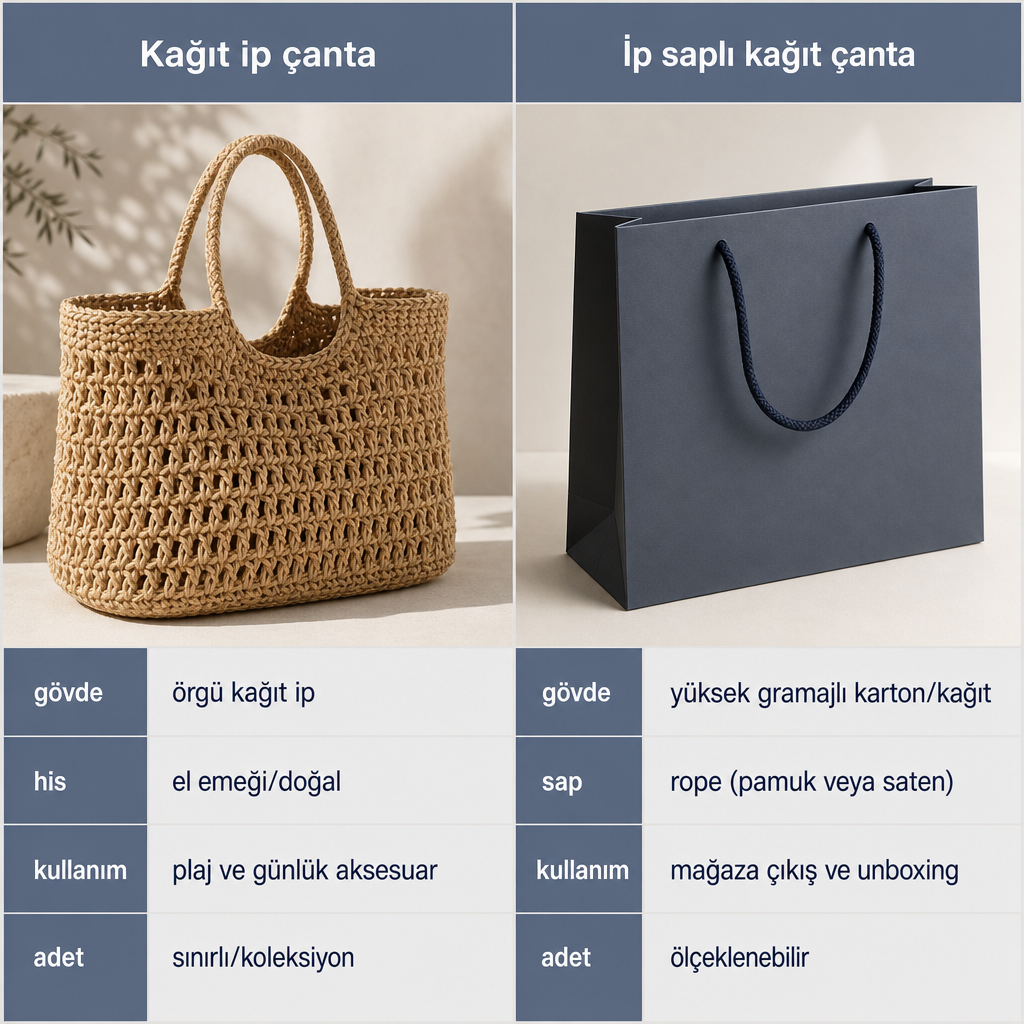
For brands, paper string bags are generally used in the following contexts: fashion accessory bags gifted for beach and everyday use, limited-edition "special collection" promotional products, and reusable bags that are part of corporate gift sets.
A parallel segment in the packaging world is rope-handle paper bags: luxury carrier bags with high-grammage paper or cardboard bodies reinforced with rope handles create a similar perception to paper string bags in branded shopping and gift packaging. These bags form the core of the premium paper bag category that turns a customer leaving the store into a mobile brand surface.
What does a paper string bag solve for brands?
For a brand, the real question is not "should I design a paper string bag?" but "how can I carry my brand's story with a sustainable and memorable physical object?" A paper string bag answers this question in three ways.
First, it creates a promotional object that is used for a long time and repurposed as long as the product itself; as the customer uses the bag again and again instead of throwing it away, brand visibility extends. Thanks to its natural appearance, it especially supports beach, everyday style, bohemian, or ecological lifestyle narratives. With its paper-based structure, it offers a lower perceived environmental footprint compared to plastic bags and synthetic fabrics.
Rope-handle premium paper bags, on the other hand, are used to elevate brand perception at the store checkout point and during the unboxing moment. With a high-grammage cardboard body, reinforced bottom, and top fold, they are designed to safely carry luxury products; soft cotton or satin rope handles provide a more comfortable grip while strengthening the bag's premium feel.
In Turkey, for premium cosmetics, jewelry, fashion, and boutique food brands, these two worlds are complementary ways to transform the functional role of packaging—that is, carrying and protection—into an emotional brand story. As Kosapack, we recommend designing the brand's checkout packaging together with the post-purchase experience; we discuss the details of this approach in our article on packaging solutions for branded unboxing.
Material, structure, and customization options
Paper string is produced by twisting recycled or specially processed paper fibers into strips; these fibers are then shaped into a form that can be used in knitting and weaving projects. Since paper is a lightweight material, it offers an option that preserves carrying comfort especially when weaving voluminous bags. With the right weaving technique, interlocking the fibers together allows the bag to retain its form and be more resistant to tearing.
The structure of a paper string bag
In a paper string bag, the body is made entirely of woven paper string; this gives the bag a textured, warm surface. The handles can again be made of paper string or of a different type of string, for example cotton; thus a visual contrast or perfect harmony can be achieved. With the right material and weaving, bags suitable for everyday use, capable of holding light-to-medium weight items, can be produced. Since the color, pattern, and weave texture can all be customized to the brand, the bag can be positioned as a collection piece within a product catalog.
Rope-handle paper bags and premium packaging
On the retail packaging side, rope-handle paper bags are the product group that carries the natural and luxurious feel offered by paper string bags to the store checkout packaging. In these bags, the body is produced from thick, high-GSM paper or cardboard; cardboard reinforcement is used at the top edge and bottom to reduce the risk of form distortion and tearing. Rope handles are made from materials such as cotton or satin, creating both comfortable carrying and a luxury perception. With printing and finishing options such as hot foil stamping, embossed varnish, and spot UV, the bags can be customized to the brand identity.
When FSC-certified and fully recyclable materials are used, these bags turn into packaging solutions that simultaneously support luxury and sustainable perception. Designing the same design language together with corrugated boxes, cardboard boxes, and labels lifts the bag out of being a single product and connects it to a cohesive brand system.
Which brand suits which scenario?
When considering a paper string bag or a rope-handle paper bag, there are five key points that need to be clarified. These also align with our consulting approach.
Brand story and style is the first criterion. If you have an identity that conveys a natural, warm, handcrafted feel, a paper string bag tells a much more consistent story than a plastic or plain kraft bag; it is especially suitable for minimal, sustainability-focused, or slow fashion brands.
The use scenario is the second point. Brands selling beach, everyday style, and lifestyle-focused products can directly add the paper string bag to their product range and offer it as promotion or gift. On the luxury retail and corporate gift side, rope-handle paper bags are at the center of store checkout packaging and the unboxing experience.
Product weight and protection needs are the third criterion. Paper string bags are suitable for carrying light-to-medium weight products with the right weaving; they may not be sufficient on their own for very heavy or fragile products. In this case, they should be used together with corrugated boxes and internal dividers. Rope-handle paper bags, on the other hand, focus on safely carrying luxury products thanks to high-grammage cardboard and a reinforced bottom.
The sustainability claim is the fourth point. When recycled paper fibers and FSC-certified materials are used, the brand can take a clear eco-friendly stance in packaging; here, the material selection, printing technique, and finishing effects—for example very glossy plastic varnishes—must be consistent with this claim.
Budget and supply model are the fifth criterion. Handmade paper string bags, due to the production time and craftsmanship required, are suitable for more limited quantities and special projects. Rope-handle paper bags, on the other hand, can meet the needs of retail, e-commerce, and corporate projects with scalable production structures; here, choosing the right packaging supplier is critical for quality and lead time. To clarify this choice, you can check our checklist for choosing the right packaging supplier.
As Kosapack, we offer paper bags, corrugated boxes, cardboard boxes, and other printed packaging under one roof. This way, brands can design both their special projects such as paper string bags and their standard unboxing packaging in the same design language. With consulting, structural and graphic design, prototyping, production managed with verified factory partners, and consolidated logistics support, we make these decisions practically implementable.
Risks and how to manage them
Paper string bags and rope-handle paper bags are a strong brand investment when used correctly; however, wrong choices can create a few risks.
The first is insufficient carrying capacity. If the weave density, fiber quality, and additional reinforcement options are not well planned when choosing a paper string bag, the bag may not carry the expected load. The second is a perception conflict. For brands selling highly technological, high-performance products, an overly organic bag language can conflict with the brand story; in this case, more geometric, premium rope-handle paper bags should be preferred. The third is the gap between the sustainability narrative and production practice. Being paper-based alone does not mean the product is green; the fiber source, printing inks, and finishing effects should be chosen in harmony with the sustainability strategy.
As Kosapack, we aim to reduce these risks on the supply side through quality control, color accuracy, and the sampling process; with a quote within 24 hours and a physical sample in 7–15 business days, we make the decision concrete before moving into production. By treating the paper string bag or rope-handle paper bag as part of a broader packaging ecosystem, we help design a brand experience aligned with your corrugated boxes, cardboard boxes, labels, and cards.
Paper string bag and unboxing strategy with Kosapack
For premium and growth-stage brands, a paper string bag is not an accessory on its own, but part of a broader packaging and unboxing strategy. Our consulting and design-focused working model brings together paper bags, corrugated boxes, cardboard boxes, labels, thank-you cards, and other elements under one roof. This way, we help you design a paper string or rope-handle paper bag concept that fits your brand story, place this bag in the same design language as your unboxing experience, in-store packaging, and corporate gift sets, and create a logistically manageable packaging set with sustainable materials and color consistency.
If you want to address the unboxing setup step by step, our guide explaining how to create the unboxing experience is a good starting point. With this perspective, a paper string bag becomes not a single campaign product, but a lasting part of your long-term brand assets.
FAQ: Frequently asked questions about paper string bags
Is a paper string bag really durable?
Paper string bags produced with the right fiber selection and dense weaving technique are more durable than expected in everyday use and can safely carry light-to-medium weight items. For very heavy or fragile products, it is recommended to support them with inner boxes and dividers.
Is a paper string bag considered eco-friendly?
Since paper string can be produced from recycled or specially processed paper fibers, when evaluated together with an appropriate recycling infrastructure, it offers a more eco-friendly alternative than plastic bags. Fiber source and printing choices reinforce this claim.
What is the difference between a paper string bag and a rope-handle paper bag?
A paper string bag is an accessory bag whose body is made of woven paper string. In a rope-handle paper bag, the body is cardboard or paper, and the handle is in rope form, and it is used as a more classic store checkout packaging.
Which sectors is a paper string bag more suitable for?
Brands that want to tell their story in a warm, organic, and sustainable language—such as fashion, beachwear, lifestyle, natural cosmetics, and boutique food—especially benefit from a paper string bag.
Should I replace my standard packaging with a paper string bag?
For most brands, a paper string bag offers the most balanced solution in terms of both cost and brand perception when positioned as a complementary product on a collection or campaign basis alongside standard packaging such as corrugated boxes, cardboard boxes, and rope-handle paper bags.