

Clarifying the right questions to ask before starting to work with a packaging supplier largely prevents color shifts, delivery delays, and regulatory surprises down the line. The practical answer to the question of how to choose the right packaging supplier is to find a business partner who meets legal obligations, aligns with your brand strategy, is technically competent, and reliably delivers sustainable solutions. This checklist was prepared to make the selection process systematic and evidence-based for premium and growth-stage brands operating in Turkey. Our goal is to ensure you have a clear evaluation framework in hand before making a decision: for each topic, we address the scope, verification steps, situation-dependent variables, and the consequences that arise when neglected.
This list carries different weightings for brands selling only in Turkey versus brands expanding into the EU or other export markets. We proceed by separating legal requirements from practical preferences; this way, you can see both your compliance risk and your brand experience goals in the same table.
Table of Contents
Main checklist: a quick look
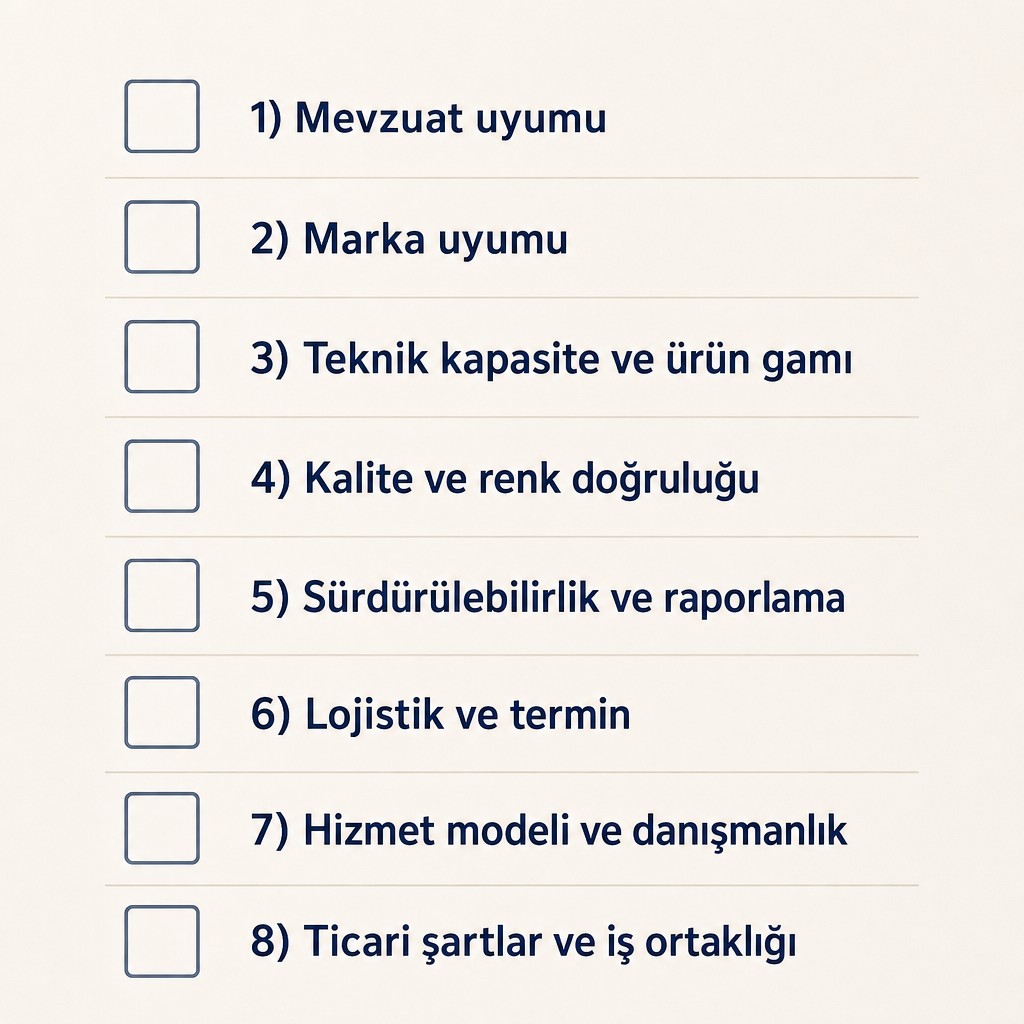
Before starting the evaluation, seeing all eight topics on a single screen speeds up the decision process. Each line corresponds to a group of requirements that we detail in the following sections.
- Compliance with regulations and legal obligations: Turkey and, if applicable, EU/export markets.
- Strategic and brand alignment: unboxing, shelf visibility, premium perception.
- Technical capacity and product range: box types, paper bags, labels, tissue, and similar products.
- Quality assurance, color accuracy, and sampling processes.
- Sustainability, recyclability, and reporting approach.
- Logistics, delivery times, and flexibility: lead times, consolidated shipments, inventory management.
- Service model and consulting depth: design, prototype, project management.
- Commercial terms, risks, and long-term partnership potential.
Compliance with regulations and legal obligations
The first question to ask relates to the market: do you sell your products only in Turkey, or do you also export to the EU or other regions? This distinction directly determines the level of knowledge the supplier must have.
All packaging placed on the market in Turkey and its waste fall under the scope of the Regulation on the Control of Packaging Waste. For producers and importers who place packaging on the market, obligations arise under the Environmental Law, the Waste Management Regulation, and the extended producer responsibility (EPR) obligations within the framework of this regulation; in addition, registration and notification processes through the Ministry of Environment, Urbanization and Climate Change's Packaging Information System come into play. For packaging entering the EU market, the Packaging and Packaging Waste Regulation (PPWR) No. 2025/40 highlights recyclability performance classes, volume optimization, and restrictions on single-use packaging.
These provisions may create different additional requirements depending on the sector; plastics in contact with food, cosmetic packaging, and electronic product packaging may be subject to different safety rules. In an area where dates and thresholds can change, it is important to confirm the obligations specific to your category with your own legal and environmental advisor.
Verification steps you can apply when selecting a supplier:
- Request a declaration of compliance with the Regulation on the Control of Packaging Waste applicable in Turkey and a written explanation of how EPR responsibilities are fulfilled.
- If you export, ask about the supplier's awareness and roadmap regarding PPWR requirements (recyclability, volume optimization, single-use restrictions).
- Clarify your own obligations in line with the Packaging Information System and relevant ministry guidelines; compare the documents provided by the supplier with your internal audit processes.
Non-compliant packaging can lead to consequences ranging from administrative fines, product recalls, damage to brand reputation, and, in some markets, sales restrictions. For this reason, compliance is a threshold that takes precedence over the other items on the list.
Strategic and brand alignment
For premium and luxury brands, packaging is a strategic tool that carries brand identity, story, and customer experience beyond protecting the product. Custom packaging is a holistic solution whose size, material, and printing are designed for the brand, turning the unboxing moment into a brand experience. The key question here is whether the supplier treats packaging as a "box" or as an extension of brand strategy.
Points you can look at when evaluating:
- Can the unboxing experience be designed to create a consistent brand perception both in-store and across online channels?
- Are solutions produced that preserve your brand tone for different scenarios such as gifts, corporate shipments, and e-commerce shipping?
- Does the packaging approach support your advertising and store investments rather than conflict with them?
As Kosapack, in our blog content we position custom packaging as the carrier of brand identity and customer experience, and we detail how we strengthen the branded unboxing experience in e-commerce shipping boxes through design. A supplier chosen without considering strategic alignment can produce packaging that protects the product but does not strengthen brand perception, leading to an experience that conflicts with your digital and physical investments.
Technical capacity and product range
Premium brands often use cardboard boxes, rigid boxes, paper bags, labels, tissue papers, thank-you cards, dividers, and envelopes together. Whether the supplier can produce these products under one roof directly affects the consistency of your launches and campaigns.
Capacity points you can inquire about:
- Can cardboard boxes, cardboard gift boxes, paper bags, labels, and similar products be produced in one place?
- Can recommended weights, structural details, and technical tables for packaging types and substrates be shared?
- Is there structural design and prototype development capability for products requiring custom dimensions and forms?
We carry out our production at our facility in İstanbul Zeytinburnu; we bring together a wide range of premium packaging, from cardboard boxes to paper bags, under one roof. A supplier with limited technical capacity may not be able to ensure consistency across different packaging types; this comes back to you as inventory confusion and quality fluctuations from print to print.
Quality assurance, color accuracy, and sampling processes
In premium packaging, color consistency, print quality, cutting accuracy, and assembly quality are of critical importance. Having the same design come out consistently across different production batches is only possible with a defined quality assurance system.
Questions you should clarify during the sampling and approval process:
- How are quality control steps (incoming quality, process control, final inspection) defined?
- Is the proofing and approval process for color accuracy clear through physical samples, color swatches, or reference prints?
- Are the sampling time and scope realistic for custom dimensions, materials, and printing, and are they defined in the contract?
In our custom brand packaging production, we follow an end-to-end process that includes design, material selection, printing, folding-gluing, quality control, and shipment; we carry out final approval and production planning through samples. When quality assurance is weak, issues such as color shifts, material differences, and faulty cutting arise; these mean returns, re-production, and campaign delays.
Sustainability and reporting approach
Packaging regulations in Turkey and the EU encourage prioritizing recyclable packaging and limiting single-use plastics. With the PPWR, packaging recyclability, volume optimization, and eco-design principles become more prominent. For this reason, sustainability is not just a preference but a way to manage future compliance costs today.
Control points you can evaluate:
- Does the supplier follow a materials policy that prioritizes recyclable cardboard and paper-based solutions?
- Are recyclability declarations and, if necessary, certifications for the materials used available? This varies according to your product category.
- Is there an approach that can report sustainability performance such as material selection, waste reduction, and logistics optimization?
In our corporate communications, we emphasize that we offer packaging solutions that prioritize sustainability and adopt a production approach that takes environmental impact into account. When sustainability is ignored, compliance costs with tightening regulations increase; moreover, trust between consumer expectations and brand rhetoric can be damaged.
Logistics, delivery times, and flexibility
The packaging supply chain covers production times, shipping, storage, and inventory management. Seasonal peak periods and sudden campaigns are the real moments that test a supplier's flexibility.
Logistics questions you should ask:
- What are the typical lead times for standard and campaign orders; can flexibility be provided when demand increases?
- What services are offered for consolidated shipping, palletizing, storage, and inventory tracking?
- Is there experience and are there business partners for domestic distribution within Turkey and, if necessary, export logistics?
We manage projects end-to-end, from design to production; we treat logistics, storage, and inventory management as part of the packaging process. A supplier with weak logistics planning causes products to be left without packaging during seasonal peak periods or leads to costly emergency production; this reduces your operational efficiency.
Service model, commercial terms, and partnership
The ideal packaging supplier is a strategic business partner who can manage design, prototyping, and production together. In this section, it is necessary to evaluate service depth and the commercial framework together; because the two, inseparably, determine the long-term collaboration.
Things to look at on the service and consulting side:
- Is there consulting and project management capacity to define your packaging strategy together?
- Are there expert teams for structural design (box form, load resistance) and graphic design (logo usage, typography, color)?
- Can iterative improvement be made by processing feedback during the prototype and sampling stages?
Things that need to be clarified in the commercial framework:
- Is the quotation process fast and transparent; is there a structure where you can convey product information through a detailed form?
- Are quality, delivery time, sampling, return/rework, and confidentiality provisions clearly defined in the contract?
- Are minimum order quantities compatible with your seasonal and campaign needs; can a win-win model be established as scale grows?
Through our quote request form, we run a consulting-focused process that offers detailed quotations, free consulting, and sample request options. Commercial terms that are not clearly defined can create surprise costs as the project progresses, delivery disputes, and conflicts between quality expectations and delivery; and a supplier that is only production-focused reduces packaging to a technical line item, causing you to start from scratch with each new project.
Supplier review with Kosapack
After evaluating your current or potential suppliers with this checklist, you may want to move on to a deeper packaging strategy study for your brand. With our consulting- and sample-focused service model managed end-to-end from design to production, we position ourselves as a strategic packaging partner for premium brands.
Steps we recommend for concrete progress:
- Summarize your products, target customer base, sales channels, and brand story in short notes.
- List the problems you experience with your current packaging (quality, logistics, sustainability, unboxing).
- Request a price and solution proposal with a detailed project brief; this way, you can turn this list into a concrete packaging development process.
If you are rethinking your current packaging, our guide on how custom brand packaging is made helps you see the process step by step.
Frequently Asked Questions
How to choose the right packaging supplier?
The right choice is a supplier who provides regulatory compliance, a design approach that integrates with brand strategy, technical capacity, sustainability, logistics flexibility, and transparent commercial terms together. Comparing these items in a single evaluation table strengthens the decision.
What legal framework applies to packaging in Turkey?
The Environmental Law, the Waste Management Regulation, and the Regulation on the Control of Packaging Waste form the basic legal framework for the design, placing on the market, and management of packaging and packaging waste. It is recommended that you confirm the obligations specific to your category with your own advisor.
What should brands exporting to the EU consider when selecting a supplier?
Under the PPWR, packaging recyclability, volume optimization, single-use packaging restrictions, and the potential to comply with reuse targets should be evaluated. It is important for the supplier to have awareness and a roadmap on these topics.
What is important in supplier selection for a premium unboxing experience?
A supplier should be preferred who can create brand-specific designs with custom dimensions, materials, and printing; who can design elements such as boxes, paper bags, labels, and inner wrapping together; and who ensures color consistency.
For which brands is Kosapack a suitable packaging supplier?
We offer custom-designed boxes, bags, labels, and inner packaging solutions at our facility in Zeytinburnu for premium and growth-stage brands such as cosmetics, fashion, jewelry, food, and e-commerce.