

Every product your brand hands over actually concludes with a moment of carrying; the paper rope bag is the most visible packaging of that moment. When the right combination of size, paper, print and handle is chosen, the bag doesn't just carry the product—it also sustains the brand's perception of quality on the way out of the store and in corporate gift deliveries. By the end of this guide, you'll be able to clarify the size, paper and handle selection, print method, durability level and the brief to send to production for your brand.
Let's lay out a realistic plan: preparing the design and technical brief usually takes 1–3 business days, and the physical sample process takes roughly 7–15 business days; mass production requires additional time depending on technical specifications and quantity. As Kosapack, we can provide a quote within 24 hours after the brief, and a physical sample within 7–15 business days. On the cost side, giving a single figure would be misleading: unit price rises in small-quantity, custom-sized and multi-color production; standard size, limited colors and high quantity bring the cost down. For a precise price, we evaluate size, paper, print, rope handle, reinforcement and quantity together.
Table of Contents
Pre-quote checklist
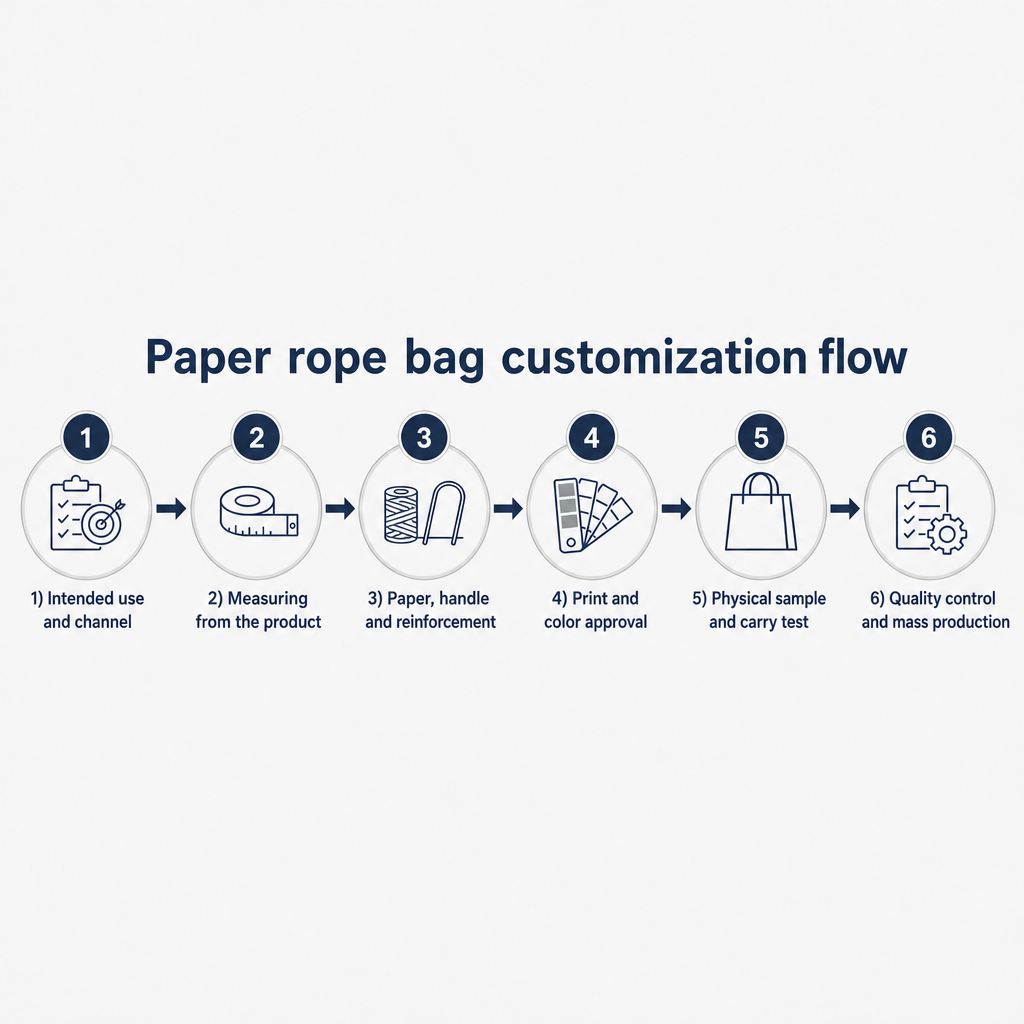
Customization doesn't start with placing a logo, but with answering the right questions. If you gather the information below before requesting a quote, the process speeds up and the number of revisions during the sample stage drops.
- The product or product set the bag will be used for
- The width, length, height and approximate weight of the product
- The targeted interior size of the bag
- Target quantity and reorder frequency
- Usage channel: store, shipping, event or corporate gift
- Paper appearance: kraft, white, colored or specially textured
- Paper rope handle color and length
- Logo and print files, requested print colors
- Need for base and mouth reinforcement
- Target unit cost and delivery date
- Whether the use requires special regulations such as food or cosmetics
- Expectation for FSC or similar sustainability certification
This list is also the skeleton of the brief you'll send us. Every item left incomplete turns into an uncertainty that prolongs the sample round.
Clarify the intended use
First, determine what load the bag will carry, for how long and in what environment. A bag that looks the same requires entirely different technical decisions depending on the usage channel.
For fashion, jewelry, cosmetics and accessory brands, the bag must carry the product safely out of the store, make the brand visible at the checkout and shelf area, support the gift experience, and be durable enough for the customer to reuse. Here, aesthetic printing, handle comfort and base durability stand out.
For event, launch and corporate gift bags, the quantity may be high while the usage duration is short. In this scenario, logo visibility, quickly producible standard sizes, easy portability and budget-friendly paper-print selection take priority.
Shipping and heavy products are a separate matter. A paper rope bag is not a shipping packaging for every product on its own. For heavy or long-distance shipments, the paper weight, side and base structure, handle connection, interior supports, and moisture and friction conditions must be tested on the sample. In most cases, we recommend having a cardboard box that protects the product inside the bag, or an outer carton. We cover in detail why branded carrying packaging is not just a logistics detail in our guide explaining the impact of branded packaging on brand perception.
Calculate the size based on the product
The bag size should not equal the product's outer size. A margin should be left for placing and removing the product, and for tissue paper, box or filler if any. Write these five measurements clearly in the brief:
- Width: the horizontal dimension of the product
- Gusset or side width: the space needed for product thickness and multiple products
- Height: how deep the product will sit in the bag
- Handle height: whether the bag will be carried in hand or on the shoulder
- Base area: whether the product will stand upright
For example, a cosmetic set consisting of several pieces requires a wider base and higher carrying capacity than a single lipstick box. For small products like jewelry, the size of the inner box, tissue or gift box is more decisive than the bag size. Think of the bag not just with a single product, but with the real usage scenario: give the size by imagining you've placed the product together with its box, filler and, if any, thank-you card.
Paper, handle and reinforcement decisions
Paper selection balances appearance and carrying capacity. Kraft paper creates a natural, warm and sustainability-focused perception; however, the color of the kraft surface affects the print result—especially light tones and brand colors can look different compared to white paper. A white or coated surface ensures colors come out vivid, photographic printing becomes sharp, and light-colored logos are applied in a controlled way. Specially textured or colored paper can be used for luxury fashion, jewelry, candle and corporate gift brands; however, these papers generally require a higher minimum production quantity, longer lead times and more comprehensive pre-print sample checks.
We don't publish a fixed weight or size list for paper rope bags, because the right weight depends on the load to be carried and must be finalized based on carrying tests. Material and weight directly affect the total cost, which is why we make the decision on the sample.
The paper rope handle determines both the appearance and the usage comfort of the bag. In the brief, specify the handle color, length, thickness, its harmony with the bag color, whether it will be carried in hand or on the shoulder, and the interior support to be used at the connection. For a premium look, a rope handle different from the bag color can be chosen; for a more cohesive brand language, the handle can be matched to a tone of the paper or print color. For heavy products, merely increasing the rope thickness is not enough; the area where the handle is attached, the mouth folding and the interior reinforcement must be evaluated together.
The mouth and base are the most frequently overlooked areas. Mouth reinforcement strengthens the handle connection, makes the bag easier to open and close, and reduces the risk of the paper tearing around the handle. Base reinforcement is especially important if glass jars, cosmetic sets, candles, bottles, multiple products or boxed products will be carried. Make the reinforcement decision based on the product's weight, base size and carrying duration; requesting a static load and carrying test on the sample from the manufacturer is far healthier than relying solely on paper thickness.
Plan the print and color approval
Printing is the most visible part of the brand identity on the bag; however, if the design is prepared without regard to producibility limits, the result comes out different from what's on screen. Before sending it to print, clarify these: will the print be single-sided or double-sided, will the background color be printed, how many colors does the logo consist of, are the Pantone or CMYK values defined, are there fine lines and small text, does the print extend into the folding or gusset area, will the paper color change the result, and is a matte or glossy finish requested.
Light-colored logos on dark kraft paper don't look as bright as they do on white paper. For this reason, digital design approval alone is not enough; in our branded packaging processes, we keep color-accurate proofing and written pre-production approval as standard. "Make it like on the screen" is not a technical definition. Provide the manufacturer, if possible, with a vector logo, CMYK and Pantone values, a file with text converted to outlines, the print size with safe area and bleed margins.
Sample and quality control plan
Don't view the sample only as a visual check. When the physical sample is in your hands, perform these tests in order:
- Place the product in the bag with its real inner packaging.
- Carry the handles for 10–15 minutes and lift from different directions.
- Check whether the base bends.
- Look for opening at the handle connections or paper tearing.
- Remove and place the product in the bag several times.
- Let the bag rest filled for a short while and examine whether the print cracks in the folding-gusset areas.
During approval, instead of saying "the print looks nice," confirm the size, paper, rope handle, reinforcement, print direction, color and packaging format in writing. Before mass production begins, share the acceptance criteria: bag width-length-gusset measurements, logo position, print color consistency, handle length and color, handle connection points, base adhesion, crushing or staining on the paper surface, fold lines and carton quantity. Since minor color differences or dimensional deviations may occur across the entire order, clarify the acceptable tolerances at the quote stage and keep the first approved sample as a reference for reorders.
How is the cost formed?
The price of a paper rope bag is not determined by a single item. The main cost drivers are: bag size, paper type and weight, print surface and number of colors, special color or textured paper, the color and structure of the paper rope handle, mouth or base reinforcement, special lacquer or coating, order quantity, die and setup costs, physical sample, packaging, storage, shipping and waste allowance.
To reduce cost, don't make the size unnecessarily large, consider standard paper and handle options, simplify the print surface, and plan the production quantity according to annual need. On the other hand, giving up the durability test may generate higher return and reproduction costs for the sake of a low unit price. For a detailed cost approach that evaluates size, material, weight, print, quantity, sample and logistics together, you can look at our guide explaining how custom box production cost is calculated; the same logic applies to bag items as well.
Food and sustainability check
If a paper rope bag is to be used as packaging that directly holds food or comes into contact with food, a compliance check must be performed before production. The Turkish Food Codex contains special rules regarding the migration of colorants into food for paper, cardboard and similar paper-based materials; the use of printed papers not produced for food contact and some recycled papers in food contact is restricted. Check the scope through the Turkish Food Codex regulation on materials and articles in contact with food, one of the fundamental reference sources on the subject.
In practice: don't use the bag in a way that food will directly contact it, separately check the compliance of the inner pouch or barrier that will contact the product, request a compliance certificate from the supplier for the paper-ink-lacquer-adhesive, and don't use the phrase "food-safe" without testing or documentation.
Sustainability claims also require similar discipline. Expressions like "eco-friendly," "recyclable" or "sustainable" are not automatically verified simply because paper is used. The paper's source, recycled content ratio, print ink, lacquer, handle material, adhesive and local recycling infrastructure must be evaluated together. FSC's certification system for paper and packaging verifies the traceability of the supply chain; check the scope of the certificate before making a certification claim. Only part of the packaging being certified does not mean the whole bag falls within the same scope; request the certificate number and which components it covers.
DIY or professional production?
A handmade or small-quantity solution makes sense in some cases: if a very low quantity is needed for an event, if a label or stamp will be used instead of printing, if the bag will carry a light product, if the size can be standardized and the visual tolerances are flexible.
However, if one of the following situations exists, professional production is safer: if hundreds or thousands of units are needed, if the same size and color is required for every bag, if the product is heavy or fragile, if brand colors are critical, if there is a store network or e-commerce operation, if food-cosmetic-export compliance is at stake, or if handle and base durability is required to be guaranteed.
When moving to the professional side, don't just ask for a price. Request the physical sample, color approval, quality control, minimum order quantity, delivery time and shipment plan together. In our service model, we handle consultancy, structural and graphic design, prototype, managed production, quality control and logistics coordination under one roof; this allows us to plan the bag as a consistent set together with the cardboard box, tissue and card inside.
Common mistakes and their solutions
| Mistake | Result | Solution |
|---|---|---|
| Size given based only on the product | The box, tissue or card doesn't fit in the bag | Measure all contents together and take a sample with the real placement |
| The kraft surface is not taken into account | Light colors come out dark and low-contrast | Take the paper color into account in the design, get a physical proof and written color approval |
| The handle connection is not tested | The handle opens up and the paper tears when the bag is full | Perform a carrying-pulling test with the real weight, review the reinforcement |
| A bag larger than necessary | Paper, storage and transport costs increase | Use a custom size with controlled clearance margin |
| Undocumented "recyclable" claim | The components may not be recyclable together | Document the material composition and the claim |
| Only on-screen design approval | The print looks different on real paper | Don't approve mass production without a color-accurate proof or physical sample |
The common denominator of these mistakes is that decisions need to be tested in the product's real use, not on paper. The few days you devote to sampling are far smaller than the cost of a mistake in mass production.
Frequently Asked Questions
For which products is a paper rope bag suitable?
It is suitable for cosmetics, jewelry, fashion products, candles, chocolate, corporate gifts and store purchases. If the product is heavy, sharp or fragile, the base, handle and interior support must be tested on the sample.
How is the paper rope bag size determined?
It is determined by including components such as the box, tissue, filler and thank-you card in addition to the product's outer dimensions. Width, height, gusset and base dimensions must be calculated together.
What is the minimum order quantity for a paper rope bag?
It wouldn't be right to give a single fixed quantity. The minimum order varies depending on size, paper, print, handle, reinforcement and production method; once the structure and finishes are clarified, we share a threshold specific to you.
How long does paper rope bag production take?
After the brief and technical approval, approximately 7–15 business days can be planned for the physical sample. The mass production time is determined separately according to quantity and specification.
Can a paper rope bag be used as food packaging?
If direct food contact is involved, only material, print and production processes whose compliance is documented should be used. A standard printed bag should not be assumed to be suitable for food contact.
Can a paper rope bag be used together with a cardboard box?
Yes. Especially in premium gift, cosmetic, jewelry and corporate sets, the cardboard box protects the product while the paper rope bag provides carrying and brand visibility. The total size of the two packagings should be the starting data for the bag design.