

If you want to build the product, its usage scenario and the brand experience together from the ground up instead of trying to squeeze the product into a standard box, you need custom-size box design. This approach is not just about adjusting width, length and height; the box's structure, material, lid mechanism, interior layout and printing are decided simultaneously, based on the product's real dimensions and transport conditions. When set up correctly, the box protects the product, reduces unnecessary empty space, strengthens brand perception on the shelf and at the moment of opening, and prevents surprises in production.
At Kosapack, we combine consultancy, structural design, graphic design, prototyping, production management and logistics in a single service chain for custom box projects. In this guide we define the decision itself, explain how to move from product dimensions to box dimensions, why structural and graphic design cannot be separated, and which checks are critical before mass production.
Table of Contents
What is custom-size box design and what does it cover?
Custom-size box design means building the packaging around the product's real dimensions, weight, fragility and usage scenario, instead of selecting one of the ready-made box sizes. A standard box with a logo printed on it is not the same thing as a box designed specifically for the brand; in a genuine custom box project, the core decisions—from the box's dimensions to its internal structure—are made according to the product.
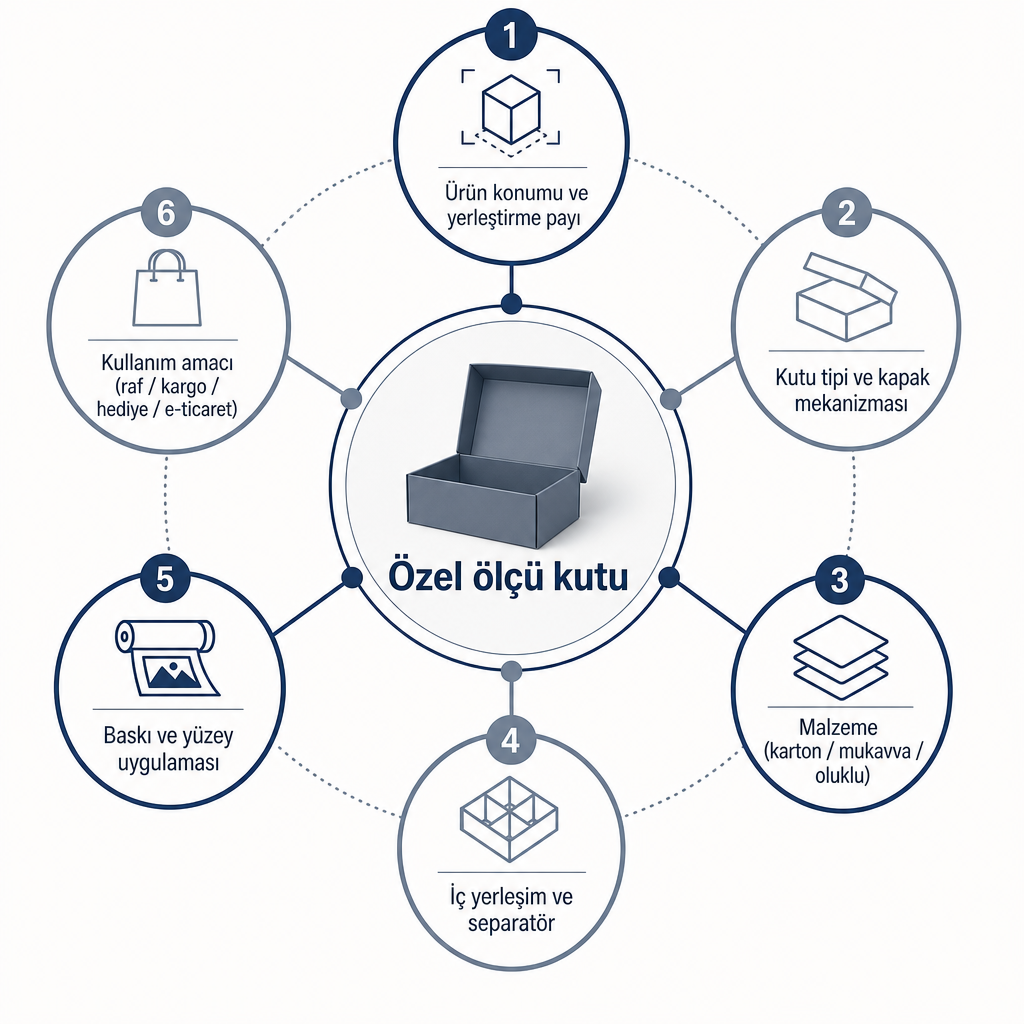
The decisions addressed together in this scope are: the product's exact position inside the box and the placement allowance, the box type and opening mechanism, the choice of cardboard–rigid board–corrugated structure, the use of separators or inserts, the printing surfaces and graphic layout, surface treatments such as varnish or embossing, and finally the box's purpose—shelf, cargo, gift or e-commerce. Storage, shipping and reproduction requirements are also taken into account from the start.
First decision: Which usage scenario will the box serve?
Before determining the size, it must be clarified where and how the box will be used. For the same product, a shelf box, an e-commerce shipping box and a gift box do not have to share the same structure. While graphic visibility on the shelf stands out for a cosmetics product, impact protection and cargo volume may be more critical for the same product in an e-commerce shipment. Instead of forcing a single box to serve every purpose, designing different structures with the same brand language gives healthier results in most projects.
| Purpose of use | Priority design criteria |
|---|---|
| Shelf packaging | Visible front face, readability, print quality and shelf impact |
| E-commerce | Impact resistance, volume efficiency, product securing and cargo conditions |
| Gift packaging | Unboxing experience, lid mechanism and in-box presentation |
| Premium product | Material feel, rigid board structure, surface treatments and interior composition |
| Multi-piece set | Separators, compartments and orderly placement of pieces |
| Multi-SKU product family | Shared design language and tiered size family |
Once the scenario is clear, the decisions on size, material and interior layout all serve a single goal; this reduces the risk of returns and reproduction in later stages.
How do you move from product dimensions to box dimensions?
The starting point is the product's outer dimensions, but the box's inner dimension is not an exact copy of the product's dimensions. A suitable allowance is needed so that the product fits comfortably, is easy to remove and does not move excessively during transport. A dimension that is too tight makes placement difficult; a dimension that is too wide creates unnecessary empty space, product movement and higher cargo volume. The goal is not for the product to "fit" into the box, but for it to be placed securely, neatly and in a way that suits the brand experience.
The information that should be evaluated when deciding on the dimensions is as follows:
- The product's width, length, height and weight
- Whether it is sensitive, fragile, or contains liquid, glass, metal or sharp-edged parts
- Whether the product will be packaged on its own or with its accessories
- How the product will be removed from the box and the securing requirement
- Whether tissue, cards, separators or fabric bags will be added
Since interior parts directly change the box's inner dimension, every item on this list should be discussed before the outer dimension is calculated.
How do you choose the box structure?
In custom-size box design, the structure is as decisive as the size. Folding cardboard, rigid board, corrugated and e-commerce boxes, along with in-box complementary products, are evaluated according to different usage purposes.
Folding cardboard boxes stand out in projects that involve high-volume production, shelf presentation, lightweight products and the need for flat shipping. Being shippable flat provides an advantage in storage and logistics; they are frequently preferred for cosmetics, food and fast-moving consumer goods.
Rigid board boxes are for projects with a stronger material feel, a premium look and an expectation of lasting use. Lid-and-base, magnetic lid, sliding drawer or specially shaped structures are built in this group. In rigid box design, body thickness, lid mechanism, in-box presentation, product securing, coating surface and the opening feel are considered together. In our rigid box service, structural design is handled together with the box model, dimensions and interior arrangement, and before mass production, evaluation can be made through plain, printed or 3D digital mockup options.
For corrugated and e-commerce boxes, impact, stacking and handling conditions during the shipping process are decisive. These boxes must be designed not only with the brand graphics but also with the product's protection needs along the transport chain: unnecessary empty space should be reduced, the product should be secured inside the box, the volume should be optimized according to the cargo scenario, and the need for internal filling or separators should be evaluated. To weigh the cost and logistics differences between the two structures in more detail, you can also review the comparison of rigid versus folding boxes; we also explain these options in scope in our guide to custom brand box production.
Why are structural design and graphic design carried out together?
Box graphics are not an image placed afterward onto a ready-made rectangular surface. They are prepared taking into account the box dieline, cut lines, fold lines, glue tabs and print boundaries. For this reason, a dieline template is created before or together with the graphic design, and the graphic file is built on this template.
The points that should be checked at this stage are as follows:
- Logos and text should not fall on the fold line
- Critical information should not come too close to the cut lines
- Unwanted printing should not occur in the glue areas
- Correct positioning of the front, back, side and interior surfaces
- Readability of the barcode, content information and usage instructions
- Preservation of the bleed allowance and safe zones
- Correct appearance of the graphic composition when the lid is opened
If structural and graphic design proceed separately, a design that looks correct on screen may, after production, break at the fold line or push an important text into the cut area. By running the two disciplines within the same project, we aim to reduce the risk of this mismatch.
Interior layout, printing and physical samples
Especially in premium products, the inside of the box is as decisive as the outer surface. The first composition seen when the lid is opened, how the product is held, and in what order the auxiliary parts appear directly affect the brand experience. In the interior layout, cardboard or fiber separators, an inner tray that secures the product, a fabric bag, tissue paper, an insert card, a thank-you card and compartments for multi-piece sets can be used. A separator is not just aesthetic; it reduces the product's movement and the contact of the parts with each other. However, since interior parts also affect the box's total size, cost and assembly time, the interior layout should be planned as one of the first structural decisions, not as a detail added after the outer box is completed.
Printing and finishing should be compatible with the box's material and purpose. For a premium perception, it is not necessary to use every treatment at once; a more effective result usually comes from a balanced combination of material, color and a limited number of surface treatments. Full-color or limited-color printing, matte or glossy surface, varnish, embossing, foiling and special coating options can be evaluated. For example, while an embossed logo with a chosen gloss contrast stands out in a jewelry box, a more minimal design with a large print area may be more suitable for an e-commerce box in terms of production and cost. The color decision should not be made solely based on the on-screen design; since there may be tone differences between the screen, the proof and the final print, the physical sample and color verification stage is important.
The physical sample is a decision point that should not be skipped before mass production, because some problems are not visible in the digital file: Does the product fit comfortably in the box, does it move when closed, does the lid mechanism give the expected feel, does the inner separator secure the product sufficiently, is the print tone close to the brand color, and does the box feel sufficiently durable in hand? In our current service information, we state that, depending on the brief, a physical sample can be presented within 7–15 business days; for a price quote, we share a 24-hour target framework. The exact time becomes clear depending on the product type, scope and project details.
Size optimization and sustainability
As the box size increases, it is not only more material that is used; storage and cargo volume also increase. A size that is smaller than necessary, on the other hand, negatively affects the product's protection and the user experience. Therefore, in custom-size box design, a balance is sought between product protection, sufficient placement allowance and minimum unnecessary volume.
In projects with cargo or palletized shipping, the compatibility of the box dimensions with the transport systems can also be taken into account. The ISO 3394 standard defines an approach based on modular plan dimensions such as 600 × 400 mm for the dimensions of rectangular transport packaging. This does not mean that every product must conform to a standard size; however, evaluating modular dimensions when planning shipping and stacking can provide logistics efficiency.
Sustainability, meanwhile, is not just about choosing recyclable material. Not designing the box larger than necessary, reducing unnecessary layers and interior parts, being able to easily separate the box from the additional parts, and evaluating the effect of printing treatments on the recycling process also fall under this heading. In our custom packaging projects, we consider topics such as recyclable materials, optimizing packaging volume and carbon footprint reporting.
Regulatory checks for food boxes
When designing a food box, aesthetic and dimensional decisions alone are not sufficient. In Türkiye, the label of prepackaged foods includes mandatory information such as the product name, list of ingredients, allergen information, net quantity, date information, storage conditions, the name and address of the food business operator, and the batch number. The location of this information on the box, its font size and readability should be planned at the start of the design; especially in small-sized boxes, trying to fit mandatory information in afterward disrupts the graphic hierarchy.
On surfaces in direct contact with food, the compliance of the packaging material, printing ink and other components with the relevant regulations must also be verified. Since food labeling rules can vary by product category, the final text and compliance checks should be confirmed with authorized experts. For current obligations, it would be appropriate to verify from the source the Turkish Food Codex food labeling regulation.
The quote brief and common mistakes
A complete brief enables the quote to be prepared more quickly and accurately. In your quote request, share the following information: the product's exact dimensions and weight, the quantity or estimated quantity range, the box's purpose of use, fragility and protection requirements, the desired box type, the need for an inner separator or additional parts, printing and surface expectations, the brand guide or existing logo files, the target delivery date, and the delivery address along with the shipping scenario.
The most common mistakes encountered in the same project also arise from these decisions being made incompletely or late:
- Focusing only on the outer dimension: Leaving the interior layout for later causes the product to move or the interior parts not to fit.
- Moving to mass production without taking a sample: The on-screen design does not show the material feel, lid resistance and real opening experience; skipping this step increases the risk of reproduction.
- Combining cargo and shelf use in the same structure: Shelf appearance and cargo durability are different priorities; loading everything onto a single box increases cost and design complexity.
- Adding mandatory information at the end of the design: When label information is not set aside from the start in food products, text that is too small to read or an unbalanced layout emerges.
- Choosing a heavier box than necessary: Thick material does not always give a more premium result; the product category, cargo channel and brand positioning should be evaluated together.
If you want to plan the entire process from the start, you can benefit from our getting-started guide to custom box design, and to see the cost items in advance, you can review our Box Prices 2026 guide. In your custom-size project, we carry out the evaluation of the product and brand brief, structural and graphic design, sampling, approval, production quality control and logistics coordination together.
Frequently Asked Questions
Is custom-size box design just about changing the box's dimensions?
No. In addition to the dimensions, the box structure, material, interior layout, lid mechanism, printing, surface treatments and usage scenario are also designed together.
Should the product dimensions and box dimensions be the same?
No. A suitable placement allowance is needed so that the product fits comfortably, is easy to remove and does not move excessively during transport.
Which brands are rigid board boxes suitable for?
Rigid board boxes can be considered in categories where material feel is important, such as premium presentation, gift experiences, cosmetics, jewelry, candles, chocolate and special sets. The final choice is made according to product weight, purpose of use and budget.
Is it necessary to take a physical sample?
Yes. A physical sample allows you to check the dimensions, material feel, print tone, box durability and opening experience before mass production. Depending on the brief, we present the sample within a framework of 7–15 business days.
What should be considered when designing a food box?
Mandatory label information, readability, food contact compliance, printing ink and category-specific regulations should be checked. In prepackaged foods, information such as the product name, ingredients, allergens, net quantity, date, storage conditions and operator details may be mandatory.