
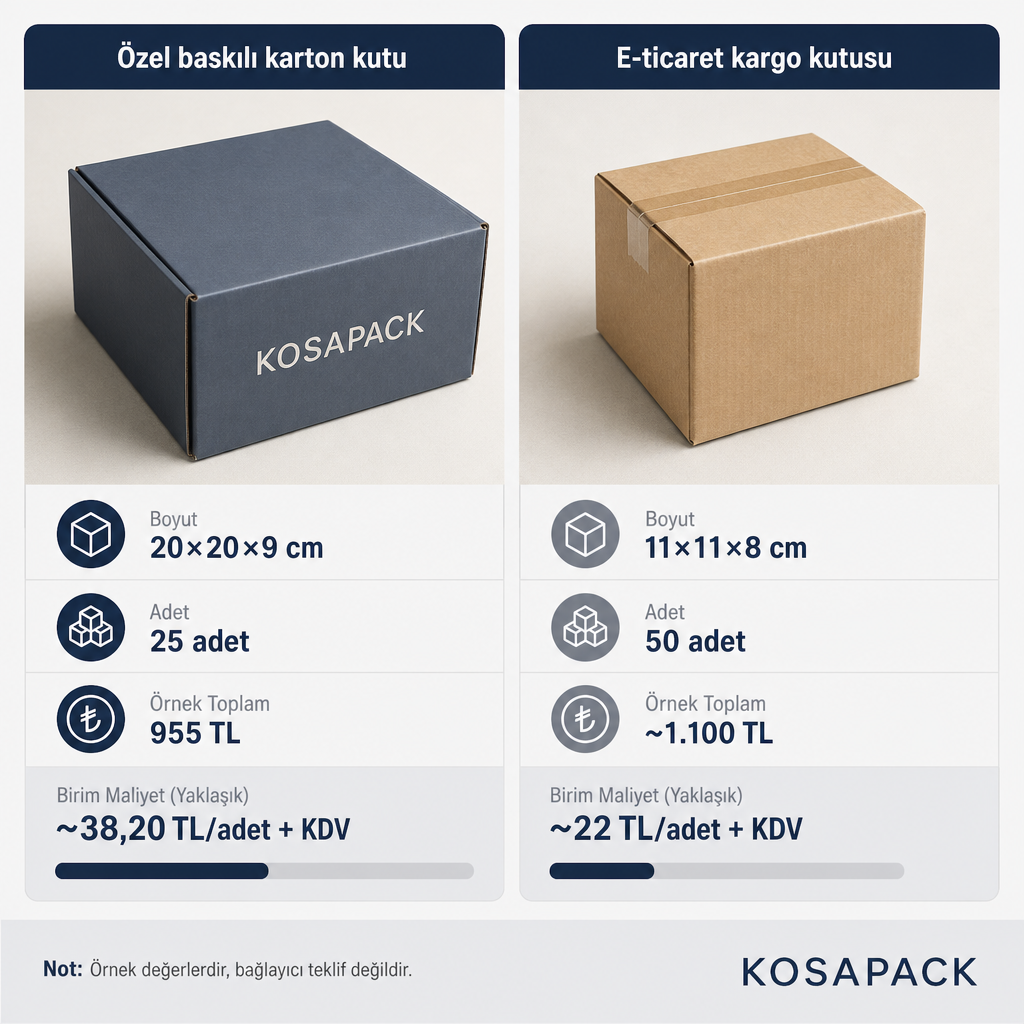
Box prices in 2026 are not set by a single fixed tariff; the type and size of the box, the order quantity, printing and coating preferences, and the scope of sample, design, and logistics all change the total cost at the same time. Among published 2026 examples in the market, 25 custom-printed cardboard boxes measuring 20×20×9 cm were shared at around 955 TL, and 50 e-commerce boxes measuring 11×11×8 cm at around 1,100 TL; the approximate unit equivalents were 38.20 TL and 22 TL respectively (excluding VAT). These are not our binding offers; they are examples shared to illustrate the market level, and the price of your project may not be the same. For this reason, reading offers solely on a "price per unit" basis is often misleading; an accurate comparison begins by equalizing not only the same box structure and technical specifications but also which services are included in the offer.
Table of Contents
How should 2026 sample box prices be read?
The values below are examples published for specific sizes and quantities; they are not a general price list or a binding offer. The amount changes with different size, material, and printing options. Read the examples as a starting point, that is, to give a sense of magnitude.
| Sample box | Size and quantity | Published sample total | Approximate per unit |
|---|---|---|---|
| Custom-printed cardboard box | 20×20×9 cm, 25 pieces | 955 TL | 38.20 TL + VAT |
| E-commerce shipping box | 11×11×8 cm, 50 pieces | Approximately 1,100 TL | Approximately 22 TL + VAT |
These two examples cannot be directly compared with each other: the product size, box structure, and quantity differ. Even though the unit price of the small e-commerce box appears lower, this does not mean a "cheaper box"; it describes a different product, in a different quantity, in a different structure. A structure requiring more dense material and labor, such as a rigid box, should also not be evaluated at the same cost level as a folding box made from thin cardboard. If you are curious about the structure of the rigid box and which usage scenarios it suits, you can take a look at our premium rigid box production guide.
What factors determine the box price?
The same word "box" can carry very different costs, because the price is not formed by a single factor but by the combination of several decisions. To make sense of an offer, these items need to be seen separately.
Box type, material, and size
A folding cardboard box may be preferred for lightweight products and shelf packaging. A corrugated box stands out for products that need protection during e-commerce and transport. A rigid box, on the other hand, provides a more solid and premium presentation; however, its material consumption and labor differ. Therefore, the name "box" alone does not explain the price; the structure, material, and intended use covered by the offer must be clearly written. As dimensions grow, more material is usually required, so an internal layout fitted to the product size reduces both unnecessary volume and movement inside the box, thereby affecting protection and shipping decisions as well.
Order quantity and setup costs
Some setup costs required for printing and production are spread across more units as the order quantity increases; for this reason the unit price may drop. However, a higher quantity raises the total order amount and creates the risk of holding more stock than needed. When determining the first order, you must consider not only the unit price but also the sales forecast, storage capacity, and reorder plan. If extra boxes printed to lower the unit price remain in the warehouse, the cost gained on paper can be lost in practice.
Printing and surface applications
The number of colors, the printing technique, and the complexity of the design affect the price. Applications such as hot foil stamping, embossing, spot varnish, or special colors require additional production steps and setup. Requesting that each effect be shown as a separate line item within the offer makes it easier to understand how much each preference changes the budget. This way, the answer to the question "where does the cost end up if we remove this effect?" becomes a visible figure rather than a guess.
Design, sample, and quality control
A price offer may not only include the production of the printed boxes. Structural and graphic design, digital proof, physical sample, and quality control may also fall within the project scope. If one offer includes these services while another contains only production, it is not fair to directly compare the apparent unit prices. Since these items may need to be paid for separately later, it is best to ask from the outset which services are included in the offer and which are priced separately.
Equalize the scope when comparing offers
Before placing two offers side by side, you need to make sure they describe the same things. Once the following headings are clarified, you will see whether the price difference genuinely comes from a production difference or from a scope difference:
- Box structure: Cardboard, corrugated, or rigid; the lid and closure style.
- Technical specifications: Internal dimensions, material and, if any, grammage, printing, color, and surface applications.
- Order quantity: The first production quantity and anticipated repeat orders.
- Pre-production work: Design, proof, die, and physical sample fees.
- What is included in the price: Quality control, packaging, and logistics.
- Taxes and delivery: Whether VAT, shipping, and delivery terms are included in the price.
- Lead time: The timeframes specified for the sample and mass production.
If a seemingly low price does not cover items you will need later, such as the sample or logistics, it does not accurately reflect the total project budget. The healthiest method is to compare offers on the basis of the same technical specifications and the same service scope. For example, if you want to keep in mind the contribution of the packaging to the brand perception while evaluating a price for a cosmetics line, the criteria in our cosmetic box design guide make it easier to define the offer scope.
Making the box cost more predictable
Before requesting an offer, prepare the product's exact dimensions and weight, where the box will be used, the order quantity, and the target delivery date. Will the product be shipped, displayed in a store, or be part of a gift set? This usage scenario determines protection, material, and presentation priorities together; the same information also defines which items the offer should include.
In printing and surface applications, first separate the essentials. If it is critical that the brand color appears correctly, share this expectation clearly; evaluate special effects only where they genuinely add value in terms of cost and brand experience. This way, the offer rests on a comparable technical brief rather than a vague "special box" request. For products where internal protection is decisive, such as jewelry or precious stones, our jewelry box production guide helps with brief preparation in order to foresee the effect of box form and layout decisions on the price in advance.
Also take into account the date on which you evaluate the price. The producer price index is an indicator used to track general price changes; it does not give the price of a specific box project. In the D-PPI data published by the CBRT, the annual change for September 2026 is listed as 27.38% and the monthly change as 2.07%. This data alone does not explain the change in paper or box prices; for sound planning, you need to obtain a current offer with a defined scope.
Getting a box price quote from Kosapack
Through our quote page, we receive your detailed price quote, consultancy, and sample request for your packaging project on the same form, and our team responds within 24 hours. Do not confuse this period with a confirmed delivery date: the physical sample and mass production schedule are evaluated separately according to the project.
Add the product information, size, quantity, your preferred box type, design files, and, if any, your printing and effect expectations to your quote request. Also share your target date for the sample and production. The clearer the brief you provide, the more the price we return will be specific to your project. If you want to examine our premium production process and quality control approach in Istanbul more closely, our premium box production guide in Istanbul completes this step.
Frequently Asked Questions
From what price in TL do box prices start in 2026?
One of the examples published in the market is around 955 TL for 25 custom-printed cardboard boxes measuring 20×20×9 cm. This is a single product and quantity scenario; it should not be considered a starting price or a binding offer for all box types.
Why can the box price differ even at the same size?
In addition to the material and box structure, factors such as quantity, printing, special effects, design and sample work, and delivery terms can vary. For this reason, the same outer dimension does not mean the same scope and technical specifications.
Does the box price drop as the quantity increases?
When the quantity rises, setup costs are spread across more units, which can lower the unit price. However, since the total expenditure may increase, the order quantity should be evaluated together with the stock and sales plan.
What information should I provide when getting an offer?
The product size and weight, where the box will be used, the desired box type, the order quantity, printing and effect expectations, and the target delivery date help prepare the offer within the correct scope. Also specify whether a design service or sample is required.