

The short answer to the question of what kraft paper is: it is a high-strength paper packaging material produced by processing wood fibers through the sulfate (kraft) process. But this definition alone does not make the right material decision. Two papers bearing the same "kraft" name can behave completely differently depending on their bleaching status, grammage, surface, coating, and conditions of use. In this guide, we explain what kraft paper is, its types, the logic of grammage, and which criteria you should look at when choosing packaging, in a way that is directly applicable to your premium packaging and e-commerce shipping decisions.
Contents
What is kraft paper and how is it made
Kraft paper is produced through the kraft (sulfate) process, in which wood chips are cooked in an alkaline solution containing sodium hydroxide and sodium sulfide. The purpose of this cooking is to separate lignin from the fibers while preserving the length and mechanical strength of the cellulose fibers as much as possible. The fundamental reason the paper is strong and durable is this preserved long-fiber structure.
The natural brown tone you are familiar with usually comes from unbleached pulp. When bleaching is applied, a whiter or cream-toned surface is obtained. For this reason, kraft paper is not simply "brown, coarse-textured packaging"; it is a broad family of materials encompassing options that behave differently from one another, such as white kraft, recycled kraft, virgin kraft, and coated kraft. In practice, when a brand says "we want kraft," it does not yet constitute a technical specification.
Decisive properties of kraft paper in packaging
The properties that make kraft paper valuable in packaging also define its limitations. To set the right expectations, both need to be viewed together.
Balance of durability and weight. The long-fiber structure provides resistance to tearing, rupture, and tensile forces. Because kraft can deliver sufficient strength with a relatively low grammage, it is preferred for carrier bags, wrapping papers, and cargo packaging. However, low grammage is not suitable for every product; the weight of the contents, transport distance, and humidity conditions must be evaluated together.
Natural appearance. The brown tone of unbleached kraft supports a natural, artisanal, and understated brand perception. In coffee, boutique chocolate, natural cosmetics, candle, and handmade product brands, this appearance stands out as a deliberate choice.
Print compatibility. Kraft paper can be printed on; however, the brown background changes the perceived tone of light colors and especially white. In full-surface CMYK printing, colors can appear more matte or warmer. Therefore, the design needs to be verified with a physical proof before production.
Limited resistance to moisture. Uncoated kraft absorbs water, moisture, and oil. When humidity rises, the fibers swell, the crease areas soften, and the box can lose its form. For liquid, oily, or cold-chain products, whether kraft alone is sufficient must be tested separately.
Recycling potential. Being paper-based is an advantage for recycling, but it is not an automatic guarantee. PE, aluminum, wax, or certain barrier coatings make the packaging composite and can complicate the standard paper recycling stream. A significant portion of glossy and laminated gift papers may not be recyclable due to their coatings.
Kraft paper types and which scenario each suits
Looking only at color when choosing kraft is misleading. The real distinction lies in fiber source, bleaching, and coating.
| Kraft type | Key feature | Suitable use | Point to watch |
|---|---|---|---|
| Unbleached kraft | Natural brown tone | Paper bags, coffee, boutique food | Background changes print colors |
| Bleached kraft | White/cream surface, high brightness | Cosmetics, jewelry, premium gift | Creates additional process and environmental load |
| Virgin kraft | Fresh fiber, high strength | Heavy products, cargo boxes | Source and cost impact differ |
| Recycled kraft | Recovered fiber | Cost-focused packaging | May require higher grammage for the same strength |
| Coated kraft | Moisture/oil barrier | Food, oily products, cold chain | Impact on recycling stream must be verified |
| Textured/embossed kraft | Pronounced tactile effect | Premium bags, invitations, cards | Print clarity varies compared to flat surfaces |
The practical outcome of these distinctions is this: if you choose recycled kraft for a heavy cargo, you may need to increase the grammage to achieve the same strength; whereas for a premium cosmetics bag, the right decision often becomes clear with a bleached or smoother-surfaced kraft.
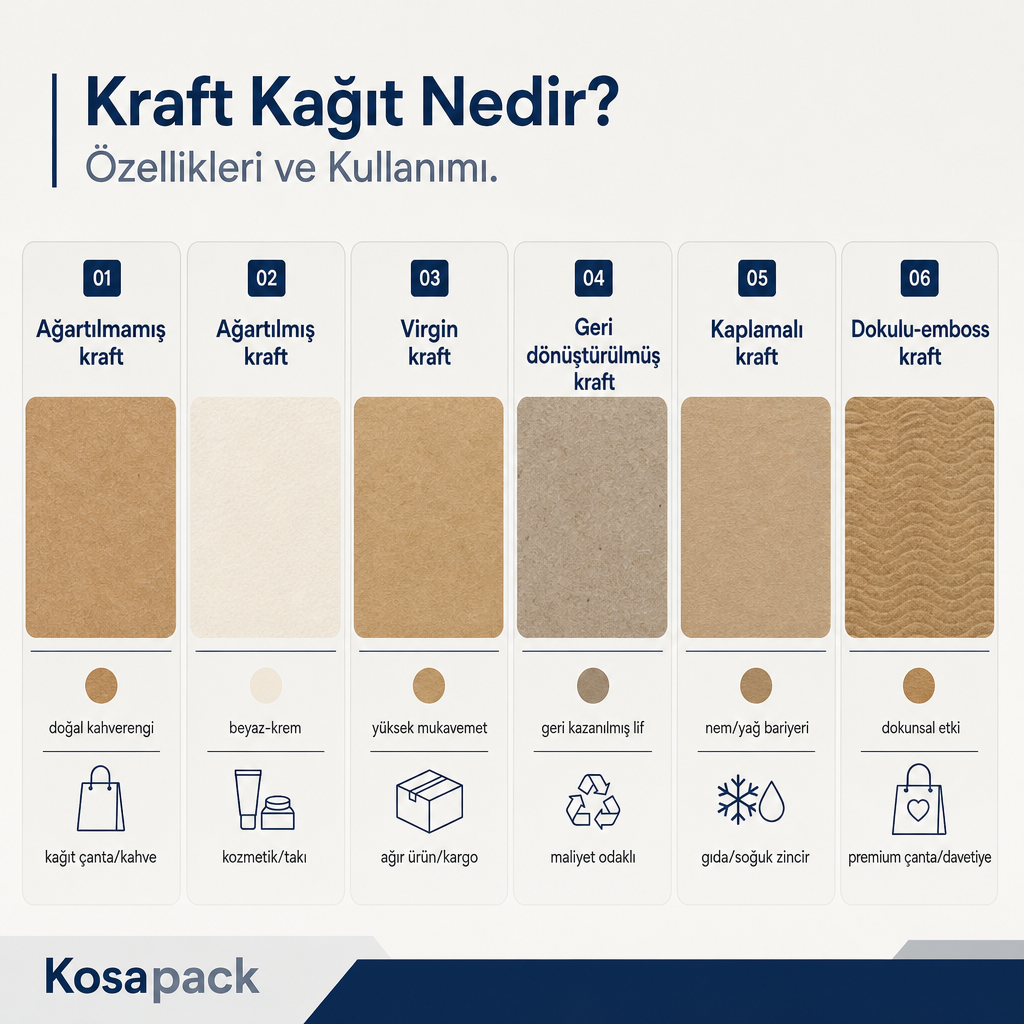
Why grammage alone is not enough
Grammage expresses the weight of the paper per square meter and the overall sense of stiffness. As grammage increases, the paper generally becomes stiffer and more durable; however, it also becomes more expensive, heavier, and harder to fold. The ranges below are only a starting reference.
| Grammage range | General character | Typical use |
|---|---|---|
| 40–80 g/m² | Thin and flexible | Tissue, wrapping, inner filling |
| 70–100 g/m² | Suitable for carrier bags | Paper bags, light wrapping |
| 100–135 g/m² | Sturdier, foldable | Labels, cards, light packaging |
| 150–200 g/m² | Stiff, close to a card feel | Premium sleeve, folding packaging |
| 200 g/m² and above | Thick and more rigid | Mailer envelopes, liner, multi-layer structures |
Two kraft papers of the same grammage can behave differently depending on the pulp type, fiber direction, moisture content, surface treatment, and manufacturer. For this reason, especially in carrier packaging, in addition to grammage, tensile, tear, burst, and crease performance must also be measured. Grammage is an estimation tool; it is not a decision tool.
Where kraft paper is used
In paper bags. While natural kraft and twisted paper handles create an artisanal perception, white kraft and flat ribbon handles give a more corporate look. Here, not only the paper grammage but also the handle attachment and the handle's carrying capacity are decisive; for heavy products, the paper, base structure, and handle must be tested together.
In folding packaging. Kraft cardboard becomes the folding packaging surface for products such as soap, candles, coffee, chocolate, and cosmetics. In color-intensive premium designs, bleached kraft stands out; if unbleached kraft is to be used, how light colors appear on the brown background should be checked with a physical proof.
In cargo and corrugated packaging. Kraft liner is used as the outer or inner surface of a corrugated box. In e-commerce shipments, the term "kraft box" alone is not a sufficient specification; the flute type, number of layers, liner structure, and compression strength must be determined together with the product weight, stacking height, and humidity.
In labels. Kraft-surfaced labels create a natural perception, but small text and light-colored logos may not provide enough contrast on a brown background. Readability and the surface to which the adhesive will be applied must be tested together.
In tissue, wrapping, and filling. Low-grammage kraft is used for in-box filling and unboxing wrapping. Here the decision point is not carrying strength but ease of folding, tearing behavior, and visual integrity.
In rigid boxes and gift packaging. Kraft paper can be used as the outer covering surface or a decorative element of a rigid box. A natural kraft surface delivers a premium tactile experience with embossing, hot foil stamping, or simple logo applications. To plan the box structure, dieline, and printing decisions in a production-ready way, you can check out our guide explaining the fundamentals of box graphics.
Criteria to consider when choosing kraft paper
The right kraft decision rests not on a single property but on the balance of several criteria that affect one another.
- Product weight: For light products, a medium grammage may be sufficient; for heavy contents such as bottles, jars, or multi-item sets, carrying and tearing strength must be tested.
- Use channel: While handle breakage is a critical risk in a store bag, impact and stacking resistance are the priority in a cargo box.
- Moisture and oil contact: For food, cosmetics, and cold-chain products, the barrier need must be determined; the recycling impact of any added coating must also be examined.
- Print and color expectation: If the brand color is critical, a white ink underlayer, higher ink density, bleached kraft, a smoother surface, and a physical color proof should be evaluated.
- Surface and tactile effect: Textured and embossed surfaces create a strong brand perception, but small-point text and fine graphics may come out less clearly.
- Certification: FSC or PEFC certificates confirm the link with responsible forest management; the certificate and chain-of-custody number should be requested from the supplier. These documents do not prove the kraft process or unconditional recyclability.
None of these criteria can be fully verified with a technical data sheet. Especially in premium printed packaging, color accuracy, crease behavior, handle carrying capacity, moisture effect, preservation of box form, label adhesion, and staining on the print surface must be checked on a sample.
Is kraft paper always eco-friendly
No. Kraft can be a paper-based and recyclable option; however, an environmental assessment cannot be made based on the brown color or "natural" appearance. The ratio of virgin or recycled fiber, forest management certification, bleaching process, coating and lamination, compatibility with recycling infrastructure, and transport distance must all be evaluated together.
For example, PE-coated kraft may be more resistant to moisture; however, separating the paper and plastic layers complicates the recycling process. In Türkiye, it is essential to collect recoverable paper waste separately from other waste, and material recycling is prioritized in packaging waste management. Therefore, before using a statement such as "100% recyclable," it is necessary to verify the coating structure and the local recycling stream.
| Advantage | Limitation |
|---|---|
| Can provide high durability | Uncoated types are sensitive to moisture and oil |
| Offers a natural and warm appearance | The brown background changes print colors |
| Can be used in different grammages and surfaces | Not every kraft type has the same strength |
| Paper-based options can be suitable for recycling | Coating and lamination can complicate recycling |
| Fits premium and sustainable design | The name "kraft" alone is not proof of sustainability |
Kraft packaging decisions with Kosapack
Choosing kraft paper is not just a decision to buy paper. The structure of the packaging, the print file, the sample, the production standard, and the delivery plan must all be addressed together. We always evaluate the kraft variant through a physical prototype, color accuracy, supplier verification, and the certification chain; we clarify the grammage, bleaching status, surface, barrier, and certificate information at the quotation stage, and prepare the physical sample before production approval.
For a clearer decision, when you share the following information with us, we can determine the right kraft variant together: product name and weight, the internal and external dimensions of the packaging, use channel, print colors, moisture or oil conditions, certificate expectation, and target quantity. To see the relationship between box structure and material cost, you can review our custom box production cost guide; and if you are planning natural-looking cosmetics packaging, you can benefit from our cosmetics box design guide.
This approach creates value especially for those seeking natural-looking cosmetics packaging, those designing branded unboxing in e-commerce, fashion and jewelry brands using premium bags, and products such as coffee, chocolate, and candles where tactile perception is critical.
Frequently Asked Questions
What is the difference between kraft paper and cardboard?
Kraft paper is a class of paper-based material produced in different grammages. Cardboard, on the other hand, is a broader term used for higher-grammage, thicker, or multi-layer paper materials. Kraft paper can be used on the surface of cardboard packaging or in one of its layers.
Is kraft paper water-resistant?
Uncoated kraft is not fully water-resistant. When it comes into contact with moisture, the fibers can swell, the paper can soften, and the packaging can lose its form. In applications where water or oil contact is expected, a suitable barrier and testing are required.
Is kraft paper recyclable?
Uncoated and uncontaminated kraft can be suitable for the paper recycling stream. However, the situation is different for kraft packaging containing plastic, aluminum, wax, or complex lamination. The conditions of the local collection and sorting system must be checked.
Can color printing be done on kraft paper?
Yes. However, the brown background changes the appearance of especially white, pastel, and light colors. For designs with high color expectations, it is necessary to obtain a physical proof or use a lighter-colored kraft.
Should kraft paper or a rigid box be chosen?
The two are not direct alternatives. Kraft paper is used as a bag, wrapping, label, or surface material; a rigid box, on the other hand, is a more rigid, structural, and protective solution. The decision is made based on product weight, protection need, transport channel, and brand positioning.