

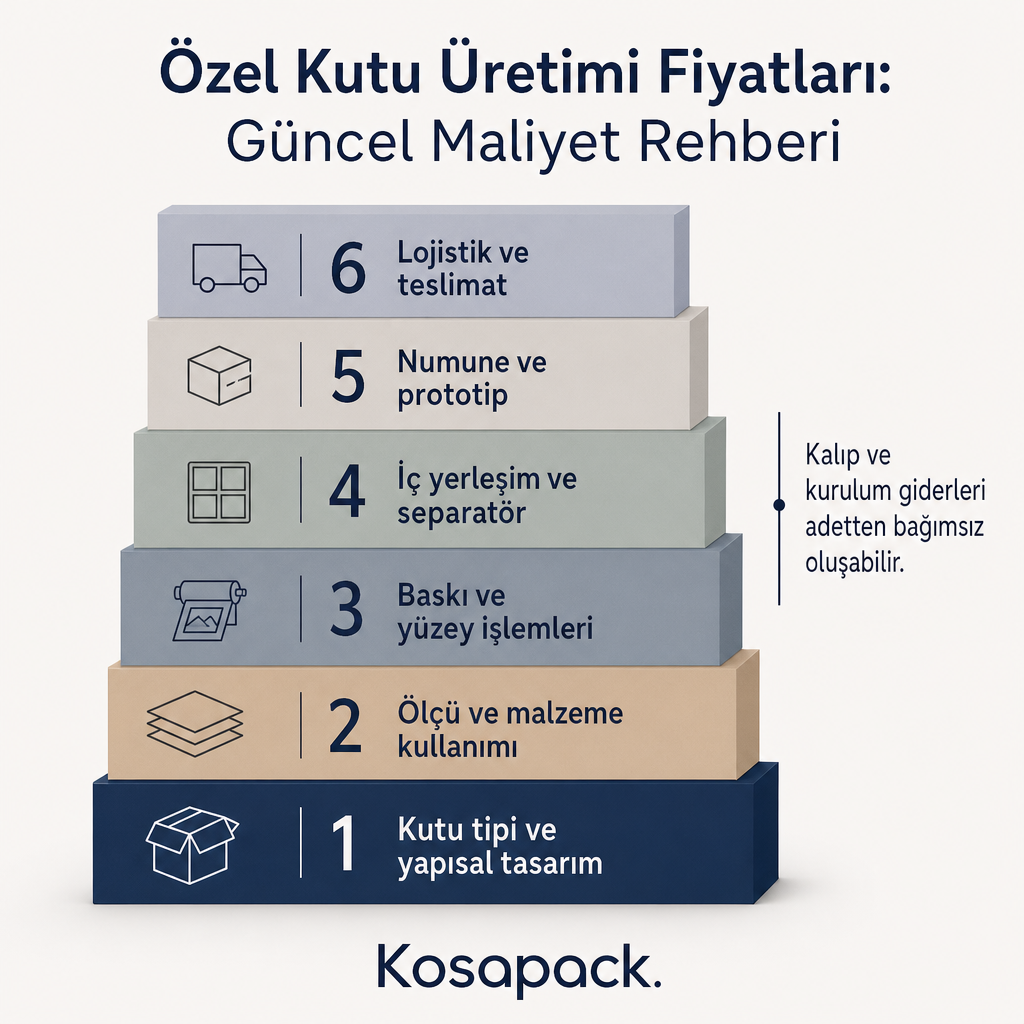
Custom box production prices cannot be given with a single list figure; because box type, dimensions, material, printing, surface treatments, order quantity, interior layout, sampling, and delivery conditions together form a cost. Even two boxes with the same outer dimensions can be priced significantly differently when their internal structure and printing differ. In this guide, instead of promising a fixed price table, we explain the items that truly determine the price within a quote and how to control them. At Kosapack, we evaluate every project through a project brief rather than a fixed unit price, and once the details are finalized we provide a quote within 24 hours and usually a physical sample within 7–15 business days.
When planning your budget, assess not only the "price per box" but the total project cost: be sure to check whether the die, printing, surface treatment, interior layout, sampling, shipping, and potential waste are included in the quote.
Table of contents
Why are custom box production prices not fixed?
A custom box is not a packaging bought off the shelf in standard dimensions. It is designed according to the product's dimensions, brand identity, sales channel, and expected level of protection. This makes it impossible to tie the cost to a single variable. A printed cardboard box designed for cosmetics, a rigid box produced for perfume or jewelry, a corrugated shipping box used for e-commerce deliveries, and a magnetic, windowed, or partitioned box prepared for a gift set are not evaluated with the same pricing logic.
The real decision here is not finding the lowest unit price. It is establishing a sustainable balance between the product, brand perception, logistics, and order volume. A decision that goes too cheap can later raise the real cost through waste, damage, and reproduction; an overly flashy choice can inflate the budget relative to volume. Keeping this balance in mind while reading the price gives a more accurate result than looking at the figure alone.
The main items that make up the cost
A custom box price is not made up of independent items but of items that add on top of each other. The first item is the box type and structural design. Folding cardboard boxes can offer advantages in storage and logistics because they can usually be shipped flat and use less material. Rigid boxes offer higher perceived value, durability, and a premium unboxing experience; however, additional processes such as wrapping, lining, handcraft, and assembly increase the cost.
Structural features that can raise the cost include a magnetic lid, a drawer or hinged structure, a windowed lid, a special shape, a multi-part interior layout, a product-specific divider, a ribbon or holding element, and details that require hand assembly. In boxes requiring a custom form and die, it is critical that the design is manufacturable; that is why our projects follow a development flow consisting of brief, structural design, blank prototype, printed sample, and mass production.
The second item is dimensions and material usage. As the box grows, not only the amount of paper or board, but also the wrapping requirement, storage space, and shipping volume increase. When determining dimensions, you must evaluate not the product's outer dimension but its net dimension, protective inner padding allowance, lid and closing gaps, divider thickness, and shelf or shipping placement together. An overly large box increases both material and, in e-commerce, dimensional weight cost; an overly small box causes the product to be cramped, the print surface to be damaged, and deformation during transport.
The third item is material selection. The comparison below summarizes which option stands out in which scenario and what determines the price.
| Box option | Scenario it is usually suitable for | Main factors affecting the price |
|---|---|---|
| Folding cardboard box | Cosmetics, non-food retail, small products | Grammage, print area, varnish, foil, die-cutting |
| Rigid box | Jewelry, perfume, candles, gift sets, premium products | Board thickness, paper wrapping, magnet, assembly |
| Corrugated box | E-commerce and shipping | Flute type, outer dimension, printing, strength |
| Box with inner divider | Multiple or fragile products | Number of compartments, die, assembly, inner material |
Looking only at the material's grammage is not enough. The product's weight, impact risk, moisture and friction conditions, and which channel the box will be used in also determine the selection and therefore the price.
How do printing and surface treatments change the price?
Printing cost is not limited to the number of colors and the print surface. The printing method, ink coverage, color accuracy, and the treatments to be applied to the outer surface of the box are evaluated together. Requesting that options such as single or double-sided printing, CMYK or spot color use, spot varnish, matte or gloss varnish, lamination, foil stamping, embossing, soft-touch coating, debossing, and textured specialty paper be shown as separate items in the quote clarifies the comparison.
Especially if a light-colored logo on dark backgrounds, a metallic appearance, or precise preservation of the brand color is required, the need for additional proofs and samples may arise. Since the tone of the design seen on screen may not be exactly the same as the tone of the printed box, sample approval manages the quality risk alongside the price. Skipping this step carries the risk of spreading the problem across the entire batch rather than a single sample.
Why does order quantity change the unit price?
In custom box production, some expenses such as the die, preparation, print setup, and machine setup occur independently of the order quantity. When these expenses are distributed over a small number of boxes, the unit price rises; as the quantity increases, the fixed startup costs are spread over a larger production run and the unit cost can drop. This explains why a high quantity appears cheaper at first glance.
However, a high quantity is not always the more economical decision. If demand forecasting is low, overproduction creates risks such as storage cost, leftover stock when the design or logo changes, packaging that becomes unusable when the product variant changes, and cash flow being unnecessarily tied up in stock. That is why, when getting a quote, it is healthier to compare not just a single quantity scenario but, for example, the first production and subsequent replenishment scenarios together.
Sampling, logistics, and quote scope
A physical sample helps catch costly mistakes before mass production. On real material and the real structure, you can check the box dimension's fit to the product, lid and closing tolerance, print tone, logo position, surface texture, cut and fold marks, how the divider secures the product, and the strength required by shipping or the shelf. Depending on the project brief, we usually plan the physical sample period as 7–15 business days. This period should not be considered separately from the price quote; the sample is a control stage that reduces the risk of reproduction and waste before mass production.
The box price and the total delivered cost may also not be the same. Especially for bulky rigid boxes, pickup from the production site, intra-city or intercity transport, palletizing, outer packaging, storage, assembled or disassembled shipping, and the number of deliveries should be evaluated separately. While folding or flat-shippable solutions provide an advantage in transport volume, pre-assembled boxes, though ready to use, take up more space. For e-commerce brands, even a few centimeters' difference in outer dimension can affect the shipment's dimensional weight calculation and the logistics cost outside the box.
The table below summarizes which information should be shared in the brief for a healthy and comparable quote, and why this information affects the price.
| Information | Why is it needed? |
|---|---|
| Product name and use scenario | Determines the box structure and protection need |
| Inner dimension or product dimension | Enables the creation of the exact box dimension |
| Box type | Distinguishes folding cardboard, rigid, or corrugated options |
| Order quantity | Affects the distribution of setup and production cost |
| Printing and finishing expectation | Determines color, surface, proof, and coating cost |
| Interior layout | Indicates the need for a divider, foam, paper, or custom die |
| Delivery address and date | Determines the shipping, production plan, and sample schedule |
In a quote request, instead of just writing "price for 1000 boxes," specifying the dimension, structure, printing, and intended use gives a much clearer result. In addition, you should ask one by one whether structural and graphic design, die and die-cutting, printing, surface treatments, dividers, sampling, assembly, packaging, shipping, VAT, waste and tolerance conditions, revision rights, and the quote's validity period are included in the price. If this distinction is not made, a seemingly low unit price can end up higher in total with items added later.
The impact of regulation and sustainability on cost
Packaging placed on the market in Turkey and packaging waste fall under the Packaging Waste Control Regulation. The regulation sets out the basic requirements regarding the production and market placement of packaging as well as the obligations of economic operators; for details, you can refer to the regulation text in the Official Gazette. For this reason, in cost calculations you need to look not only at the purchase price but also at the packaging's life cycle.
The recyclability of the material, the ability to separate different materials from one another, the reduction of unnecessary packaging volume, suitable printing options, the effect of coating and lamination on recycling, the management of production waste, and the supplier's sustainability reporting are all part of this evaluation. The sustainable option may not always be the cheapest option; however, material reduction, more efficient sizing, and lower logistics volume can improve the total cost. Reducing packaging waste and recycling-friendly design are also among the topics considered in the relevant regulations.
Risks to watch out for in low-priced quotes
The lowest quote may not be the best quote offering the same technical scope. Checking a few points concretely before deciding prevents costs that emerge later.
- Mass production without a sample: Going into production without seeing a physical sample causes errors in dimension, color, lid tolerance, or interior layout to spread across the entire batch.
- Vague material definition: Expressions like "thick cardboard" or "premium paper" are not technical. Grammage, thickness, surface, coating, and material type should be put in writing.
- Costs not included: If it is not clear whether the die, print preparation, assembly, shipping, and VAT are included, it is impossible to compare quotes.
- Excessively low quantity price: A very low price may mean lower grammage, limited printing, low strength, or out-of-scope quality control. Sending the same brief to different suppliers to equalize the technical scope gives a healthier comparison.
- Overly large box: Rather than looking more premium, a large box can let the product shift inside, increasing the need for protective material and the shipping cost.
When getting a quote from Kosapack
We evaluate custom box projects through a brief rather than a fixed list price. After a short project summary, we aim for a quote within 24 hours and usually a physical sample within 7–15 business days. If you want to speed up the process for premium and growth-stage brands, it is enough to add the following to your quote request: a product photo or technical dimensions, the desired box type, inner and outer dimensions, estimated order quantity, brand logo and design file, expected surface treatments, inner support or divider need, delivery city, and launch date.
In categories such as cosmetics, jewelry, candles, chocolate, fashion, electronics, and e-commerce, the box's priority changes. In some projects shelf visibility stands out, in others shipping strength, and in others the unboxing experience. That is why the price request should be evaluated together with the product category and sales channel. For a broader framework on box types and production options, you can check the guide explaining the scope of brand-specific box production, for technical details specific to cardboard boxes the guide on having custom printed cardboard boxes made, and for the details of our Istanbul-based production process you can review the premium box production guide.
Frequently Asked Questions
How are custom box production prices calculated?
The price is calculated by evaluating together the box type, dimension, material, grammage, printing, surface treatments, quantity, interior layout, sampling, and logistics items. A net price cannot be finalized without a project brief.
What is the minimum order quantity in custom box production?
The minimum quantity varies according to the box's structure, printing technique, die need, and production model. It should not be assumed that the same quantity condition applies to folding cardboard, rigid, and corrugated boxes.
Which is more economical, a rigid box or a cardboard box?
There is no single correct answer. A folding cardboard box can often offer lower material and logistics cost. A rigid box, on the other hand, provides a more premium structure and durability; however, wrapping, assembly, and accessories can increase the total cost.
Is the sample fee included in the custom box price?
This depends on the quote scope. Whether the sample is included, how many revisions can be made, and how mass production will proceed after sample approval should be clearly stated in the quote.
Are VAT and shipping included in the price?
This should be checked separately for each quote. Whether the unit price covers VAT, shipping, assembly, die, and sample costs should be asked in writing.
What is the most effective way to lower the custom box price?
The most effective method is not to directly reduce quality but to optimize the dimension, eliminate unnecessary surface treatments, choose the box structure according to the use scenario, and align the order quantity with demand forecasting.