
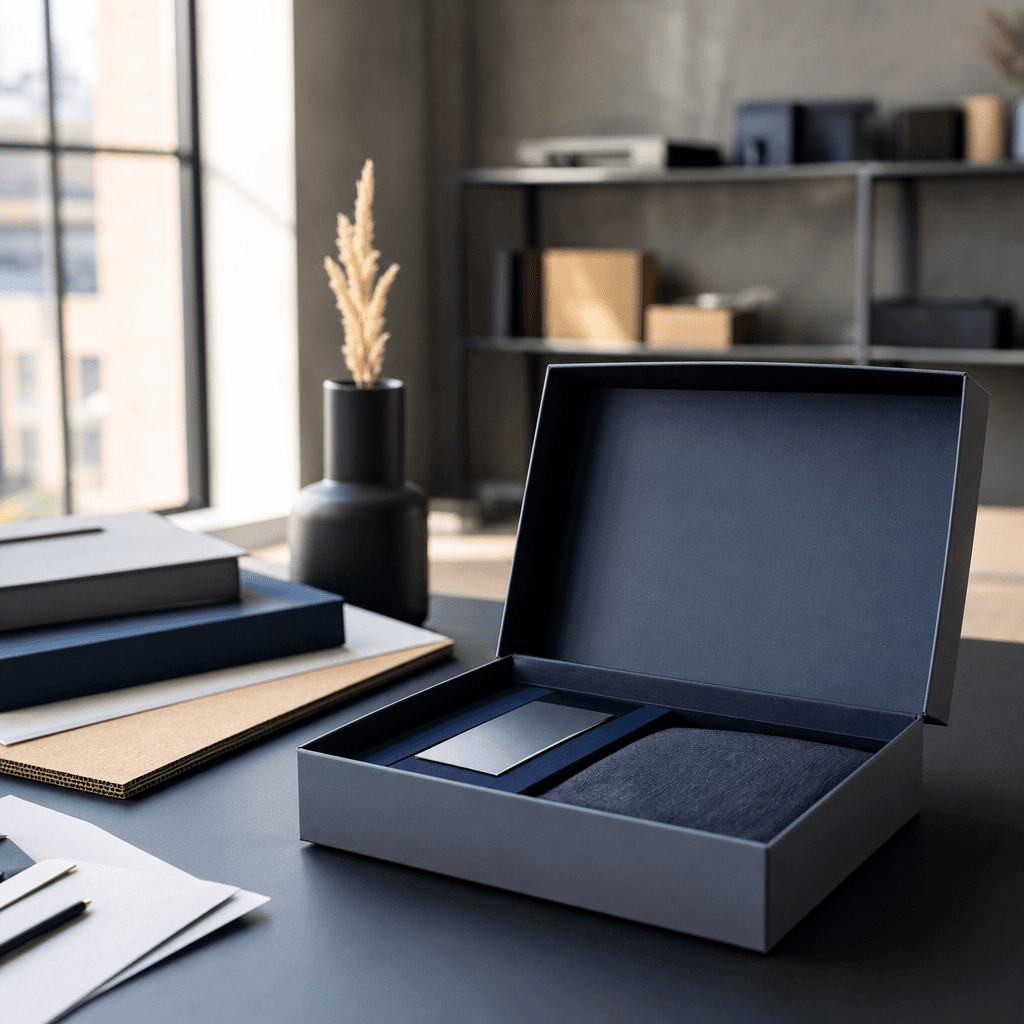
The shortest answer to the question of what custom box production is: instead of placing your product in a random ready-made box, it is the process of defining the box's dimensions, structure, material, and printing specifically for your brand and product. This is not a printing job; it is a system that designs the brand's physical experience on the shelf, in shipping, and at the moment of opening. As Kosapack, we have prepared this guide both to clarify the definition and to provide a framework that helps you think about how to make the right box decision for your brand.
Table of Contents
What exactly is custom box production?
Custom packaging is not just an ordinary box that merely protects the product; it is a holistic packaging solution that carries the brand's identity, story, and customer experience, with its dimensions, material, and printing designed specifically for the brand. Custom box production, on the other hand, refers to how this packaging is brought to life industrially: the box's size, structure, material, and printing are designed from scratch for a specific product and brand objective.
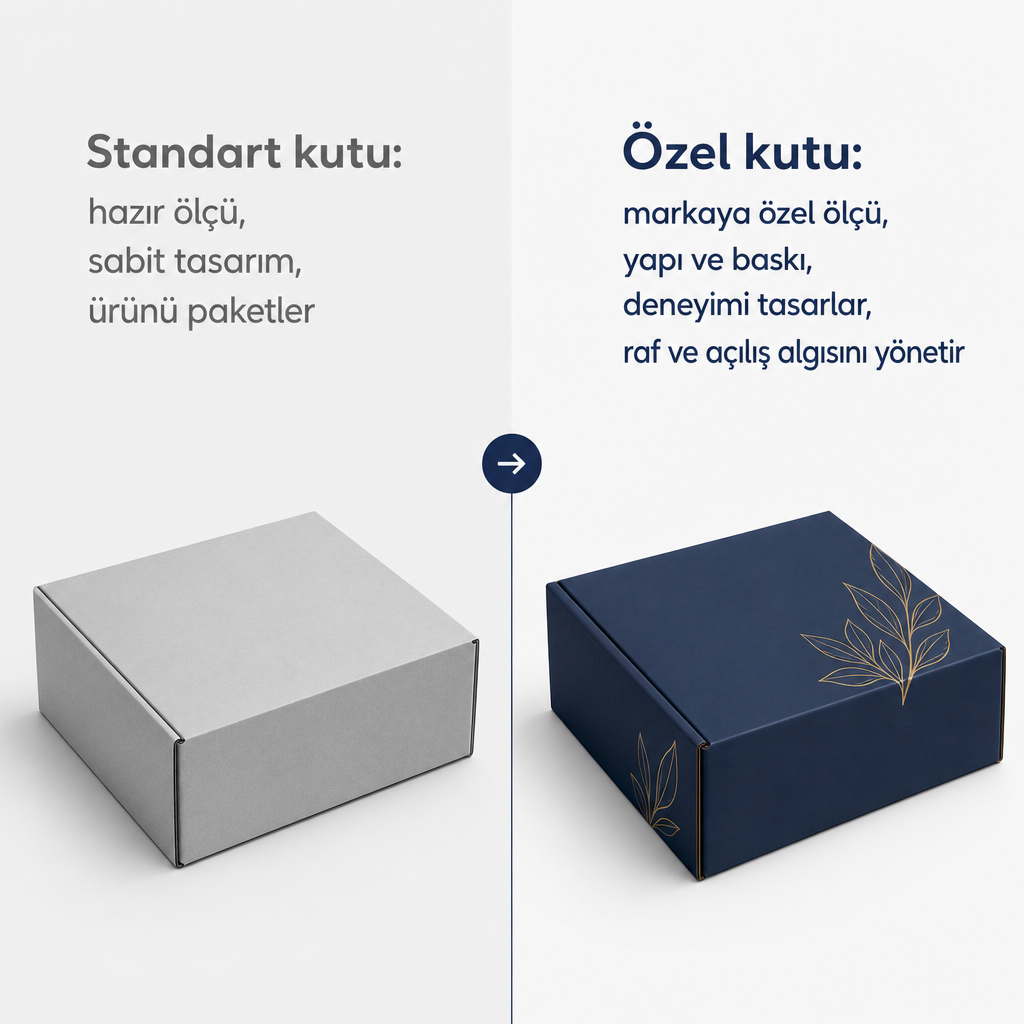
The difference is tangible. Standard packaging consists of predetermined ready-made dimensions and designs. In custom box production, however, the width, length, height, wall thickness, opening feel, and printing language are entirely defined according to the brand. This way, while the box physically matches the product exactly, it also manages brand perception on the shelf and at the moment of opening.
If we summarize this in a single sentence: a standard box packages the product, while a custom box tells the brand's story and designs the experience.
What decision are you making?
Custom box production is a much bigger decision than the question "which box is cheaper?". It is a strategic choice regarding your brand's showcase on the shelf, in shipping, and at the moment of opening, and looking at packaging as merely a cost item often leads to overlooking the true impact of this decision.
This choice directly affects: the customer's first impression and unboxing experience, how your brand is perceived on the shelf and in online visuals, operational metrics such as breakage, crushing, and return rates, the perceived value per unit, and the possibility of premium pricing.
That is why custom box production should be viewed not as a "printing job" but as a systemic investment through which you build the brand's physical experience. The right structure protects the product while strengthening the brand; the wrong structure increases both costs and return rates.
How does custom box production work?
Custom-sized box production is a multi-stage process that begins with consultancy and design and is completed with material selection, printing, sampling, and mass production. Seeing the stages separately makes it easier to understand which decision is made at which point in the project.
1. Needs and product analysis. The product's size, weight, fragility, shelf life, sales channel (retail, e‑commerce, corporate gifts), and targeted customer experience are analyzed. For e‑commerce, the impact and stacking load during the shipping process come to the fore, while for a luxury store, visual impact on the shelf and tactile feel become decisive.
2. Designing the box structure. Based on the findings from the analysis, the box's dimensions, opening style, lid type, and details such as magnets or ribbons are determined. In the technical specification, the net internal dimensions, production tolerances, carrying direction, and the need for internal separators or inserts are defined.
3. Selecting material and printing technology. Depending on the product and brand positioning, the main body material such as rigid cardboard, folding carton, or corrugated cardboard is selected. Then, finishing decisions such as covering paper, grammage, kraft or SBS carton type, matte/glossy lamination, special varnish, and foiling are made. The printing technology is determined according to the print run and color requirements.
4. Prototype and physical sample. Before mass production, both a structural prototype and a physical sample produced with the correct color and material are critically important. The sample eliminates the biggest risk of making decisions without seeing how the product fits into the box, the opening feel, color accuracy, and logistical durability.
5. Mass production, quality control, and logistics. Based on the approved sample, technical drawings and production molds are finalized, and then mass production begins. Steps such as pre-print file checking, sample inspection during production, and final quality control before shipment prevent large-scale losses. The boxes are shipped flat for folding cartons, or assembled and sent to the warehouse or directly to the logistics center for rigid boxes.
Custom box types and which solution stands out where?
Custom box production is not limited to a single type of box; different structures come to the fore depending on the brand objective and product type. If you would like to see the differences between rigid boxes and folding boxes in more detail, you can review the rigid box vs. folding box comparison.
Rigid box. This is a luxury structure that permanently retains its form, with special covering paper, textile, or foil applied over thick gray cardboard. It is preferred for high unit-value products such as jewelry, niche perfume, luxury cosmetics, special edition chocolate, premium beverages, and corporate gift sets. It strengthens the gift perception with details such as a sense of weight, magnetic lid, internal separator, and fitted insert.
Folding carton box. These are structures produced from thinner cartons such as SBS or kraft, printed and cut, then shipped flat and formed at the filling point. They are ideal for cosmetics, dietary supplements, light food, personal care, and shelf products. They offer high storage and shipping efficiency; their unit cost is more affordable than rigid boxes.
Corrugated boxes and shipping/mailer boxes. These boxes, produced from corrugated cardboard, are used in the roles of e‑commerce shipping boxes, subscription boxes, or protective outer boxes. The combination of a rigid box with a protective shipping box is a frequently used solution to provide both experience and protection together for high-value products.
Complementary packaging elements. When the box, cardboard bag, label, tissue paper, thank-you card, fabric pouch, and in-box separators are considered together, brand-specific packaging turns into a system. Especially in the premium segment, preparing these components with the same design language and material quality significantly strengthens the brand's overall perception.
Key criteria for the right custom box decision
Gaining clarity on a few topics before starting custom box production directly raises the quality of the decision.
Brand positioning and customer experience
First, the answer to the question "how should the customer feel when they hold the box?" must be clear. Brand tones such as luxury, minimal, natural, young, or corporate determine every point from material to color, from texture to opening scenario. For a luxury perception, rigid boxes, textured covering papers, foiling, and embossing come to the fore; for a simple and sustainable image, natural kraft carton, minimal printing, and recyclable materials are preferred.
Product characteristics: weight, fragility, shelf life
The box's job is first to protect the product, then to tell the brand's story. The product's weight, fragility, moisture and heat sensitivity, and shelf life directly determine the box structure. For heavy or glass products, wall thickness, internal support elements, and carrying direction must be correctly designed. For food products, food-contact-safe internal materials and the necessary legal disclosures must be taken into account; at this point, it is recommended to verify compliance with the relevant regulations specifically for the project.
Sales channel, logistics, and storage
Retail shelf, boutique store, e‑commerce, wholesale channel, or corporate gifts; each channel has its own requirements. For e‑commerce, the box must be resistant to vibration and impact during the shipping process, while also being stackable in the warehouse and operationally practical. Since folding carton boxes can be shipped flat, they provide a logistical advantage for brands with limited warehouse space; rigid boxes increase space requirements in assembled shipping while creating a strong added value in the store and gift experience.
Sustainability and material selection
Consumer expectations and regulations are making sustainable packaging increasingly critical. Recyclable or recycled-content papers, water-based inks, and designs that minimize plastic use come to the fore. Avoiding unnecessary volume and material reduces both the carbon footprint and logistics costs. The most efficient moment to make sustainability decisions is during the material and design stage; if left to the end, it becomes difficult and expensive to correct.
Budget, quantity, and total value
Unit price alone is not a sound criterion; the right perspective is to focus on the total value in return for the targeted experience. Although a rigid box generally has a higher unit cost than folding carton, it can raise the product's perceived value with its luxury perception and gift value. As quantity increases, the cost decreases as special molds and preparation processes are spread across the units; therefore, a volume strategy is important in campaign, ongoing product, and collection planning.
Supplier and project management
Custom box production is not just printing; it is a chain consisting of consultancy, design, sampling, production, and logistics. Working with a partner who can provide end-to-end service, has established quality control processes, and takes sample management seriously speeds up the project and reduces risks. To see in detail what to look for when selecting a supplier, you can review the checklist for choosing the right packaging supplier.
Common mistakes and how to avoid them
A poorly planned custom box project can weaken the experience while increasing costs. The most frequently encountered risk areas are:
- Choosing the wrong box type for the product: Using thin cardboard for a heavy or fragile product means insufficient protection and a high return rate.
- Ignoring dimensional tolerances: No margin left for the product to fit "perfectly snug" is realistic during production and filling; dimensions and tolerances must be professionally defined.
- Going to mass production without sampling: Approvals given without seeing the color, texture, dimensions, and opening feel can lead to thousands of defective boxes being produced.
- Not accounting for logistics and storage: Realizing storage inadequacy afterward for bulky products such as rigid boxes creates additional costs and operational difficulty.
- Leaving sustainability to the end: If not considered during the material and design stage, correcting it later becomes both difficult and expensive.
Most of these risks, when discussed with the right supplier from the start, turn custom box production into a controlled investment.
Custom box production with Kosapack
As Kosapack, a premium custom packaging company based in Istanbul, Zeytinburnu, serving more than 500 brands, we handle custom box production as an end-to-end managed brand project. Our goal is to enable the brand to carry out this process with less email traffic and greater control.
Our working model covers the following stages: consultancy for packaging strategy, structural and graphic design development, prototype and physical sample production, mass production managed with verified factory partners, and consolidated logistics that combine different product groups in a single shipment.
The product range we offer under one roof includes rigid cardboard boxes, folding carton boxes, corrugated boxes, and mailer boxes; as well as complementary elements such as cardboard bags, labels, tissue paper, thank-you cards, fabric pouches, and in-box separators. In projects, we prioritize custom-sized box engineering, strict quality control, high-color-accuracy proof management, and sustainability steps such as carbon footprint tracking with recyclable materials. Our goal of providing pricing within 24 hours and physical samples within 7–15 business days facilitates the decision-making processes of premium and growth-stage brands that want to move quickly.
If you would like to see the entirety of the custom packaging concept within a broader framework, you can also read the foundational guide titled What is custom packaging as a complement to this content.
Frequently Asked Questions
How is custom box production defined in a single sentence?
It is the end-to-end planning and production of boxes whose dimensions, structure, material, and printing are designed from scratch according to your product's size, weight, and brand identity, instead of ready-made standard boxes.
Is custom box production necessary for every brand?
In fast-moving consumer goods and price-focused segments, standard boxes may be sufficient. However, in premium, luxury, and DTC e‑commerce brands, the custom box is one of the fundamental touchpoints that determines brand perception and the unboxing experience.
How long does custom box production take?
The process consisting of product analysis, design, sampling, and mass production can vary from a few weeks to a few months when planned correctly. In projects where the entire set such as box, bag, and label is planned together, going live within 3–8 weeks may be possible.
Can small and boutique brands also have custom boxes made?
Yes. Although the quantity varies according to the box's structure and printing technology, solutions that make the brand look professional without increasing the stock and logistics burden are possible for boutique brands. With the right design and material decisions, a strong brand impact can be created even in limited quantities.
How is a sustainable custom box designed?
Using recyclable or recycled-content papers, reducing plastic internal parts, using only as much material as needed, and being able to track the carbon footprint are the fundamental elements. We address these criteria together with the brand's objectives during the material and design stage.
When considering custom box production for your brand, you can use this guide as a decision framework; you can accordingly plan the right combination of structure, material, and supplier that will turn your product, target audience, and brand story into a physical experience.