
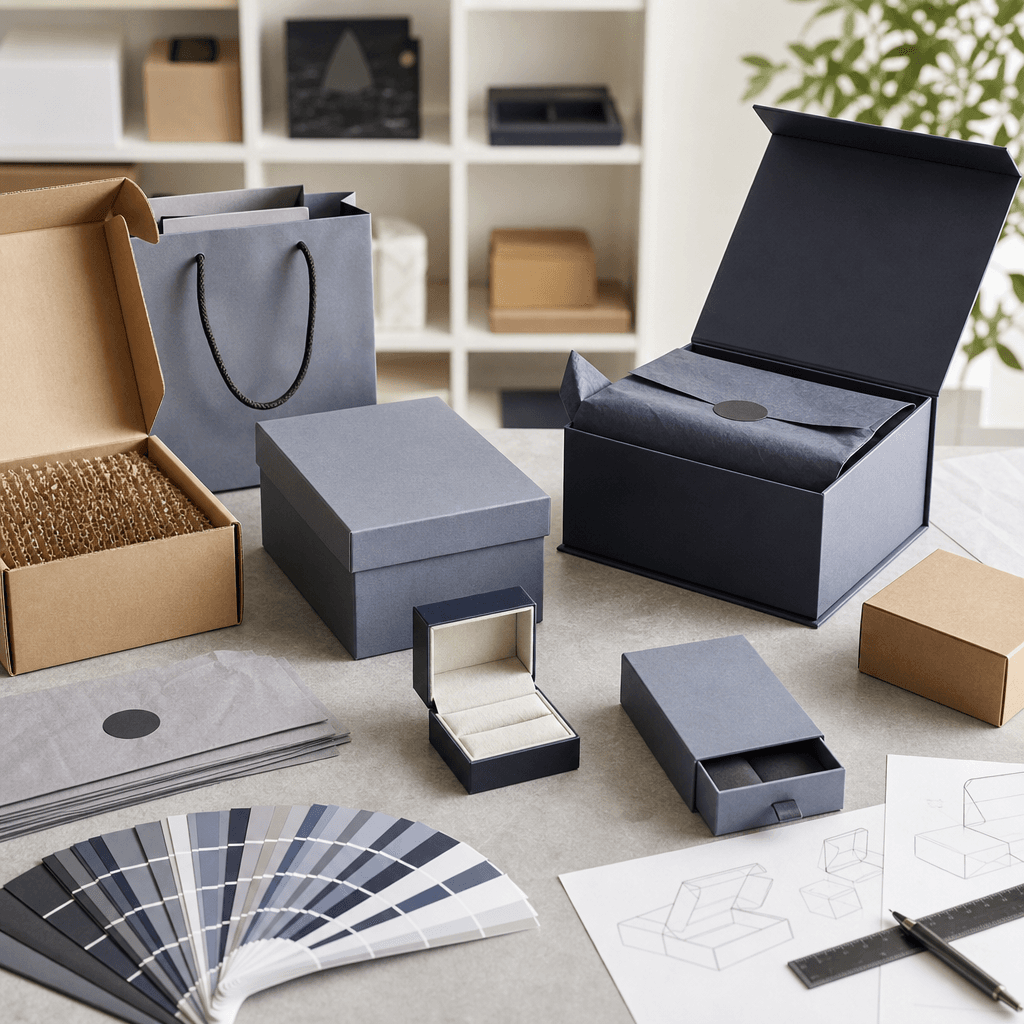
Custom box production is the process of defining a box's structure, material, and printing from scratch according to the product's size, fragility, and unboxing experience, instead of choosing from ready-made dimensions. At Kosapack, we start this process with consultancy; we manage it as a single chain that includes structural and graphic design, prototyping, production overseen by our verified factory partners, and consolidated logistics.
Table of Contents
- What is custom box production and how does the mechanism work?
- Types of custom boxes: rigid, folding carton, shipping, and inner packaging
- Why is custom packaging for your brand a strategic investment?
- Which criteria are decisive when choosing the right custom box?
- The next decision: brief, quote, and sample
- Frequently Asked Questions
What is custom box production and how does the mechanism work?
What makes a box "custom" is not having a logo printed on it, but being defined for a single product from its dimensions to its lid mechanism. Technical resources describing industrial box production clearly describe this logic: the process begins with defining the box's size, shape, and function. In other words, whichever product, serving format, and transport scenario it will be packaged for, the construction is built accordingly.
Once this definition is clarified, it's time for the material class. Customization guides prepared for different material groups show that the step following design is selecting the material suited to durability, weight, and usage scenario, followed by cutting, folding, joining, and surface finishing processes. On the cardboard and corrugated side, this chain proceeds as feeding the cardboard into the machine, printing the brand graphics, fluting, die-cutting, folding, and gluing operations.
The summary of the mechanism is this: design decision → material decision → industrial processing → protective or decorative final layer. None of these four links is independent of the others. Changing the wall thickness affects the folding lines, changing the folding line affects the position of the printing area, and changing the printing surface affects whether the material can carry processes like varnish or embossing.
We don't leave this chain as pieces the customer has to manage one by one. During the consultancy stage, we clarify the product's positioning and packaging goal; in structural design, we plan the construction according to product dimensions and the material and wall structure according to protection needs. On the graphic side, we prepare the box's unfolding template (dieline), check that the design is correctly positioned on this template, and ensure the file's suitability for printing. Production runs with our verified factory partners but under our quality and deadline oversight; different packaging items are also shipped from a single point through consolidated logistics.

Types of custom boxes: rigid, folding carton, shipping, and inner packaging
Matching custom box production with a single product type is the most common narrowing seen on the brand side. When "box" is mentioned, a corrugated shipping carton comes to mind; yet the same brand's shelf packaging, gift box, shipping box, and inner packaging are based on completely different structural logics. Our portfolio is built to cover this distinction.
Rigid (set-up) boxes. Structures with a covered cardboard body that don't fold and leave a distinct sense of weight in the hand. Preferred for luxury gifts, cosmetics, jewelry, and premium product presentation. Different opening mechanisms such as lid-base, magnetic lid, or sliding drawer directly determine the unboxing scene.
Folding carton (foldable cardboard boxes). The backbone of shelf packaging. Stands out in cosmetics, food, and fast-moving consumer goods in terms of both printing area and storage efficiency. Being shipped flat and assembled at the point of use reduces warehouse load for brands with many SKUs.
Corrugated boxes and e-commerce shipping boxes. Carton and mailer structures designed for shipping, storage, and branded unboxing. Here, aesthetics and impact resistance are part of the same equation. In our e-commerce shipping box selection guide, where we address the selection logic on the shipping side in more detail, we examine the balance between durability and brand visibility together.
Paper bags and fabric pouches. They serve as an extension of the box in store checkout, event, and gift scenarios. Fabric pouches protect the product with a second layer inside the box, especially in jewelry, accessory, and luxury categories.
In-box separators and inner parts. Cardboard or fiber dividers that fix the product in place and establish order in multi-part sets. Most of the composition seen when the lid opens is determined by these parts.
Labels, tissue papers, and cards. Silk paper, thank-you and insert cards, product and bottle labels; they affect brand perception as much as the box itself. Our label design rules, where we separately address the design discipline on the label side, show how the box and label are read together.
Mailer envelopes. They offer a branded transport layer for textiles, documents, and thin products without creating volume.
The practical result of being able to produce all these items under one roof is this: the box, inner separator, tissue, card, and label can be planned within the same color target and the same deadline schedule. Color shift and delivery date mismatch, the most common problems with parts from separate suppliers, are therefore reduced from the start.
Why is custom packaging for your brand a strategic investment?
Viewing custom box production as a cost item means ignoring half of what the box actually does. The box's first task is of course protection: the thickness, density, and wall structure of the cardboard and corrugated board determine impact absorption and resistance to tearing; the right fluting, cutting, and folding lines ensure structural integrity. When this is not done, damaged delivery, returns, and customer service load increase directly.
The second task is communication. Resources describing the box production mechanism emphasize that for the box to become a tool that truly represents the brand, smart graphic design must be combined with professional conversion processes. In other words, a beautiful design file does not achieve its purpose if not produced with the right cutting and printing quality; and neither does a well-produced but poorly designed box.
The third task is experience. In categories such as cosmetics, jewelry, candles, and chocolate, the composition seen when the lid opens — the box's inner surface color, the way the separator presents the product, the folding of the tissue paper, the card on top — determines the brand's emotional impact. This scene is also the frame of the image shared on social media. The box's texture, matte or glossy feel, and degree of rigidity are elements that trigger premium perception; while heavy and rigid structures reinforce the gift feeling, light and practical structures may be more accurate for everyday consumption products.
A common misconception needs to be corrected here: a premium box does not mean the thickest and heaviest box. Premium perception arises from the material–printing–design combination fitting the product category. An unnecessarily heavy structure, while increasing shipping cost and environmental load, may also look "exaggerated" for the category. Establishing this balance is one of the first topics we discuss during the consultancy stage.
On the printing side, color accuracy is decisive for us. The brand color staying in the same place on screen, in the proof, and in the final print is possible by taking the proofing stage seriously; that's why we treat color proofs not as a skippable formality of the process, but as an approval gate. On the material side, we see the use of recyclable paper and cardboard and carbon footprint reporting as a responsibility we own — because sustainability is no longer a silent message of the packaging, but a clear signal that the consumer reads.
Which criteria are decisive when choosing the right custom box?
This section is not a ranking, but a set of questions that need to be clarified before a decision. The clearer a brand's packaging brief is on these headings, the more accurately the quote and sample process proceeds.
Protection need and structural performance. Is the product fragile, heavy, or liquid? How many times does the transport chain pass from hand to hand? These answers directly determine the material class and wall structure. The same visual design is produced with very different constructions at different levels of protection.
Dimension, tolerance, and SKU structure. The box's inner dimension is built according to the product's outer dimension, with a margin left to facilitate placement. However, the real question for brands is at a higher level: will a single product be packaged, or a product family? If a dimension family is designed, both warehouse management and design consistency become easier. This is exactly where our custom sizing capability is most useful; instead of being squeezed into standard shelf dimensions, a box set graded according to the product family can be defined.
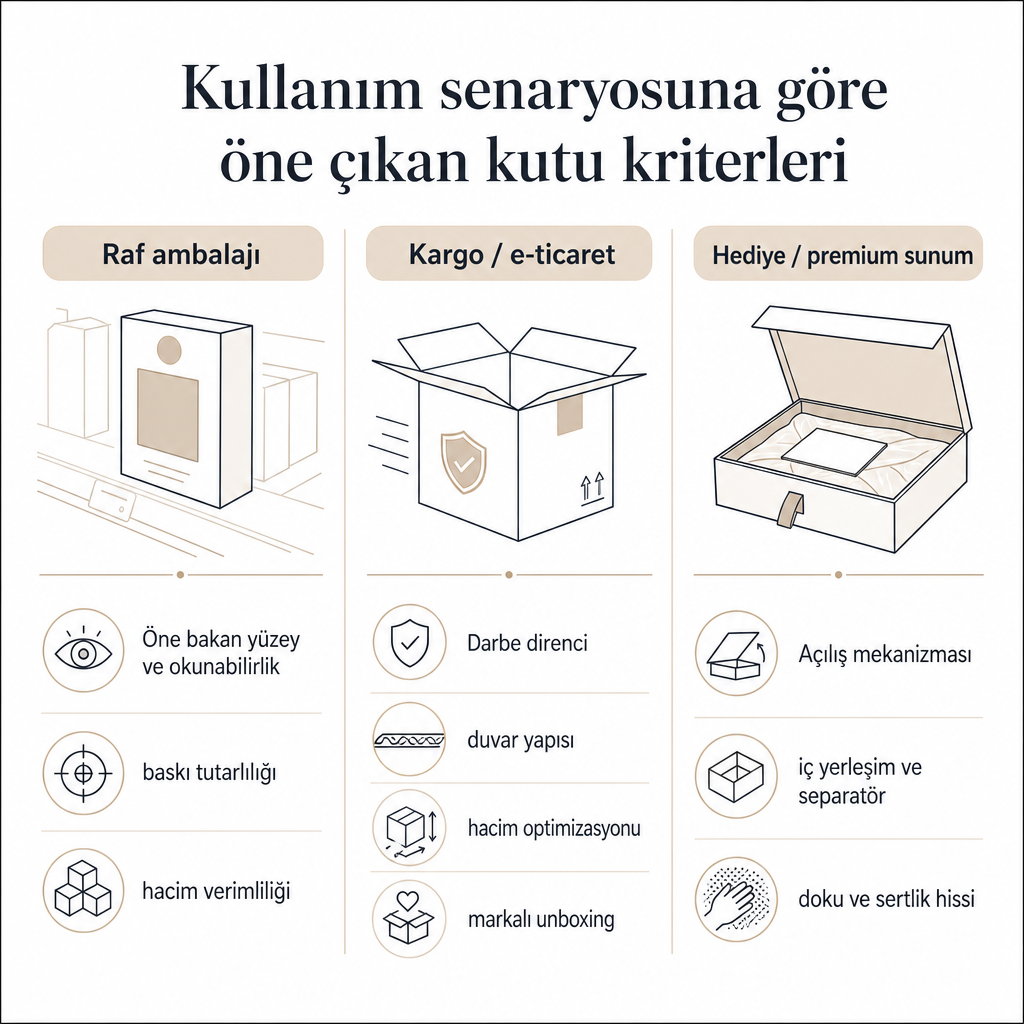
Usage environment: shelf, shipping, or gift? In shelf packaging, the front-facing surface and readability; in shipping, impact resistance and volume efficiency; in gifts, the opening mechanism and inner scene come to the fore. Most brands try to load all three onto the same box and usually get an average result in all three. Considering separate box types for separate scenarios often yields a more economical result.
Printing and brand story. Logo, typography, color palette, illustration, and textural effects concretize the brand's positioning. The critical point here is that the design is worked on the unfolding template: a graphic that falls on a folding line or text too close to the cut does not deliver the expected effect in production.
Inner arrangement and unboxing setup. How will the product stand inside the box? Separator, fabric pouch, or tissue? If there are multiple parts, which one will appear first? Since these decisions can also change the box's outer dimension, they must be addressed together with structural design.
Sustainability and material perception. Choosing recyclable material, reducing the number of unnecessary layers, and optimizing volume; this affects both the environmental load and the logistics cost. We prefer to discuss sustainability claims not as a general promise, but at the level of material and reporting.
Operational framework. Industrial box production is planned according to print run, number of prints, material type, and line capacity. What needs to be known on the brand side is the campaign schedule, stock shelf life, storage capacity, and reproduction cycle. A box that must be ready for a launch is planned differently from a shelf box that will be reprinted throughout the year.
Regulatory framework. Packaging in direct contact with food requires compliance with the relevant regulations; issues such as sharp edges, ink suitability, and easily tearable material must also be evaluated according to the category. It is appropriate to settle for a general warning under this heading: since specific obligations vary according to product category and sales geography, they must be confirmed on a project-specific basis with our team and official sources.
The next decision: brief, quote, and sample
The decision to be made at this point is not how the box will look, but how the project will be started. In practice, the inputs we need are limited: the product's dimensions and weight, which scenario it will be used in (shelf, shipping, gift), estimated quantity range, target delivery schedule, and your brand guide if available. Once this information is clarified, we can quickly produce the quote and material recommendation; then the physical sample allows the printing and material quality to be evaluated in hand, not on screen.
We addressed the step-by-step progression, from file preparation to approval stages, in a separate piece of content. If you want to see the process in order, our guide on how to have custom packaging made for your brand is a continuation of this article. Once we have your category, quantity range, and schedule, we prepare a material and structure recommendation tailored to you — because the right box is not one chosen from a catalog, but one defined for your product.
Frequently Asked Questions
What is the fundamental difference between custom box production and buying a ready-made box?
In a ready-made box, the product is fitted to the existing dimension; in custom box production, the box is defined according to the product. This difference is not only aesthetic but functional: because the inner space is reduced, the product moves less during transport, because the volume is optimized, shipping efficiency increases, and the printing area is positioned according to brand communication.
Can I have items such as box, label, tissue, and card made in the same project?
Yes. Rigid and cardboard boxes, corrugated shipping boxes, paper bags, fabric pouches, labels, tissue papers, thank-you cards, mailer envelopes, and in-box separators are all included in our portfolio. The most concrete benefit of planning these items in a single project is that the color target and delivery schedule are not divided among the parts.
Does a premium box necessarily require thick and heavy material?
No. Premium perception arises from the material–printing–design trio fitting the product category. While rigid and heavy structures give a strong feeling in gift and luxury presentation, a lighter and more practical construction may yield a more accurate result in everyday consumption products. Unnecessary thickness increases both shipping cost and environmental load.
Are sustainable material options possible in custom production?
We carry out the use of recyclable paper and cardboard and carbon footprint reporting as an approach we have adopted. We recommend which material and structure combination in your project meets both your sustainability and protection goals by evaluating your product category and shipping scenario together.
Can an e-commerce box and a shelf box be produced with the same design?
The visual language can stay the same, but the structural logic is usually different. In a shipping box, impact resistance, wall structure, and volume efficiency are prioritized; in a shelf box, the readability of the front-facing surface and printing consistency are decisive. Instead of loading both scenarios onto a single box, defining two separate structures connected to the same brand system is often more efficient.
Can the process proceed if I don't have a design file?
Yes. We offer structural design and graphic design within the scope of our services; we prepare the box's unfolding template and set up the design on this template. If you have a brand guide, logo, and color information, the process proceeds faster; if not, we define it together during the consultancy stage, starting from your packaging goals.