
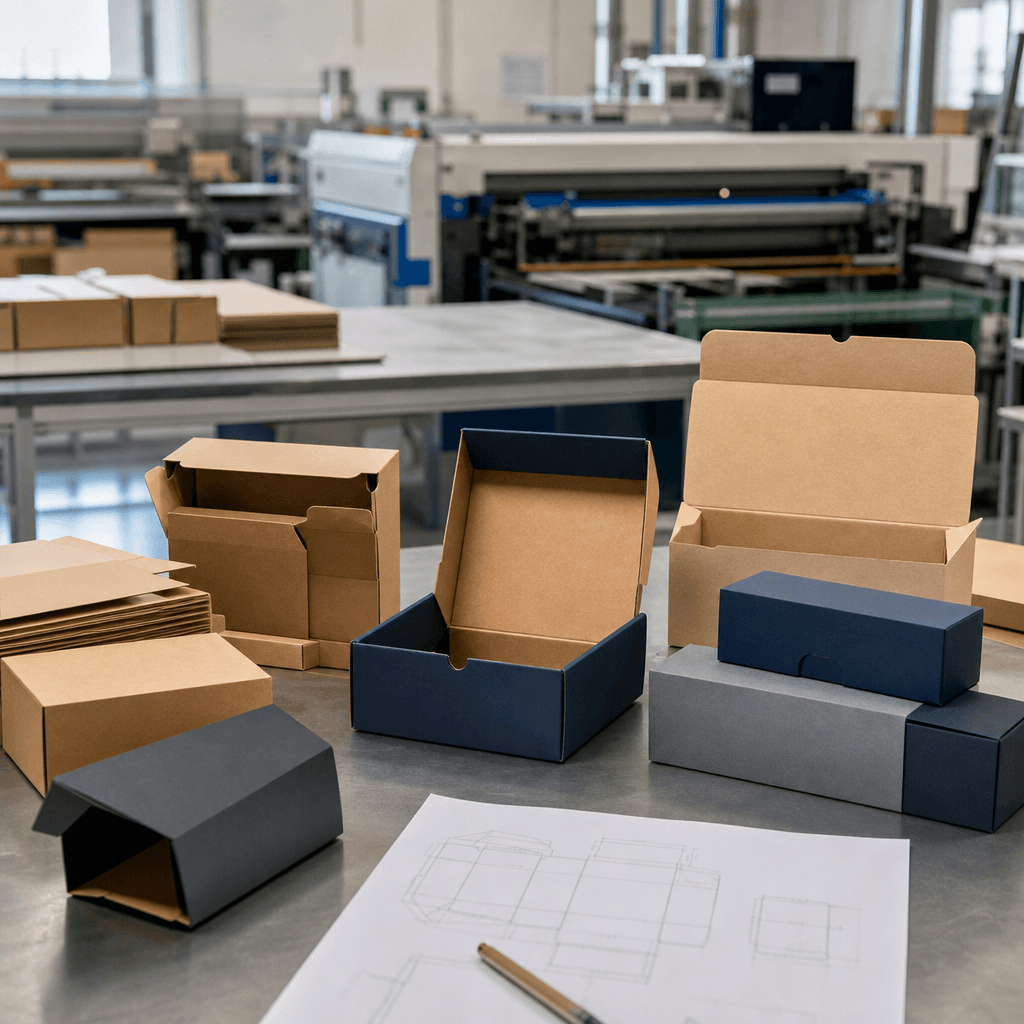
Custom-sized box manufacturing is the end-to-end planning and production of packaging that is engineered from scratch according to your product's dimensions, brand identity, and logistics needs. In other words, it is not a standard box selected off the shelf; it is a solution where the width, length, height, wall thickness, opening feel, and print are designed specifically for your product. At Kosapack, we run this process by bringing design, prototyping, printing, and logistics together under one roof; instead of a single order, we build a strategic packaging partnership for brands.
In this guide, we explain the essence of the decision, how the process works, which options are on the table, and which criteria you should consider when choosing the right box for a premium brand.
Table of contents
The core decision to make: design for the product or the experience?
Before moving on to custom-sized box manufacturing, there is one question you need to answer: Do you see the box as a transport tool that protects the product, or as an experience design that carries your brand? This distinction is the starting point for all technical decisions.
For premium cosmetics, jewelry, chocolate, candle, and fashion brands, the box is often the first physical contact made with the customer. Lid height, wall thickness, opening feel, and print quality directly affect the perceived value of the product; a box that looks cheap also overshadows the value of the product inside.
In e-commerce and DTC brands, the balance shifts slightly. Here, custom-sized box manufacturing primarily becomes an investment made to reduce shipping damage, lower return rates, and feed repeat purchases with a branded opening experience. A box in which the product does not rattle around and is carried with the right filling and internal placement lowers both logistics costs and customer complaints.
Therefore, the decision is not "getting a box made." It is bringing your product, brand positioning, sales channel, and sustainability goals together in a single packaging architecture. Defining these four axes from the outset both speeds up and reduces the cost of every subsequent step.
How does custom-sized box manufacturing work?
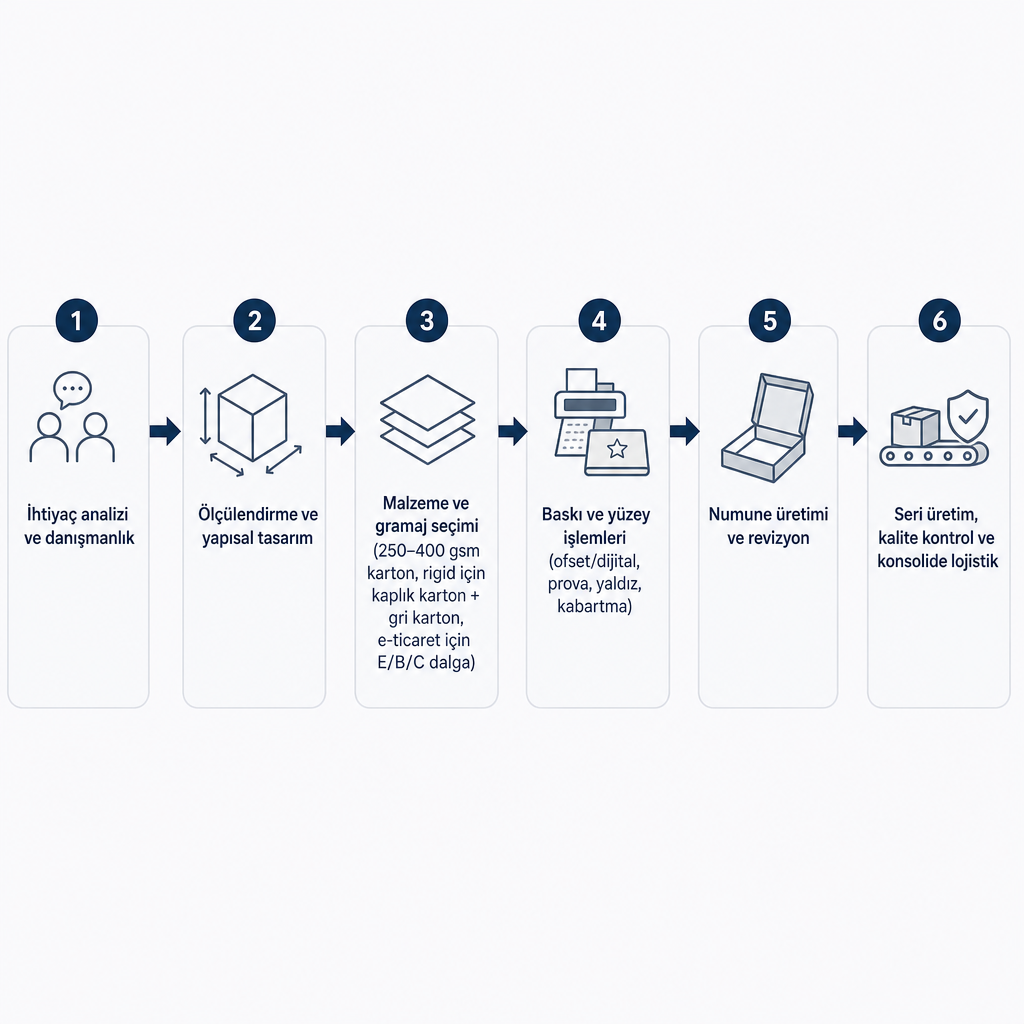
Custom-sized box manufacturing is, by nature, a multi-stage process that begins with consulting and design and is completed through material selection, printing, sampling, and mass production. Preserving the order of the stages prevents costly mistakes that could arise later.
The first stage is needs analysis and project consulting. Your brand's goals, product range, sales channels (store, e-commerce, wholesale), annual volumes, and budget are put on the table. At this point, the box type, estimated dimensions, printing needs, and sustainability expectations such as recyclability and carbon reporting become clear.
The second stage is sizing and structural design. The product's net width, length, height, and tolerances are taken; internal clearance, support elements, and internal volume are calculated based on transport scenarios. The structural design team determines the wall thickness, locking system, lid type (top lid, drawer, magnetic, sliding), and, if needed, dividers (insert, tray, separator) according to the product's weight and fragility.
The third stage is material and grammage selection; it is the most critical decision that determines the box's carrying capacity, premium feel, and print result.
- In folding carton boxes, the grammage is mostly in the 250–400 gsm range; 300 gsm is a common reference for FMCG and general retail, while 350 gsm is common for more premium shelf boxes.
- In rigid box outer coverings, coated board and creative wrapping papers are used, while high-density materials such as gray board are used for the inner layer.
- For e-commerce and heavy products, impact-absorbing, transport-focused boxes are designed with E, B, or C flute corrugated cardboard.
The fourth stage is printing and surface finishing. A die line is created according to the approved structure and dimensions; graphic design establishes brand consistency with your logos, typography, and visuals. Printing is done on offset or digital systems depending on the quantity and number of colors. In premium brands, proofing processes that secure color accuracy, surface finishes such as lamination, varnish, hot foil stamping, embossing, and spot UV, and texture preferences such as matte, soft-touch, and textured paper elevate perception.
The fifth stage is sample production and revision. Before moving to mass production, a physical sample is produced to test the dimensions, material rigidity, colors, and opening-closing feel; if necessary, the size, grammage, or surface finish is revised. When this step is skipped, problems such as incorrect dimensions, product breakage, or color deviation are only noticed after production and cause both cost and reputation loss.
The final stage is mass production, quality control, and logistics. Based on the approved sample, printing, cutting, folding, gluing, and assembly are completed; color consistency, dimensional deviations, strength, and surface defects are checked with systematic procedures. The boxes are delivered to the warehouse or filling facility via consolidated shipment; in multi-brand or multi-product projects, we also handle the logistics of the packaging.
Options: box types, materials, and experience design
Throughout the process, your decisions come together along three main axes: box type, material, and brand experience. Considering these three separately clarifies both the budget and the outcome.
Box type. The rigid box (luxury cardboard box) offers high perception and strong protection for cosmetics, jewelry, chocolate, candles, and corporate gifts. The folding carton box is a print-focused and logistically efficient solution for shelf products, FMCG, and light premium products. The corrugated cardboard box, on the other hand, stands out with impact absorption and transport durability for e-commerce and heavy or bulky products.
Material and sustainability. Recyclable cardboard and corrugated boards reduce the environmental footprint compared to solutions containing plastic. The right combination of grammage and flute prevents unnecessary material use, optimizing both the unit cost and carbon emissions. In other words, sustainability here often does not conflict with cost—it regulates it.
Brand and unboxing experience. Inner printing, custom colors, personalized message cards, texture, and the opening choreography strengthen the branded opening feel, especially in e-commerce and DTC brands. In premium rigid boxes, lid rigidity, magnetic closing feel, and internal placement should align with the product's perceived value; an expensive product coming out of a loosely closing box ruins the entire perception.
To build these three axes together and see in more detail which box type suits your brand, you can take a look at our cardboard box selection guide and our article explaining what custom packaging means.
Decision criteria: the right box for premium brands
When working with a strategic packaging partner, the custom-sized box decision becomes clear through five criteria. Evaluating these in order makes it easier to find both the right type and the right budget.
Product features and protection needs. Weight, fragility, surface sensitivity, and the shelf or shipping scenario directly determine whether the box should be rigid, carton, or corrugated. A fragile glass jar and a light textile product cannot be protected with the same architecture.
Brand positioning and price point. In the luxury and premium segment, rigid boxes and creative wrapping papers create high perception; in the mid-segment, well-printed carton boxes balance cost and perception. The level of the box should be consistent with the product's retail price.
Channel and logistics requirements. The box architecture of a product that will only go onto a store shelf cannot be the same as that of a product that will go both to the shelf and to shipping. Pallet placement, stacking, and shipping standards should be taken into account from the outset.
Sustainability goals. Recyclable materials, FSC or similarly certified boards, and avoiding unnecessary material make possible a design aligned with your corporate sustainability strategy.
Budget, volume, and timing. The unit cost depends on the chosen box type, material, and printing technique. In large-volume projects, well-planned custom-sized box manufacturing can lower the total cost of ownership thanks to logistics efficiency and damage reduction. Sample and production times should also be aligned with your launch calendar.
If you want to see end-to-end how these criteria apply to your brand, you can review our article explaining step by step how custom box manufacturing comes to life.
Risks and common mistakes
When not managed correctly, custom-sized box manufacturing turns into visible costs for premium brands. The mistakes we most frequently encounter fall under a few headings.
- Providing incorrect or incomplete dimensions: Even millimeter-level deviations cause the box not to close or the product to rattle inside.
- Ignoring the material's carrying capacity: The wrong grammage or flute type increases the risk of crushing and breakage, especially in e-commerce boxes.
- Skipping color management and the proofing process: Color deviations disrupt the consistency of brand identity and weaken the shelf appearance.
- Moving to mass production without seeing a sample: Decisions made without a prototype produce mistakes that are difficult and costly to reverse.
- Viewing the box only as a cost item: For premium brands, the box is part of perception, repeat purchase, and gift value; a cost focus at the wrong level enlarges brand damage in the long run.
Most of these mistakes are prevented with a single discipline: taking the right measurements, locking in the right material, and approving the physical sample before moving to mass production.
Frequently Asked Questions
What is the difference between custom-sized box manufacturing and a ready-made stock box?
Ready-made boxes are produced with predetermined standard dimensions and materials. Custom-sized box manufacturing, on the other hand, is packaging designed from scratch according to your product's specific dimensions, weight, and brand goals, with printing and material tailored to you.
Which box type is most suitable for premium brands?
In premium categories such as cosmetics, jewelry, chocolate, and candles, luxury cardboard (rigid) boxes are the most frequently preferred solution thanks to their high perception, sense of weight, and shelf presence. The exact choice varies according to the product's weight and sales channel.
Why is it important for e-commerce and DTC brands?
Custom boxes correctly sized according to the product and shipping scenario reduce transport damage and return rates while increasing customer satisfaction and loyalty with a branded opening experience.
Is sustainable custom-sized box manufacturing possible?
Yes. Using recyclable cardboard and corrugated board, selecting the right grammage, and avoiding unnecessary material in the design make production both eco-friendly and economical.
What is the advantage of working with a single packaging partner for multiple products?
Managing rigid boxes, carton boxes, corrugated boxes, paper bags, and additional packaging elements under one roof strengthens brand consistency; it simplifies the quotation, quality control, and logistics processes. We can plan the right combination for your project together.