

The answer to the question of how to have brand-specific packaging made with a properly planned packaging project can actually be tied to a clear timeline and budget range: if your preparation is complete, you'll usually take your first order live within 3–8 weeks. The cost per unit, on the other hand, starts from a few lira depending on the material, printing technique, and quantity, and rises toward premium segments. Since we at Kosapack manage design, sampling, production, and logistics under one roof, we help you get the points that create the most delays and costs under control from the very beginning.
This guide makes the process practical step by step for premium and growing brands operating in Turkey. Since we work across more than 25 verticals such as cosmetics, e-commerce, food, fashion, jewelry, and electronics, we share concretely which decision should be made at which stage and where risk accumulates.
Table of Contents
The outcome, timeframe, and estimated cost this process will provide you
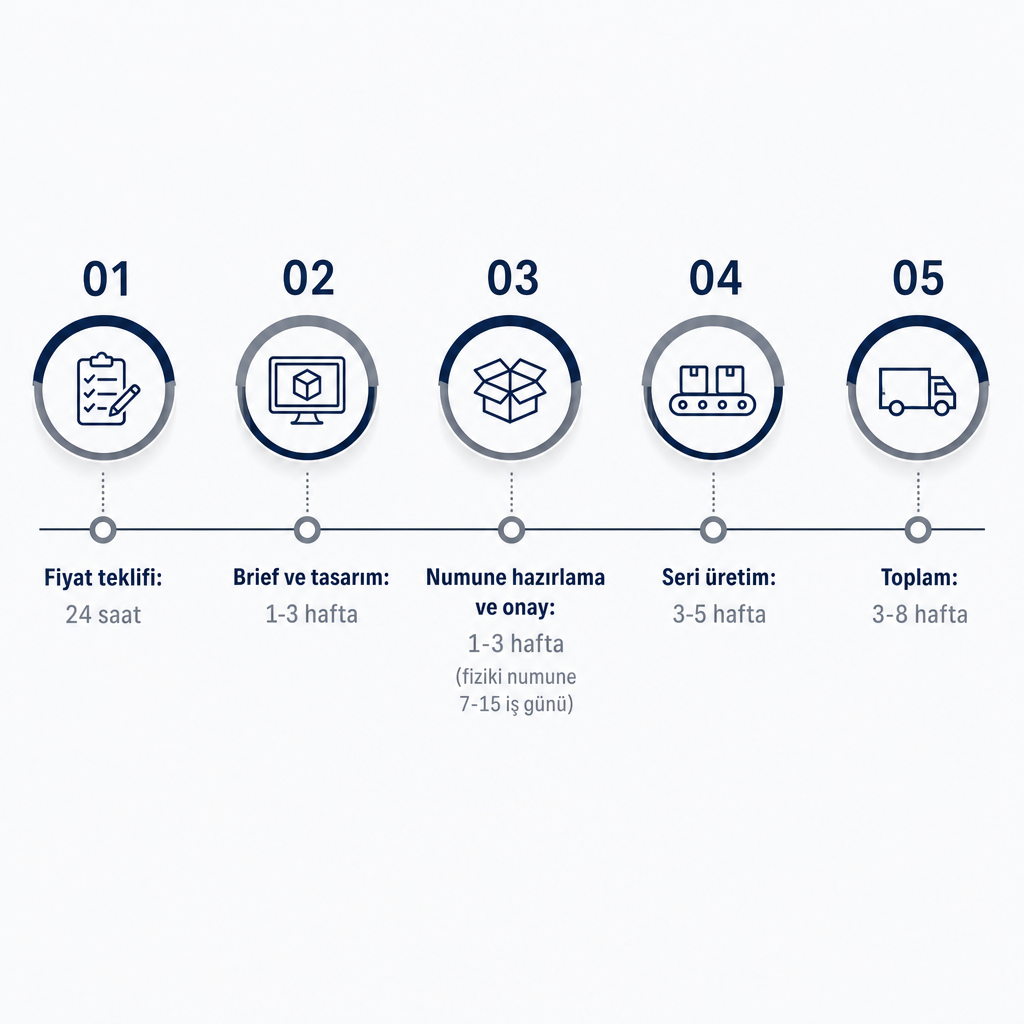
Brand-specific packaging is not a single box order; it means building a system that determines your brand's perception on the shelf, in shipping, and at the unboxing moment. In a properly planned project, you can take components such as boxes, bags, labels, thank-you cards, and inner fillers live together within 3–8 weeks. This range varies according to design complexity and order quantity; projects requiring custom die-cutting, foil, or multi-piece inner layouts approach the upper limit.
On the cost side, giving a single figure would be misleading. The price per unit is shaped by the material choice such as cardboard, corrugated board, or textile, by techniques such as offset printing, spot UV, hot foil, and embossing, and by the order quantity. The difference between a simple folding carton and a foiled rigid gift box can change the unit cost several times over. That's why defining the budget as a range before the design prevents costly revisions later on.
The real advantage of working end to end emerges in time and risk management. When you manage design, sampling, production, and consolidated logistics with a single partner, you largely eliminate the coordination burden between different suppliers and communication-related errors. If you'd like to see in more detail how packaging turns into a marketing tool, you can review the article where we discuss the marketing power of brand-specific boxes.
The checklist you need to prepare before starting
The speed of the quotation and design stage largely depends on how prepared you come to the table. When you clarify the items below, we can prepare a far more accurate proposal and pricing.
- Brand positioning: Core concepts such as premium, luxury, natural, sustainable, young, or corporate should be defined; this directly affects the material and design language.
- Product information: Dimensions, weight, fragility, shelf life, storage conditions, and shipping method.
- Use case: Online order box, store shelf packaging, gift box, PR kit, or corporate gift.
- Quantity and budget: For example, 500–5,000 units in the first production and a reorder plan for the following 6–12 months.
- Logistics and storage: Warehouse space, palletizing capability, frequency of shipping via cargo or courier.
- Sector-specific legal requirements: Frameworks such as the Turkish Food Codex and the Cosmetic Products Regulation in food and cosmetics determine packaging and label decisions.
- Sustainability expectations: Recyclable material, FSC-certified paper, carbon footprint reporting, or plastic reduction.
- Corporate identity files: Logo, color codes (Pantone/CMYK/RGB), typography, and visual style guide.
- Project timeline: Launch date, campaign period, seasonal collection, or special occasion targets.
If the information in this list is missing, the process doesn't stop, but it slows down and proceeds on assumptions. If you'd like to review the fundamentals of what custom packaging means for brands, you can take a look at our foundational guide explaining what custom packaging is.
Step by step: how to have brand-specific packaging made
1. Clarify the strategic goal of the packaging
First determine what you expect from the packaging: to strengthen the unboxing experience, to stand out on the shelf, to create a premium gift feeling, or to tell your brand story? This goal determines both the packaging type and the design language together. If standing out on the shelf is the priority, folding cartons and graphic power take the lead; if the gift feeling is the priority, rigid boxes and surface finishes become decisive.
2. Gather the product and technical requirements
Especially in regulated sectors such as food, cosmetics, and electronics, packaging is not just aesthetics but a technical and legal matter. The product's fragility, weight, and sensitivity to moisture and heat guide the material choice. For paper, plastic, or metal materials in contact with food, compliance with the Turkish Food Codex and related communiqués is essential. In cosmetics and personal care, the use of labels, ingredient declarations, warnings, and symbols must be addressed within the framework of the Cosmetic Products Regulation. On the labeling side, the compliance of mandatory fields such as product name, ingredients, net quantity, expiry date, manufacturer information, and batch number with the legislation must be checked.
3. Choose the right packaging type
From the portfolio we offer under one roof, we determine together the combination suitable for your product. Rigid boxes are suitable for luxury products such as jewelry, cosmetics, chocolate, and premium sets. Folding cartons are an economical and flexible option for cosmetics, food, and shelf packaging. Corrugated e-commerce boxes are used for shipping durability, paper bags for store and event use, and labels for brand information on bottles and jars. Inserts, dividers, thank-you cards, and tissue papers complete the in-box experience; textile pouches, meanwhile, provide reusable premium packaging. When deciding on the right cardboard structure, our guide on cardboard box types and the right choice for your brand is a practical starting point.
4. Start the design process: brief, structural and graphic design
In brand-specific packaging design, two layers work together. Structural design covers the box form, the way it opens, the locking system, the internal compartments, and the carrying handle; while protecting the product, it also stages the unboxing moment. Graphic design, on the other hand, defines logo placement, color palette, typography, and printing techniques (offset, screen printing, lamination, spot UV, hot foil, embossing). Planning these two layers together rather than separately safeguards both manufacturability and aesthetic integrity. We work with you through a detailed brief and prepare structural and graphic proposals suited to your brand's positioning.
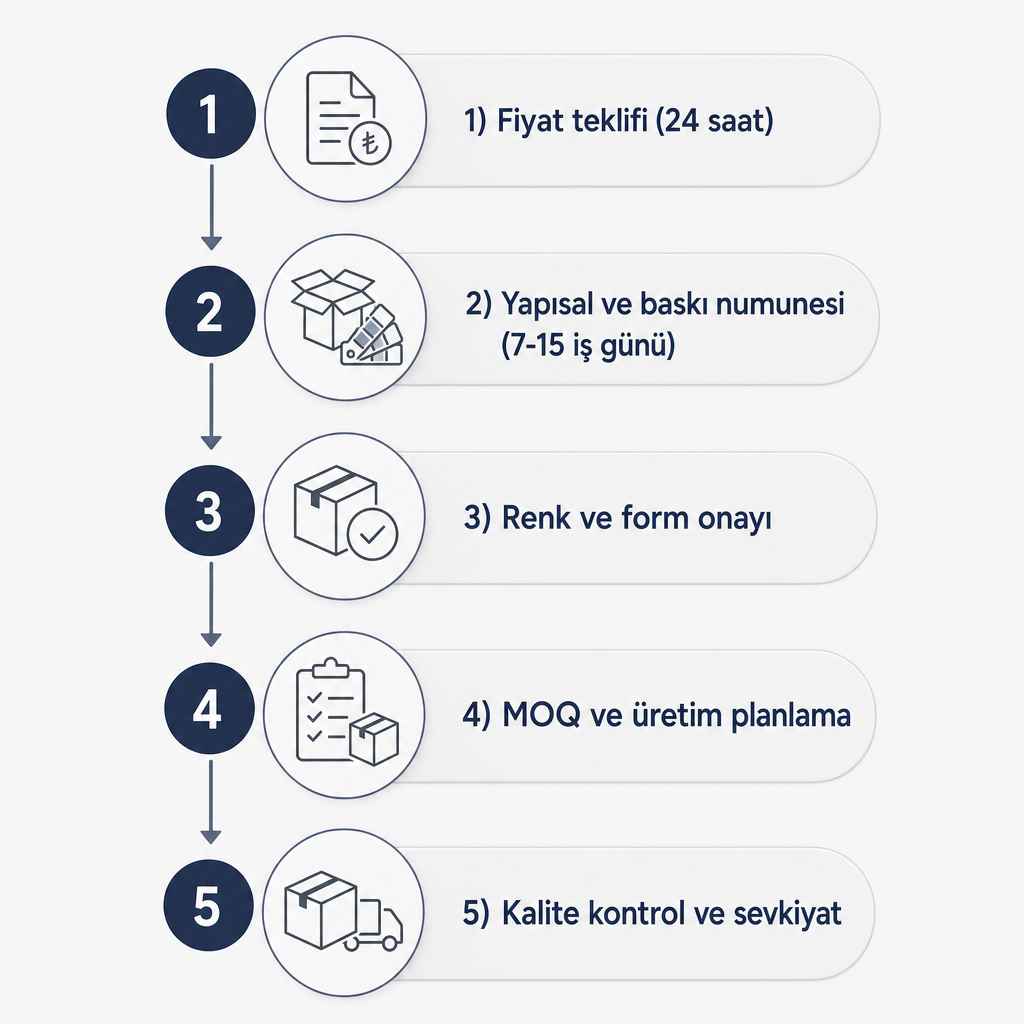
5. Reduce risk with samples and print proofs
The sample is one of the most critical stages of the process. With a structural sample, you test whether the box form works correctly, whether the product moves inside, and the lid durability. In the print proof, you check color accuracy (especially Pantone brand colors), the clarity of the logo, the legibility of small texts, and the surface finishing quality. We usually provide a price quote within 24 hours and a physical sample within 7–15 business days; thus you approve the project through a real example. Trying different grammages, coatings, and inner layout alternatives at this stage, and requesting a second iteration when necessary, pays off in the long run in terms of both cost and brand perception.
6. Final approval, production planning, and quality control
After the samples are approved, production is planned technically. The minimum order quantity and total volume are clarified; printing plates, cutting dies, and surface finishing molds are prepared. In every batch, we apply systematic control procedures for print quality, color tolerance, material thickness, gluing durability, and packaging standards. Determining the delivery deadline, whether the shipment will be made all at once or in batches, and the reorder plan at this stage lowers operational risk.
7. Logistics, storage, and inventory management
After production is completed, storage conditions become important; humidity, temperature, and sunlight can affect the form of cardboard and paper packaging. To use warehouse space efficiently, the right pallet and stacking method is needed. For e-commerce brands, SKU-based inventory tracking, forecasting consumption speed during campaign periods, and determining the reorder threshold are critical. Our consolidated logistics model simplifies operations, especially for growing brands, by combining different packaging types under a single shipment.
8. Launch, measurement, and improvement
The job doesn't end once the packaging goes live. Unboxing videos, social media comments, and return reasons provide feedback from the customer side; the experience of the warehouse, logistics, and sales teams reveals internal usage issues. By monitoring metrics such as the damaged product rate, packaging-related return rate, and engagement, you can fine-tune the material, design, or quantity in the next batch. This cycle transforms packaging from a one-time expense into an evolving asset.
Common mistakes and how to prevent them
Starting the design without clarifying quantity and budget. Uncertain quantity and budget lead to unnecessarily expensive or unmanufacturable designs. Define the quantity and target unit cost range from the very start; base the design on this framework.
Ignoring legal requirements. Failing to comply with legislation, especially in food and cosmetics, can cause last-minute revisions or the product being unable to reach the market. Before designing, check basic frameworks such as the Turkish Food Codex, communiqués on food-contact substances and materials, and the Cosmetic Products Regulation, or seek expert consultancy.
Rushing the sample approval. Approving the sample without examining it in detail creates problems noticed once production is finished. Test the sample with the actual product, try it in several scenarios, and request a second sample if necessary.
Choosing the wrong material and grammage. Too-thin cardboard distorts the form of heavy products; cardboard thicker than needed raises the cost unnecessarily. Evaluate the recommended grammage and material combinations, and compare alternatives through samples.
Not accounting for logistics and storage. Packaging volume that exceeds the warehouse or dimensions that don't fit the pallet create operational trouble. Evaluate pallet dimensions, shelf height, and handling processes together with your teams during the design stage.
When to do it yourself, when to choose a professional manufacturer
Proceeding with your own internal resources makes sense in some narrow scenarios: at very low quantities (for example, small campaigns of 50–100 units), for simple single-color stickers or minimal logo applications on ready-made kraft boxes, and for low-risk products not subject to regulation. In these cases, you can source ready-made boxes and labels and manage the application yourself.
However, when one of the following thresholds comes into play, working with a professional manufacturer is strategically more sound: if quantities are at a medium–high level and regular reorders are needed; if the products are in regulated sectors such as food, cosmetics, or electronics; if your brand is in the premium or luxury segment and color accuracy is critical; if you want advanced processes such as foiling, embossing, custom die-cutting, or multi-piece inner layouts; or if you'll use the packaging in multiple countries or channels.
At this point, our role is not just to print. We watch over regulatory compliance, run color and quality control processes, manage supply chain risks, and by handling design, sampling, production, and logistics end to end, we become a strategic packaging partner for your brand. Your next step is to receive a customized proposal and quote by sharing your product's dimensions, target quantity, and use case.
Frequently Asked Questions
What is the cost of having brand-specific packaging made?
The cost per unit varies according to box type, material, printing techniques, level of workmanship, and quantity. In premium boxes that include custom printing and coating, the cost increases noticeably compared to plain cardboard boxes. By providing a price quote within 24 hours, we help you clarify your budget range.
How long does the process take in total?
The brief and design usually take 1–3 weeks, sample preparation and approval 1–3 weeks (our physical sample target is generally 7–15 business days), and mass production and shipping 3–5 weeks depending on the product type. In total, most projects go live within the 3–8 week range.
What should the minimum order quantity (MOQ) be?
The MOQ varies according to product type and printing technique; there are certain levels for premium boxes requiring custom die-cutting and molds. At very low quantities the unit cost rises, while medium–high quantities are more suitable for optimizing the unit cost.
What should I pay attention to in packaging for food products?
For materials in contact with food, it is necessary to comply with the criteria in the Turkish Food Codex and related communiqués. Mandatory information on the packaging and label, such as the product name, ingredients, net quantity, and expiry date, must comply with the legislation. We guide you in choosing the appropriate material and printing ink.
Does brand-specific packaging make sense for small e-commerce brands?
Yes, when planned correctly. Custom packaging strengthens the unboxing experience and can increase repeat purchases and social media visibility. We develop scalable packaging strategies for brands in the growth stage.