

Cosmetic packaging production is the process of designing and manufacturing together the material, weight, printing, surface treatment, and logistics setup of the structure that protects, carries, and sells your product on the shelf. In other words, it is not simply choosing a single box; it is a technical decision that simultaneously resolves brand positioning, regulatory compliance, protection needs, and cost balance. When set up correctly, it directly ties both your retail shelf performance and your e-commerce unboxing experience to brand perception and profitability. In this guide, we address together what cosmetic packaging production is, the legal framework in Turkey, the fundamental building blocks, and the criteria you as a brand should base your selection on.
Table of Contents
What exactly is cosmetic packaging production?
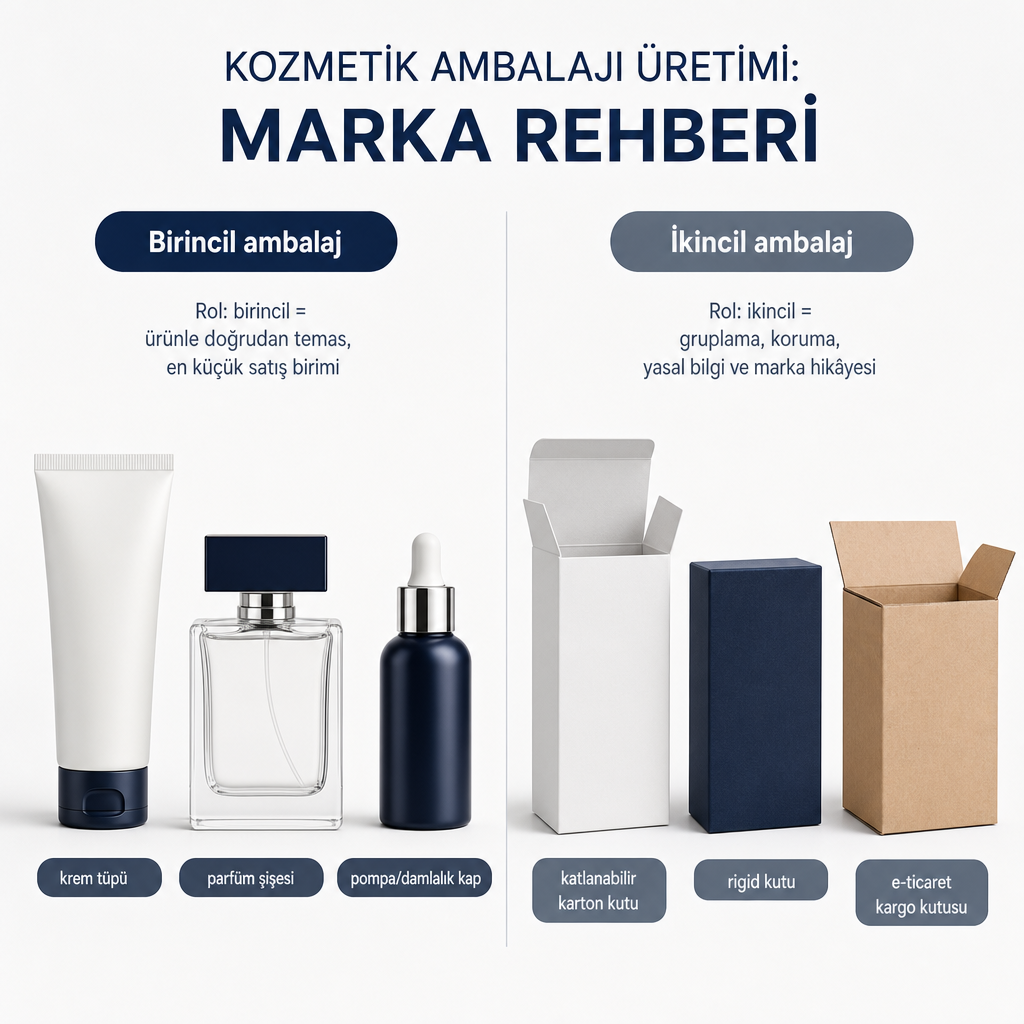
Cosmetic packaging is generally addressed in two layers from a regulatory standpoint. Primary packaging is the container that comes into direct contact with the product and forms the smallest sales unit; a cream tube or a perfume bottle falls into this group. Secondary packaging, on the other hand, is the outer packaging that can be separated from the product, groups one or more products, and most often appears as a cardboard box.
In the cosmetics category, the real strategic area is often this secondary packaging. A cardboard box, rigid box, gift box, or e-commerce shipping box directly determines the product's perception because it both carries the legally required information and makes the brand story visible. That is why the packaging decision should be treated not as an aesthetic preference but as a technical and commercial decision.
At Kosapack, we are a private packaging manufacturer based in Zeytinburnu, Istanbul; we offer all packaging components such as custom cardboard boxes, rigid boxes, corrugated shipping boxes, labels, cards, paper and fabric bags for premium brands under one roof. This integrity makes it possible for cosmetic brands to design all parts—from the product box to the shipping packaging—with a consistent brand language.
Legal framework for cosmetic packaging in Turkey
Your decisions in cosmetic packaging production must comply with the Cosmetic Products Regulation in force in Turkey and the related guidelines. The legal framework draws the boundary of your design freedom: technical choices such as reserving space for certain information on the packaging surface, choosing a readable font and contrast, and opting for a liquid-resistant printing system are direct consequences of these requirements.
According to the regulation and application guides, the following information must appear on the packaging in an indelible, legible, and visible manner:
- Name and address of the manufacturer or importer company
- Nominal content (weight, volume, or count)
- Minimum durability period or period after opening (PAO symbol or written statement)
- Function of the product (stated separately if not clear from the packaging)
- Batch/lot number or reference identifying the product
- Ingredient list (INCI ingredients, under the heading "Ingredients")
- Country of origin for imported products
- Special usage warnings and precautions, if any
This density of information affects surface planning in packaging design from the outset. On a low-volume serum box, making room for the mandatory texts while preserving brand identity requires a careful balance in typography and space usage.
On the sustainability side, ecolabel criteria come into play. Ecolabel guides for personal care and cosmetic products clarify the definitions of primary and secondary packaging and emphasize avoiding unnecessary secondary packaging as a requirement for environmental performance. In other words, automatically putting every product into a cardboard box can have a counterproductive effect for a brand that makes sustainability claims. These two faces of the regulation—carrying mandatory information and avoiding excessive packaging—together define the framework of your packaging decision.
The fundamental building blocks of cosmetic packaging
Cosmetic packaging production is shaped less around a list of order steps than around four interrelated decision areas. Evaluating these areas together prevents costly revisions later.
Packaging type and structural design
The most commonly used outer packaging types for cosmetic brands serve specific purposes. The folding carton is a shelf-compatible, economical solution with high printing flexibility for creams, serums, makeup, and hair care products. The rigid box—that is, a hard box with a lid or drawer—provides premium perception and high protection for perfumes, luxury care sets, and gift kits. The corrugated shipping box is the shipment packaging of e-commerce and DTC brands; the combination of a cosmetic product cardboard box on the inside and a branded shipping box on the outside is a common setup. Labels, in-box cards, dividers, and paper/fabric bags are supporting components that complete the product's first-touch and unboxing experience.
Material and weight selection
The substrate and weight decision is a critical technical parameter for both durability and premium perception. Typical approaches for cosmetics and luxury care can be summarized as follows:
| Packaging type | Substrate | Typical weight/structure |
|---|---|---|
| Folding carton | Coated/bristol cardboard | 300–350 gsm shelf benchmark |
| Premium perfume box | Heavy cardboard or rigid | 400–450 gsm or 1.5–2 mm grey board + coated lamination |
| E-commerce shipping box | E-flute corrugated board | ~1.5 mm standard; B/C or BC combination for heavy products |
These values are not absolute rules but a starting reference. The final weight becomes clear when product weight, shelf and shipping risks, sustainability goals, and cost balance come together.
Printing and surface treatments
Printing and finishing are the layer that makes your brand's positioning visible. Offset printing is mostly preferred for premium cardboard boxes; it is suitable for high color accuracy and fine typography. In color management, you need to ensure that brand colors are reproduced correctly using Pantone references, proof prints, and color scales. On the surface treatment side, matte/glossy cellophane lamination, spot UV and soft-touch varnish, hot foil stamping, emboss/deboss, and spot varnish areas are used to highlight the logo or product name. Setting up these treatments in a single production file and getting them approved with a physical sample significantly reduces the risk of surprises in color and tactile feel.
Sustainability perspective
Ecolabel criteria limit the use of unnecessary cardboard boxes by clarifying the definitions of primary and secondary packaging. For example, not using an additional cardboard box for a hand cream in tube form can be a criterion in terms of the ecolabel. When secondary packaging is required, the principle of minimum sufficient weight comes to the fore: choosing the lightest solution that provides product protection and shelf presentation is advantageous in terms of both cost and carbon footprint. Choosing unnecessarily heavy cardboard is often an unnoticed loss in cost and sustainability.
What should you base your selection on as a brand?
The right packaging is not a single correct answer but a balance dependent on your brand's context. It helps to clarify the decision across four axes.
Brand positioning. For perfume, luxury care, and niche cosmetic brands, premium finishings such as heavy weights, rigid boxes, soft-touch varnish, and foil strengthen the gift perception. For a broad portfolio, drugstore market shelves, or high-volume campaign products, standardized folding carton structures, controlled weights, and simple design provide cost and logistics advantages. For detailed box type selection, you can review our guide explaining the ways to choose the right box for your brand.
Sales and delivery channel. On the retail shelf, you need a box that is thin yet feels sturdy, can stand upright, and quickly draws attention with its front face. On the e-commerce and DTC side, an unboxing experience is designed alongside the product cardboard box with a branded shipping box, inner dividers, a label, and a thank-you card. If you want to delve deeper into the shipping box choice, our e-commerce shipping box selection guide facilitates your channel-focused decisions. In corporate gifts and sets, the combination of a rigid box, inner cardboard divider, and fabric/paper bag carries the premium perception.
Product form and protection needs. Products in the form of bottles, tubes, compact makeup cases, droppers, or pumps require different structures depending on impact and leakage risks. For a glass perfume bottle, a custom-cut divider inside a rigid box reduces the risk of breakage; for small makeup products, tightly sized cardboard inner supports are needed to prevent the product from shaking inside the box.
Sustainability and regulatory compliance. Ecolabel guides and the Cosmetic Products Regulation are the fundamental reference points that regulate both the packaging volume and the density of information on it. For sustainability-focused brands, recyclable cardboards, optimal weight selection, and primary/secondary packaging design compliant with ecolabel criteria are evaluated together.
Cosmetic packaging solution model with Kosapack
We position ourselves as an end-to-end packaging solution partner for cosmetic, e-commerce, fashion, jewelry, and premium FMCG brands; this model was designed to reduce the complexity of decision-making in cosmetic packaging production. We determine the right box type and cardboard/corrugated structure together according to the product, channel, and brand positioning.
Our service model consists of complementary stages. With packaging consultancy, we clarify the right type and structure; in structural and graphic design, we integrate the box form, opening mechanism, inner divider, and graphics into a single file. In the prototyping stage, we enable you to test the color, weight, and tactile feel before production with a physical sample that includes printing and finishing. In managed production, we carry out mass production through verified factory partners with weight, printing, and color verification controls; with consolidated logistics, we combine the boxes, labels, bags, and cards in a single shipment.
Our approach, which offers quick pricing and a physical sample within 7–15 business days, aims to align with the product launch timelines of growth-stage brands. Our portfolio includes the cardboard boxes, rigid gift boxes, corrugated shipping boxes, paper and fabric bags, labels, in-box cards, and dividers that cosmetic brands need; thus, you can design the entire unboxing ecosystem under a single supplier. For teams that want to work in more detail on box dimensions and structure, our guide addressing the ways to choose the right box is a good starting point.
Common mistakes and practical scenarios
When packaging decisions are made incorrectly, the brand suffers on both the cost and perception sides. The most common mistakes are as follows:
- Excessive weight: Increases cost and carbon footprint while lowering shelf and shipping efficiency.
- Insufficient protection: Low weight or a faulty inner divider on fragile glass bottles raises the breakage and return rate.
- Non-compliant labeling: A missing ingredient list, an unreadable expiration date, or insufficient manufacturer information increases audit risk and consumer complaints.
- Unnecessary secondary packaging: Putting every product into a cardboard box conflicts with ecolabel criteria, undermining the sustainability claim.
- Color inconsistency: Logo and brand colors appearing different between the proof and production disrupts shelf integrity.
Most of these mistakes can be spotted and corrected early through pre-production consultancy and sample approval. Let's look at three typical scenarios to demonstrate the concrete decision mechanisms (brand names are examples).
Niche perfume brand (premium, low volume). A rigid box with a 1.5–2 mm grey board core and coated lamination is preferred as the outer packaging. On the finishing side, the logo and perfume name are embossed with soft-touch varnish, gold foil, and embossing. In the inner structure, a cardboard or cardboard+foam divider cut to the bottle form is used. The aim is to create the feeling of a collector's piece in the shelf and unboxing experience.
E-commerce-focused skincare set (DTC, subscription). A 300–350 gsm coated cardboard folding carton is used for each product, and the label information is placed in compliance with the regulation. The outer packaging is an E-flute corrugated shipping box with the brand logo and a short opening message. The products are secured during shipping with a thank-you card, usage guide, and cardboard divider.
Economical makeup series for the drugstore market shelf (high volume). The cost per unit is lowered with a standardized folding carton structure, optimized weight, and a single die. In the design, easy-to-read typography, a distinct category color, and in-shelf visual integrity stand out. In terms of sustainability, unnecessary secondary packaging is avoided by using boxes only for products that require protection and shelf presence.
Frequently asked questions
What should the minimum quantity be for cosmetic packaging production?
The minimum quantity varies according to the packaging type you choose (folding carton or rigid box), the weight, and the finishing. In the logic of mass production, since die and printing setup costs are spread over certain quantities, the threshold differs on a project basis. For premium and growth-stage brands, we optimize these thresholds together according to the project.
What information is mandatory on the packaging?
The manufacturer/importer name and address, ingredient list, nominal content, minimum durability period or period after opening, batch/lot number, usage warnings if necessary, and product function must appear clearly and indelibly on the packaging. For details, it is necessary to base decisions on the Cosmetic Products Regulation and the current guides.
Is a single box sufficient for e-commerce?
For cosmetic products with glass and fragile packaging, a shipping box alone is generally not sufficient. Most DTC brands solve both protection and the unboxing experience together with a combination of a shelf-compatible cardboard product box on the inside, an E-flute shipping box on the outside, and an inner divider.
Should I completely give up the cardboard box for the ecolabel?
No. The criteria emphasize avoiding unnecessary secondary packaging for products whose primary packaging already protects them. For fragile products, or those requiring shelf arrangement or transport, a cardboard box can still be justified; what matters is designing with the minimum necessary weight and volume.
How does the process proceed with Kosapack?
It generally goes through the stages of product and channel analysis, packaging type and material decision, design and printing setup, approval with a physical sample, and mass production + consolidated logistics. It is made flexible according to brand needs in each project. Once you clarify your product list and target channel, planning a discovery session accelerates the process.