
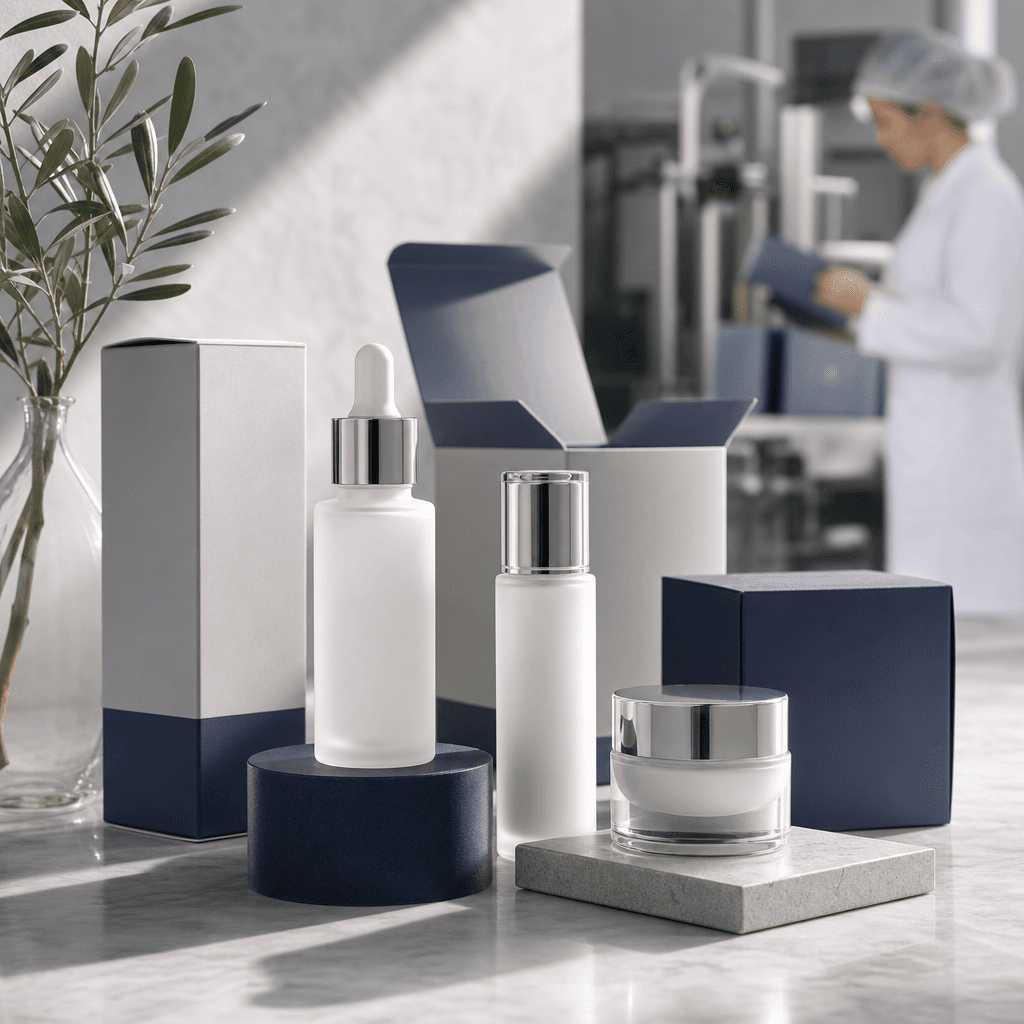
A cosmetic product's first contact with the consumer is often established through its packaging, even before the texture of the cream or the note of the perfume. The first glance on the shelf, the moment of opening the e-commerce box, the feeling when twisting the lid of a jar; all of them silently tell the brand's promise of quality. This is precisely where cosmetic packaging production becomes a discipline that must solve aesthetics and function simultaneously: the product will be protected, transported, presented correctly, and at the same time carry the brand story. Kosapack, headquartered in Istanbul Zeytinburnu, establishes this balance for cosmetic brands under one roof with premium and custom packaging solutions; it manages the process from start to finish, from consultancy to design, from prototype to mass production and consolidated shipping.
This article explains what components cosmetic packaging consists of, how aesthetics and function are designed together, by which criteria the right production partner is selected, and how a typical production process progresses with Kosapack. The focus is entirely on brands and professional production; not the production of primary containers such as bottles, jars or pumps, but the secondary packaging, labels and unboxing components that wrap around these products are addressed.
Table of Contents
- Aesthetics and Brand Experience in Cosmetic Packaging
- Functional Design: Protection, Ease of Use and Logistics
- Cosmetic Packaging Production Process with Kosapack
- Premium and Sustainable Materials: Kraft, Special Papers and More
- Cosmetic Packaging Scenarios for E-Commerce and Retail
- Criteria to Consider When Choosing the Right Packaging Partner
- Frequently Asked Questions
Aesthetics and Brand Experience in Cosmetic Packaging
The elements that make up packaging design in cosmetics are generally grouped into two main categories: graphic design and functional design. The graphic side determines how the product is perceived on the shelf and in hand; color, shape, typography and material selection are the cornerstones of this perception. The story told by presenting a skincare serum with a matte, calm surface is completely different from that of a glossy gilded perfume box. What creates this difference is carrying a visual language consistent with the brand identity onto the right components.
How the visual language will be established begins with the target audience. In packaging design, it is recommended to first clarify elements such as the age, preference and expectation of the target consumer, and then to select colors, fonts and graphics suitable for this profile. The same approach also involves placing the product's most valuable functions in a prominent position on the packaging surface; for example, blue-green tones can be used to strengthen the feeling of freshness, or raw material visuals can be used to emphasize naturalness. In cosmetics, packaging is a showcase that silently highlights the product's strongest selling argument.
Kosapack builds this aesthetic layer for cosmetic brands with multiple components. Rigid boxes for perfumes, skincare sets, makeup palettes and gift sets offer high print quality and premium perception; the tissue paper placed inside the box and thank-you cards transform the unboxing moment into a brand experience. The labels on the bottle, jar and tube bring together product information with brand aesthetics on the same surface. Getting the composition of the label right is a design discipline in itself; we have detailed the specifics on this topic for premium brands in the content titled label design rules for premium brands.

It is not enough for these components to be beautiful individually; the real point is that they all speak the same visual language consistently. When the box's color and the label's tone, the thank-you card's typography and the bag's print come together under the same brand roof, the consumer feels that they have bought not a product but an experience. Kosapack's ability to manage multiple components with the same color profile and print parameters is precisely to ensure this consistency.
Functional Design: Protection, Ease of Use and Logistics
No matter how strong the aesthetics are, if the packaging does not fulfill its function, the brand experience is damaged with the first broken bottle. Cosmetic packaging is expected to serve four purposes at the same time: protecting, transporting, presenting and marketing the product. Therefore, functional design is as critical a topic as graphic design and must be considered from the outset at the design table.
At the focus of the functional side is user experience. Ease of opening, dosage convenience and features that preserve the product's freshness determine the practical value the consumer feels with every contact with the product. When it comes to fragile glass bottles and jars, protection takes priority; the product inside the box must not shift and must be secured against impacts. Kosapack's in-box separator solutions are designed exactly for this: products sold as sets are positioned inside the box both safely and aesthetically, providing both logistical protection and shelf-front arrangement at the same time.
The logistical dimension is decisive especially for e-commerce and DTC brands. Corrugated boxes are suitable for protecting fragile products such as bottles and jars during the shipping process and are the carrier of regular shipment models such as subscription boxes. For smaller-volume and less fragile products, for example single masks, mailer envelopes offer a cost-effective alternative. On the retail side, printed paper bags function as a carrying solution that takes the brand identity beyond the store.
An overlooked aspect of functional design is that material and form decisions directly affect cost and shelf performance. For a cream or serum going on shelf-top sale, lightweight and print-friendly foldable cardboard boxes are the main secondary packaging form of cosmetics in mass production; they offer cost-effectiveness and print flexibility together. In contrast, a luxury gift set deserves a rigid box that creates a value perception with its weight and sturdiness. Choosing the right form means aligning the product's price positioning with the packaging's perception.
Cosmetic Packaging Production Process with Kosapack
Cosmetic packaging manufacturing, within the general industry framework, consists of the steps of design, material selection, production, inspection and quality control, and packaging and distribution. Kosapack combines these steps with its own end-to-end service model and presents the brand with a single responsible partner instead of fragmented suppliers. The process roughly progresses in five stages.
1. Strategy and consultancy. The brand shares its product range (skincare, makeup, perfume), sales channel (e-commerce, retail, spa) and target audience. Based on this information, Kosapack provides guidance for suitable packaging types, material and print options. This stage is the point where market and consumer analysis turns into packaging decisions; when the right questions are asked here, costly reversals in subsequent steps are prevented.
2. Structural and graphic design. Structural details such as box form, dimensions, opening-closing mechanism and internal placement are designed. At the same time, the color palette, typography, logo usage and label composition are conceived in harmony with the brand identity. The design is positioned to highlight the product's most attractive functions on the surface.
3. Prototype and color verification. Kosapack states that it can present a physical sample within 7-15 business days after the brief. This sample provides the opportunity to hand-test the harmony of the design with the product and brand identity. The color-accurate proofing process applied for color accuracy minimizes the difference between the sample and mass production, especially in situations where tone and texture consistency is critical in cosmetics.
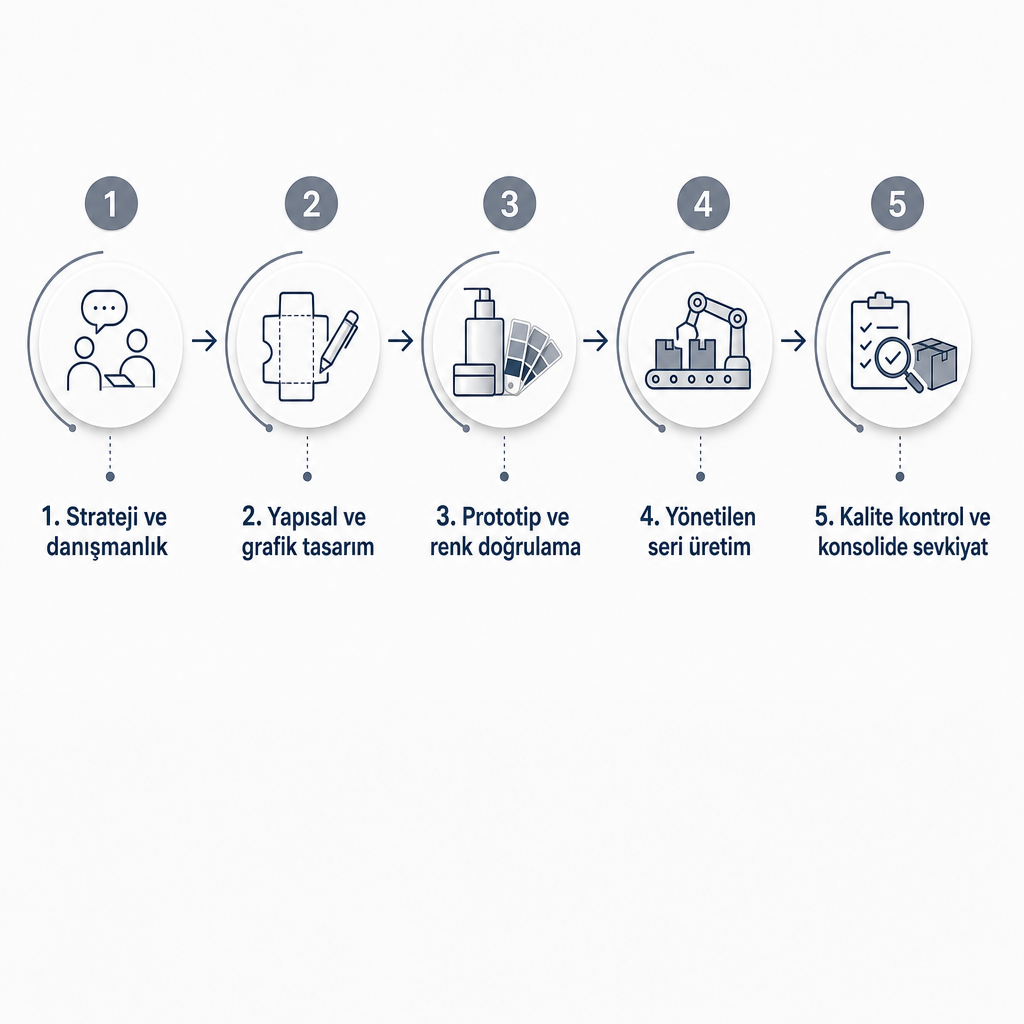
4. Managed mass production. While Kosapack carries out design and project management in-house, it manages production through verified factory partners. This model provides capacity scalability and supports the claim of offering different packaging types such as rigid boxes, cardboard boxes, bags and labels under one roof. When different components are produced with the same color profile and print parameters, the brand appearance remains consistent throughout the set.
5. Quality control and consolidated shipping. Post-production inspection is carried out based on print quality, color consistency and material craftsmanship; eliminating defective products is a fundamental step of quality control. Then multiple components such as box, label, tissue and card are consolidated in a single shipment and delivered to the brand. This consolidation is a concrete value proposition that reduces multi-supplier complexity.
Speed is one of the most visible advantages of this process. Kosapack works with the promise of a price quote within 24 hours and a physical sample within 7-15 business days; considering that the design, prototype and mass production cycle in custom-design packaging generally takes longer, this timeline creates a significant time gain for fast go-to-market in new product launches.
Premium and Sustainable Materials: Kraft, Special Papers and More
Material selection is a decision that determines both aesthetic perception and environmental impact at the same time. Among the fundamental elements of effective cosmetic packaging design, material is counted along with color, shape and typography; the texture and surface feel of the material directly affect the consumer's quality judgment of the product. Therefore, material is not a detail considered at the final stage of design, but a strategic decision made from the outset.
Sustainability is no longer a preference but an expectation in cosmetic packaging. The use of sustainable materials (recyclable, biodegradable or bio-based) and the minimization of packaging waste are shown among the important principles of skincare packaging design trends. It is also stated that biodegradable packaging is increasingly preferred by consumers compared to single-use and non-recyclable options. Kosapack's commitment to recyclable material use and carbon footprint reporting directly aligns with this expectation and offers a concrete basis in the purchasing decision for brands that want to build a sustainability story.
Kraft-based cardboard and recyclable paper bags are the practical building blocks of sustainable cosmetic packaging. The natural texture of kraft paper aligns especially with the visual language of skincare brands that emphasize naturalness and purity; it carries both the environmental message and aesthetic consistency on the same surface. For brands that want to deepen their knowledge about the properties and uses of this material, our content titled the properties and types of kraft paper is a comprehensive starting point.
Making the material decision correctly requires balancing many variables, from the product's price position to shelf life, from brand values to logistical realities. Brands that want to evaluate which material is suitable for which product can find the decision criteria together in our guide choosing the right packaging materials for your brand. Kosapack evaluates these variables together according to the product range during the consultancy stage and recommends the material combination that fits both the brand's aesthetic and sustainability goals.
Cosmetic Packaging Scenarios for E-Commerce and Retail
The packaging needs of cosmetic brands diverge sharply according to the sales channel. The way the same serum is shipped in e-commerce and the way it is presented on the store shelf require completely different components. Therefore, the packaging decision should be considered not through the product but through the channel.
DTC and e-commerce unboxing sets. For cosmetic brands selling directly to consumers, the moment of opening the box is a brand touchpoint as important as the store window. A typical set consists of a shipping box that protects the fragile product, the tissue paper wrapping the product inside, the label on the jar or tube, and a thank-you card added to the box. The thank-you card is a small but effective touch that increases customer loyalty by carrying a brand message, usage instructions or a campaign code. All these components coming from a single partner with a consistent visual language transform the unboxing moment into a cohesive rather than scattered experience.
Subscription and recurring shipments. Regular subscription boxes require a packaging system that is both durable and repeatable. In this scenario, corrugated boxes provide transport safety, while in-box separators ensure that changing product sets are arranged neatly in every shipment. For smaller and less fragile contents, mailer envelopes reduce costs.
Retail shelf and store experience. For products going on the store shelf, foldable cardboard boxes stand out with both print flexibility and cost-effectiveness; they clearly convey the brand identity on the shelf. In in-store shopping, printed paper bags go beyond being a carrying solution and turn into a promotional tool that carries the brand around the streets. In luxury skincare or perfume sets, reusable fabric bags strengthen the sustainability narrative with both premium perception and a reuse message.
Gift and corporate sets. For products sold as sets, the real challenge is to place multiple pieces inside the box both safely and impressively. A gift set in which a rigid box, in-box separator and tissue paper are conceived together elevates the value perception the moment it is opened. In corporate gifting and promotional purchases, the same components turn into a cohesive presentation that carries the brand's message.
The common point of these scenarios is that the design is made not for a single product but for a system. Kosapack's ability to manage rigid boxes, cardboard boxes, bags, labels, tissue paper and cards under one roof makes it possible to build these channel-specific systems consistently and in a single shipment.
Criteria to Consider When Choosing the Right Packaging Partner
In cosmetic packaging production, choosing a partner covers a decision far broader than the price of a single box. The criteria below make it easier for you to evaluate together the topics that stand out in independent industry guides and the corresponding offerings Kosapack provides.
| Decision criterion | Why it matters | Kosapack equivalent |
|---|---|---|
| Brand identity alignment | Consistent carrying of color, typography and logo | Graphic design service and color accuracy process |
| Functionality and protection | Product safety, ease of use, shipping durability | Structural design and in-box separator solutions |
| Sustainable material | Consumer expectation and environmental impact | Recyclable material, carbon footprint reporting |
| Quality control | Consistency between sample and mass production | Strict quality control and color-accurate proofing |
| Speed and launch alignment | On-time go-to-market | 24-hour quote, sample in 7-15 business days |
| Component integrity | Reducing supply complexity | Box, bag, label, tissue, card under one roof |
Most of these criteria feed each other. For example, without quality control and color accuracy together, the brand identity established at the design table may deteriorate in mass production. Likewise, component integrity is not just a logistical convenience; it also eliminates the risk of the box, label and bag coming from different suppliers scattering the brand appearance with tone differences.
Clarifying the brand's own priority when making a decision makes the job easier. While sample and quote speed stand out for a brand that needs to launch a new product quickly, print quality and structural detail are decisive for a brand preparing a luxury gift series. Kosapack's consultancy stage is built precisely on defining this priority together and structuring the process accordingly.
On the legal side, it is worth being careful: cosmetic product packaging must comply with the relevant legislation, product safety and labeling obligations. Since specific requirements such as mandatory label elements and symbols vary by product, category and market, it is recommended that these matters be verified specifically for the project.
Frequently Asked Questions
How long does it take to prepare a sample for cosmetic packaging?
Kosapack states that it can present a physical sample within 7-15 business days after receiving the brief. In addition, a price quote can be provided within 24 hours. This timeline provides an advantage especially for brands that want to see and approve the design by hand and go to market quickly in new product launches.
How is color consistency maintained between the sample and mass production?
Kosapack applies the color-accurate proofing process for color accuracy. Since tone and texture consistency is critical especially in cosmetics, this process aims to minimize the difference between the sample and mass production. When different packaging components are also managed with the same color profile and print parameters, the brand appearance remains consistent throughout the set.
What options are there for sustainable cosmetic packaging?
Recyclable cardboard, kraft-based materials and recyclable paper bags stand out among the sustainable options. Kosapack works with a commitment to recyclable material use and carbon footprint reporting; this offers a positioning aligned with consumers' increasing environmental expectations.
Can all packaging components of a single brand be obtained from the same place?
Yes. Kosapack offers rigid boxes, foldable cardboard boxes, corrugated boxes, paper bags, labels, tissue paper, thank-you cards, mailer envelopes, fabric bags and in-box separators under one roof. The components are consolidated in a single shipment and delivered to the brand; this reduces multi-supplier complexity.
Does Kosapack produce primary packaging (bottles, jars, tubes)?
Kosapack's portfolio is built on secondary packaging, labels and unboxing components. Primary containers such as bottles, jars, pumps or tubes are outside this portfolio; however, the labels on these products and the box and carrying solutions that wrap around them can be designed and produced by Kosapack.
How should we, as a brand, get started with cosmetic packaging design?
The process begins with a brief that includes information about the product range, target audience and sales channel. Based on this information, Kosapack provides guidance for packaging types, material and print options, then moves on to the structural and graphic design stage. The fastest start is to send your product details to Kosapack to initiate the quote and sample process.