
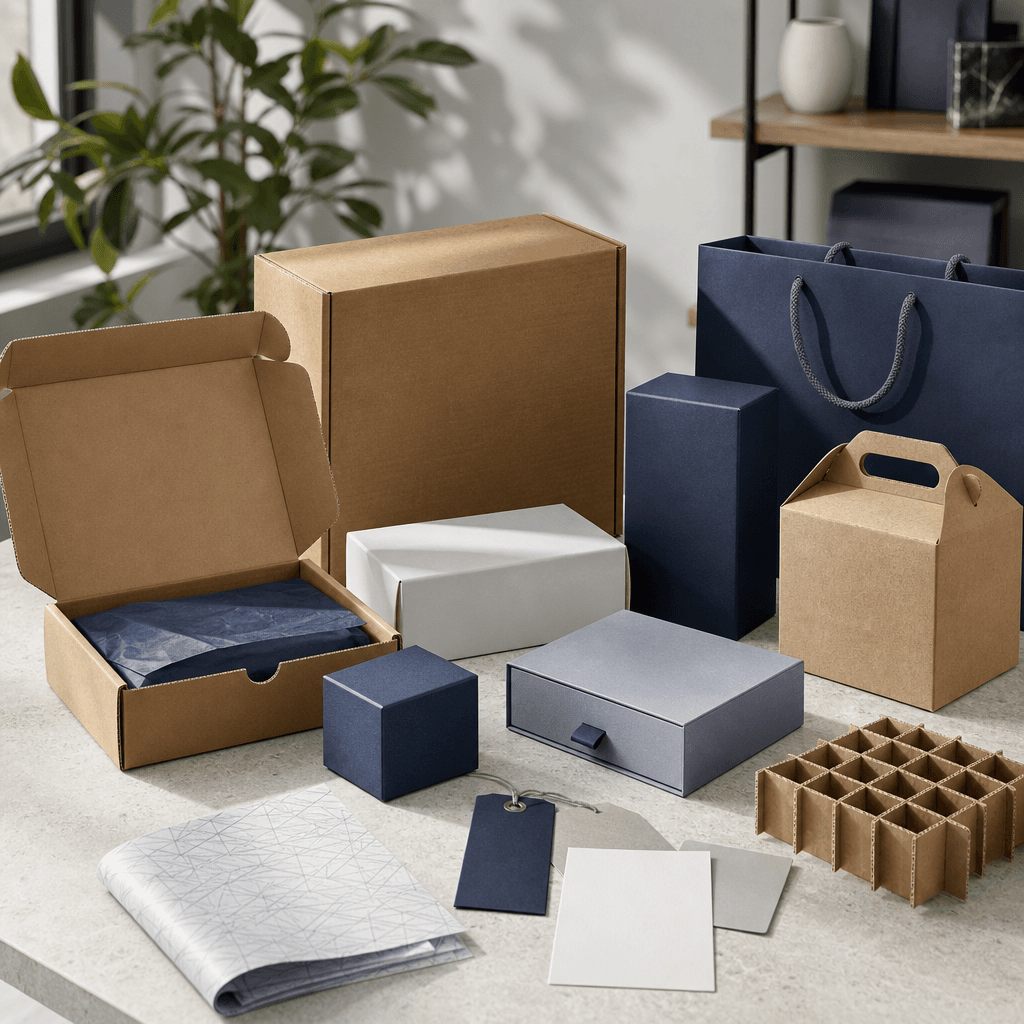
A cardboard box is a structural packaging solution made from cardboard or corrugated board that protects your product while simultaneously carrying your brand. Choosing the right cardboard box for your brand requires more than looking at a single dimension; you need to evaluate material type, box structure, print quality, and your sustainability goals together with your product's physical properties. For a premium brand, a cardboard box is not a cheap carton; it is a design decision that shapes the customer's first contact with the product.
We prepared this guide so you can see box types, the differences between them, and the criteria to consider during selection all in one place. Since at Kosapack we produce folding carton, corrugated shipping box, and rigid box solutions under one roof, we explain the distinctions below not from theory, but from daily production practice.
Table of Contents
- What is a cardboard box and how does it work?
- Cardboard box types and the differences between them
- Why is a cardboard box important for your brand?
- What to consider when choosing the right box
- Your next decision
- Frequently Asked Questions
What is a cardboard box and how does it work?
A cardboard box is produced from a cellulose-based material, meaning cardboard obtained by pressing paper fibers, or from corrugated board formed by combining multiple paper layers with a fluted layer. Single-layer cardboard provides high print quality and sharp folding lines, while corrugated board gains resistance to impact and pressure thanks to the wavy structure in between. These two basic structures determine what the box will protect, where, and how.
The function of a cardboard box works across three layers. The first is protection: the box is a physical shell that separates the product from moisture, impact, and stacking pressure. The second is transport efficiency: a properly dimensioned box reduces internal space, preventing the product from shifting and avoiding unnecessary volume. The third is communication: the surface of the box becomes a stage that tells the brand's story through print, color, and tactile finishes.
When we bring a cardboard box to life, we first analyze the product's physical requirements and its channel, then establish the box geometry through structural design. Graphic design and color management are built on this framework; during the prototype stage, we produce a physical sample, and before production, we check color accuracy and dimensional tolerances. What determines a box's performance is considering substrate, grammage, finish, and ink choices together rather than separately. This holistic approach, as we detail in our custom box production guide, enables the box to take on both protection and branding duties at the same time.
Material durability is also verified through testing, not estimation. Depending on the box type, checks such as a drop test from 1 meter, stacking test, folding test, or 50-plus open-close cycles on magnetic lids show in advance what the box will do throughout its transport and shelf life. This is decisive especially for e-commerce shipments with long cargo journeys and for premium gift boxes that are opened and closed many times.
Cardboard box types and the differences between them
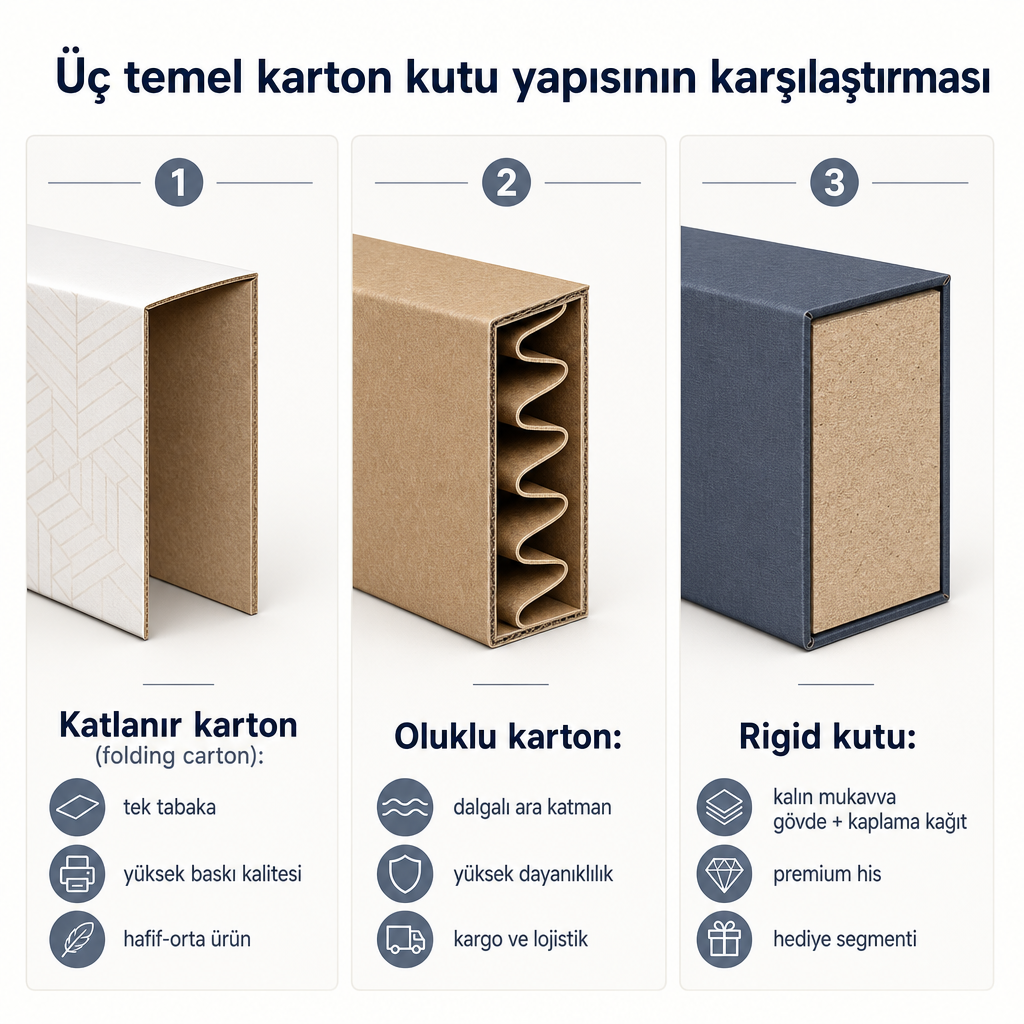
A cardboard box is not a single category but a family separated by distinct differences. Distinguishing the three main solutions through their use scenarios and print-finish possibilities is the shortest path to the right choice.
Folding carton refers to boxes produced from single-layer cardboard that are shipped flat and folded at the moment of use. It is the most suitable structure for high print quality, thin sharp folding lines, and elegant surface finishes. The shells of cosmetic boxes, retail shelf packaging, and light-to-medium weight premium products such as chocolate and candles mostly belong to this class. Its power to stand out on the shelf and provide a good feel in hand is high; however, on its own it is not structured to bear heavy transport loads.
Corrugated cardboard box is the solution where durability is central, thanks to the wavy (flute) layer in between. It is the backbone of e-commerce and logistics shipments. The flute type and wave combination determine the box's resistance to external pressure and impact during transport. Since printing can be applied to both the inner and outer surfaces, the corrugated box today is not just a protective container; it is a brand touchpoint that reaches all the way to the door. As we explain in our e-commerce shipping box custom print approach, inner printing and unboxing design turn this type into an extension of the brand.
Rigid boxes are the premium class where a thick cardboard or chipboard body inside is wrapped with a specially printed cover paper on the outside. It does not fold, is fixed in form, and gives a distinct sense of weight and sturdiness in hand. It is frequently preferred for jewelry, high-segment cosmetics, corporate gifts, and luxury chocolate boxes. Aesthetics and protection come to the forefront together; structures such as magnetic lids, drawers, or book forms are common in this segment. In our custom box production guide, we address in more detail how these bodies come to life.
What separates these three classes is not only appearance; the load they carry, production logic, and print behavior are different. For the same brand, three different solutions can be designed together across three separate contexts: folding carton on the shelf, corrugated box in shipping, rigid box for a special occasion gift. While the product stays the same, the box's role changes according to context.
| Structure | Standout strength | Typical use | Print and finish |
|---|---|---|---|
| Folding carton | High print quality, elegant surface | Shelf packaging, cosmetics, gift shell | Wide finish range, sharp detail |
| Corrugated cardboard | Durability for transport | E-commerce, cargo, logistics | Inner and outer surface printing |
| Rigid box | Sturdiness and premium feel | Jewelry, luxury gift, upper segment | Custom print on cover paper |
Why is a cardboard box important for your brand?
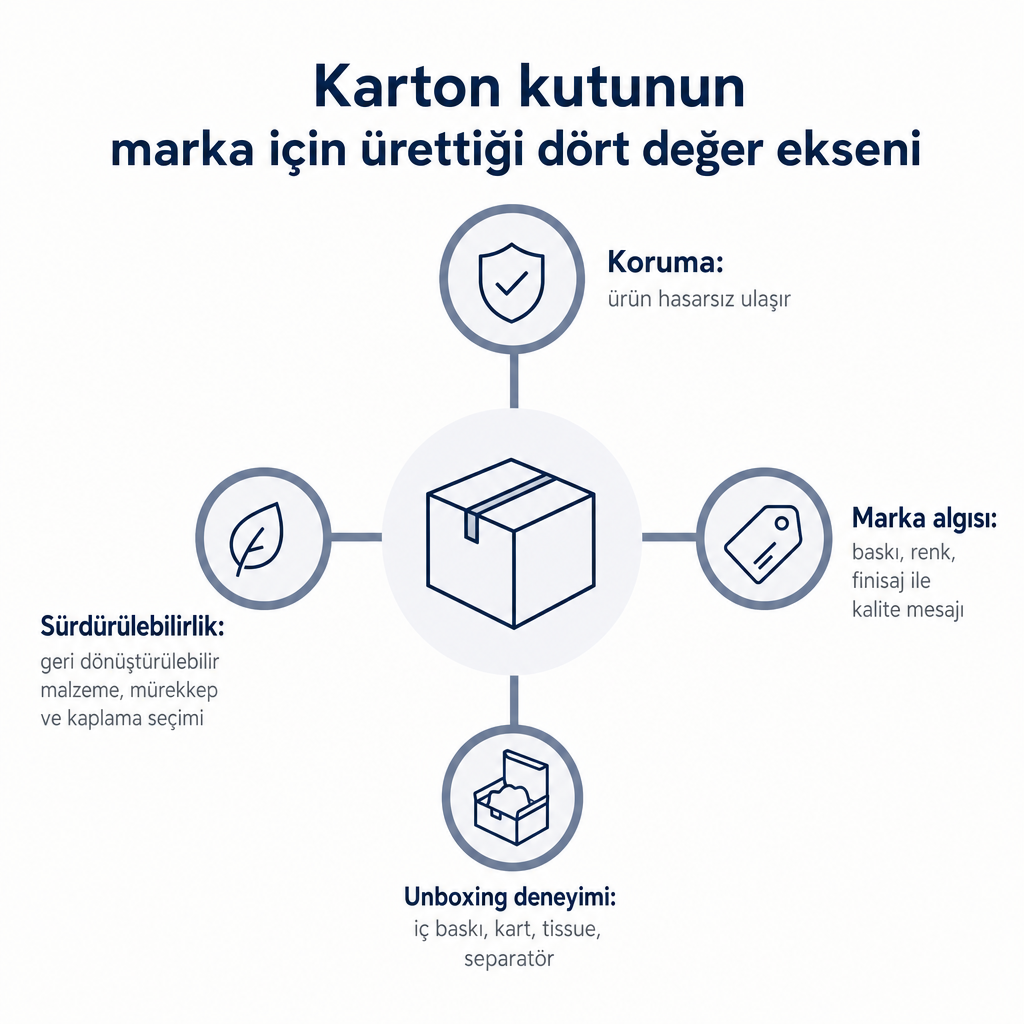
For premium and growth-stage brands, a cardboard box is not a cost item but a value-generating touchpoint. This value emerges across several axes at once.
The protection dimension is the most invisible yet most fundamental. A product that reaches the shelf or the customer's door damaged weakens everything the brand communicates in a single stroke. The right structure and the right grammage ensure the product arrives in the condition it should; internal support, separators, and dividers complete this assurance for fragile products.
The brand perception dimension touches directly on the moment of purchase. Whether the color holds true in print, whether the surface is soft-touch or glossy, the placement of a spot varnish or metallic detail all convey a quality message before the product is even opened. In categories such as cosmetics and jewelry, this feel is talked about as much as the product itself.
The unboxing experience turns the cardboard box into a storytelling tool, especially for e-commerce and DTC brands. When inner printing, a thank-you card, tissue paper, and separator design come together, the moment of opening the box turns into a shareable scene. This scene is one of the most genuine moments the brand establishes with the customer without any additional advertising budget.
The sustainability dimension is also increasingly decisive. Cardboard and corrugated board are, thanks to their cellulose-based structures, largely recyclable material classes. Material choice, ink type, and coating decisions directly affect this profile. At Kosapack, our focus on recyclable materials and our carbon footprint reporting allow us to present these criteria to the brand transparently; thus sustainability becomes not a slogan, but a concrete choice reflected in the production decision.
What to consider when choosing the right box
When determining the cardboard box suitable for your brand, the decision becomes clear across several axes. These are not a sequential procedure but criteria to be weighed together; each affects the others.
Know your product. The first axis is the product's physical realities: width, length, height; weight; fragility. While a folding carton may suffice for a light cosmetic or piece of jewelry, heavy or delicate products may require a corrugated box with internal support. For fragile products such as glass, ceramics, and electronics, a separator, filler, or a second outer corrugated structure should often be considered alongside the box. We conduct this analysis at the first meeting by evaluating your product and usage conditions together.
Determine the channel and scenario. A box that will stand on a shelf and a box that will make a cargo journey do not have the same requirements. In a retail box, visual appeal and shelf presence come first; in an e-commerce box, transport durability and unboxing communication are decisive; in a corporate gift, aesthetics and protection weigh heavily together. If there are multiple channels for the same product, one should look not at a single box, but at a box family that differentiates according to channel.
Reflect your brand positioning. The box's color, print quality, and tactile finish directly convey the brand's segment. Color accuracy, a physical sample, and design consultancy ensure these goals are verified before going into production; at this stage we close the gap between the color you see on screen and the box that arrives in your hand.
Clarify the material and technical choice. Substrate type (coated cardboard, natural kraft, corrugated), grammage, finish (matte, glossy, soft-touch, metallized), and ink type are parameters to be decided together. Locking these specifications in writing at the quotation stage prevents differences in expectation in the outcome. Leaving the cardboard class, gloss level, or finish undefined is the most common source of disappointment.
Define your sustainability goal. The recycled content ratio, the expectation of forest-source certification, ink preference, and the effect of lamination-metallization coatings on recycling are weighed here. If your environmental goal is clear, writing it into the box's material and finish decisions from the start is far more effective than revising it afterward.
In categories such as food, cosmetics, and pharmaceuticals, cardboard boxes may be subject to safety and contact regulations specific to the product group. This is a field that varies from category to category; there is no general rule of "this document is mandatory for every box." If your product requires an inner surface with direct food contact, we need to clarify together the applicable legislation and certification scope according to your category.
These criteria are not a step-by-step application list; the answer to each reshapes the others. If you want to learn how to run the concrete order and design process, our guide on how to have custom packaging made for your brand explains these steps in detail.
Your next decision
The cardboard box suitable for your brand is not a single "right answer"; it is a design decision that emerges where your product, channel, positioning, and sustainability goal intersect. The fastest way to clarify this intersection is to put your product and usage scenario on the table together. When you share your product dimensions, target channel, and brand expectations with us, we can recommend the box type and material direction suitable for you and verify it with a physical sample. This way, you can hold and see your box before putting it into production.
Frequently Asked Questions
What is the basic difference between a cardboard box and a corrugated shipping box?
A cardboard box is a general upper category; a corrugated shipping box is a sub-type of it. Folding carton is produced from a single layer and, with its high print quality, is mostly used in shelf and gift packaging. In a corrugated shipping box, a wavy flute layer is added between two paper layers; since this structure increases resistance to transport, it is preferred in e-commerce and logistics shipments.
Which cardboard box types are used more for premium cosmetic brands?
Two structures stand out in premium cosmetics. Folding carton is used for product shells requiring high print quality and elegant finish, while rigid boxes that provide sturdiness and a tactile feel are frequently used for upper-segment and gift products. The right choice is determined according to the product's weight, segment, and the targeted unboxing experience.
How can I ensure my cardboard box is both sustainable and has high print quality?
These two goals do not exclude each other; the decision comes from designing the material and ink choices together. While preferences such as recyclable cardboard medium and water-based or soy-based ink strengthen the sustainability profile, substrate, grammage, and finish decisions preserve print quality. We define this balance together according to your product and make it transparent with carbon footprint reporting.
Which durability checks are important when choosing a cardboard box for e-commerce shipments?
The box is expected to protect the product throughout the cargo journey, so durability should be verified by testing rather than estimation. Depending on the box type, we apply checks such as a drop test from 1 meter, stacking test, and folding test. These checks show in advance, before production, how the chosen flute structure and grammage will behave under real transport conditions.
How can I integrate my brand identity into the cardboard box design?
Brand identity is reflected on the box not just by printing a logo; it is achieved by establishing coherence with color management, surface finish, inner printing, and complementary elements. During the graphic and structural design stage, we carry your brand colors, tone, and unboxing goal onto every surface of the box; elements such as tissue paper, thank-you card, and separator complete this coherence.
Why are the prototype and physical sample so important in the final decision?
There can always be a difference between the color and design seen on screen and the box that arrives in your hand. A physical sample lets you see, before going into production, that the color holds true in print, that the dimensions fit the product, and that the finish gives the feel you expect. This verification reduces surprises and costly revisions in mass production.