
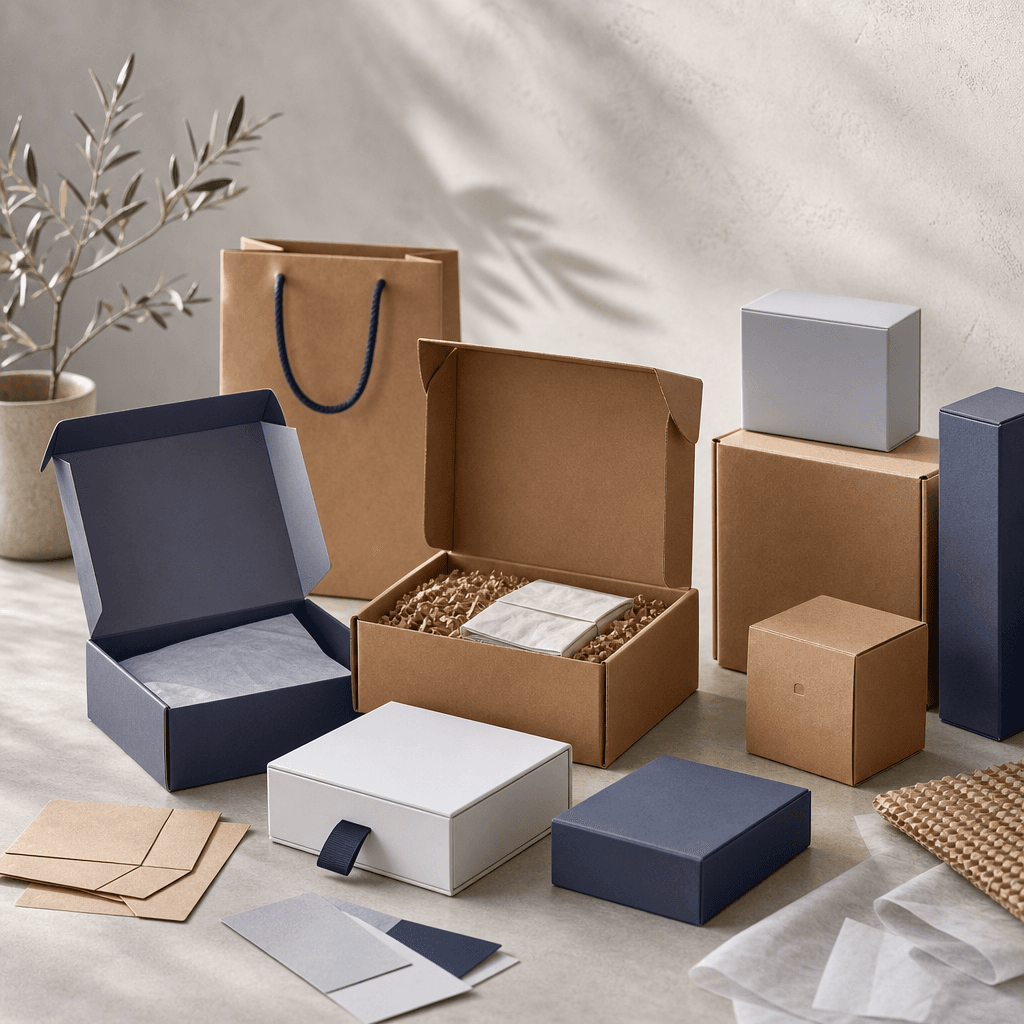
Choosing the right cardboard box does more than just protect your product; it also determines shelf impact, brand perception, and the moment the customer opens the box. To make a sound decision, the product's physical characteristics, your sales channel, and your brand's positioning must all be considered together. In this guide, we explain how we at Kosapack, as a brand, evaluate these three axes together and what you should pay attention to.
Although a cardboard box may appear at first glance to be a single product, it is actually an umbrella concept encompassing different structures, materials, and intended uses. The box a cosmetics brand sees on the shelf and the box in which an e-commerce order arrives at the door often belong to different classes. That's why the answer to the question "which cardboard box is right for my brand?" begins with first clarifying which category we're talking about.
Contents
- What a cardboard box is and how it works for your brand
- Cardboard box types and which one stands out in which scenario
- Why it matters: the hidden cost of the wrong box choice
- What to look for when choosing the right cardboard box
- Your next step: clarifying the brief together
- Frequently Asked Questions
What a cardboard box is and how it works for your brand
A cardboard box is a packaging body made from fibrous cellulosic material, defined by measurable parameters such as density, thickness, moisture resistance, and compression strength. Beyond physically wrapping your product, it performs three jobs at once: protection, brand communication, and logistical fit. Which corner of this triangle carries the most weight largely determines what the right box will be for you.
On the protection side, the box's job is to keep the product undamaged while it is stacked in the warehouse, transported, and until it reaches the customer's hands. On the brand communication side, the box is your brand's first physical representative on a shelf or in an unboxing video; color accuracy, surface feel, and print quality directly affect perceived value here. On the logistics side, the box's dimensions, weight, and structure quietly determine many items, from shipping cost to storage efficiency.
The balance of these three jobs varies by product and channel. While brand communication and print quality come to the fore for a cosmetics product that goes on a retail shelf, protection and durability take priority for an e-commerce order that ships out on its own. As a brand, we solve this balance based on your product sample and brand goals, working out the box structure and dimensions during the design phase; that way you don't have to calculate the technical parameters one by one.
The type of paper is also an inseparable part of this work. In folding cartons, the typical weight range is 250–400 gsm. According to Packaging School's technical reference, while 300 gsm is considered the main benchmark for most FMCG and cosmetics boxes, 350 gsm is a common reference for premium and retail shelf boxes. These values are adjusted up or down depending on the product's weight and its presence on the shelf.
Cardboard box types and which one stands out in which scenario
Under the cardboard box umbrella, three main categories stand out in practice: the folding carton, the rigid box, and the corrugated e-commerce box. These three differ markedly in terms of material, feel, durability, and print quality, and each fits a different need. As a brand, at Kosapack we manage all three of these categories under one roof; in other words, a brand's product box, shipping box, and gift box can be planned in the same project.
The folding carton is the standard for secondary packaging for lightweight products such as cosmetics, personal care, and shelf items. It is made from thin but print-friendly cardboard, can be stored flat, and is ideal for carrying the brand image on the shelf. The rigid box, on the other hand, is preferred for products with high perceived value such as jewelry, premium cosmetics, and chocolate; its thick body, weight, and surface feel create a luxurious impression. The corrugated e-commerce box absorbs impact and provides stacking strength thanks to its fluted structure in orders where the product must be protected on its own throughout the shipping journey.
The general tendency in choosing a material category proceeds in this direction: cardboard for lightweight retail products, corrugated structure for heavy products requiring durability, and rigid cardboard for luxury applications. On the substrate side, chromo/coated cardboard is considered for high print quality, SBS (Solid Bleached Sulfate) for durability and clean printing, and kraft and CCNB for a more raw look and budget balance.
| Box type | Typical use | Material / weight tendency | Print & finishing | Perceived brand position |
|---|---|---|---|---|
| Folding carton | Cosmetics, personal care, shelf products | Coated/chromo, SBS, 250–400 gsm | High print quality, matte/glossy, spot varnish | Retail and premium shelf |
| Rigid box | Jewelry, premium cosmetics, chocolate | Thick body, coated cardboard | Soft-touch, foil, embossing | Luxury / gift |
| Corrugated e-commerce box | Shipping, multiple products, heavy products | Corrugated (fluted) structure | Functional + inside print option | DTC / shipping-focused |
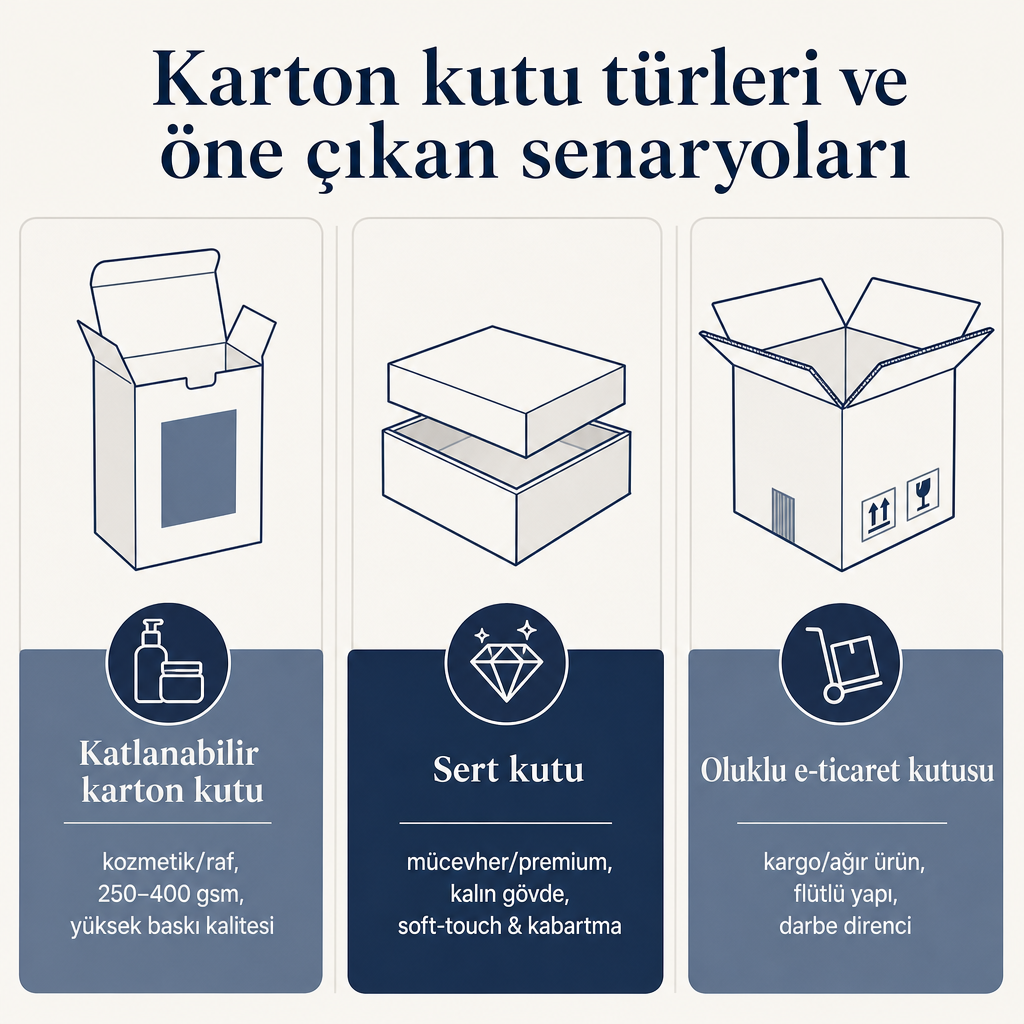
These distinctions are not sufficient on their own; more than one box type can come into play for the same product. For example, a cosmetics set may simultaneously require the folding carton on the product itself, the rigid box that holds the set together, and the corrugated shipping box that carries it all to the door. When it comes to the number of products to be placed inside, fragile components such as bottles/jars, and sensitive contents such as textiles or chocolate, the design of internal dividers and separators is also added to this picture.
Why it matters: the hidden cost of the wrong box choice
The price of the wrong cardboard box choice often emerges long after the first invoice line item. The packaging should be neither too large nor too small for the product; dimensions affect both protection and cost at the same time. While an overly large box creates the need for void fill and unnecessary volume, an inadequate structure causes the product to be damaged during transport.
This risk is even more pronounced in e-commerce, because the box is the product's only means of protection during shipping. A weak corrugated structure or a missing internal solution increases the damage rate and thus the return burden. Every returned product is not just a cost; it also leaves a negative mark on the customer experience.
In a shelf environment, however, the issue shifts to visibility. A folding carton with low print quality, colors that don't hold, or a surface that doesn't meet the brand's promise goes unnoticed on a full shelf. In the premium segment, this means a direct erosion of perceived value. Conversely, finishes such as soft-touch lamination, an embossed logo, or metallic details raise the product's perceived value when used in the right place.
The unboxing side is a separate area of gain, especially for DTC and social media-focused brands. Elements such as inside printing, a message card, and inserts in custom colors turn the moment of opening the box into a shareable experience. Finally, sustainability is becoming increasingly decisive: 100% recyclable cardboard, certified paper, and minimal plastic use are factors that influence consumer preference. As a brand, we offer the use of recyclable materials and, upon request, carbon footprint reporting in a way that aligns with this expectation.
What to look for when choosing the right cardboard box
The path to the right box is less about a procedure and more about asking the right questions. As a brand, the topics we discuss with you during the brief phase are exactly these. Asking yourself the following axes will both clarify your decision and speed up the design process.
- Product characteristics: What are the size, weight, and fragility of your product? Is it a single product or a multiple set? A fragile glass bottle and a foldable textile require very different box structures. While a folding carton is sufficient for lightweight cosmetics products, a rigid box or a combination of high weight plus internal separators comes to the fore for products containing heavy glass or multiple sets.
- Sales channel and logistics: Will the product be sold on a shelf, shipped by courier, or distributed as a corporate gift? In e-commerce, durability and shock-absorbing internal solutions take priority; on the retail shelf, print quality and brand perception are the priority.
- Brand language: Is your brand minimal, luxurious, or natural? The natural look of kraft cardboard suits organic and naturally sourced products, while coated cardboards allow for vivid and sharp prints.
- Sustainability goals: How binding are recyclable materials, certified paper, and low plastic use for you? This goal shapes both the substrate and the finishing choice.
- Print and finishing expectations: Matte, soft-touch, or glossy? Are details such as foil, embossing, or inside printing part of the unboxing experience? Not leaving values such as gloss level ambiguous ensures the output matches the expectation.
At this point, it's worth mentioning a common mistake: describing the cardboard type with a vague statement like "just make it premium." "Premium cardboard" is not a specification on its own. Speaking clearly about values such as weight, substrate type, and finishing is critical for consistency in both the sample and mass production. Likewise, material suitability and product coding/traceability should not be neglected in food and cosmetics products; if food contact is involved, choosing certified and suitable materials comes to the fore. Since exact regulatory requirements vary by product and market, we recommend evaluating this matter specifically for your product.
You don't have to calculate these criteria one by one yourself. We work out the box structure, dimensions, and, if needed, internal separator solutions during the structural design phase based on your product sample and brand goals; we also make the decision concrete with the ability to test and revise using a physical sample. You can also find the broad framework of the decision process and the decision points in the article explaining our approach to preparing brand-specific packaging in custom box production.
Your next step: clarifying the brief together
The right cardboard box decision becomes clear when you bring together your product, your sales channel, and your brand language in a brief. At this stage, the product dimensions you have on hand, weight information, the channel (shelf, shipping, or gift), and your brand's visual language are the most valuable inputs. Once you gather this information, we can recommend the box type, cardboard type, and finishing combination suited to your product.
If you're curious about the process end to end, you can review the framework from brief to delivery in our step-by-step guide explaining how brand-specific packaging is made. You'll find the shelf impact and design decisions specific to cosmetics brands in the article explaining our design solutions that create shelf impact in cosmetics packaging production. Planning the folding carton, rigid box, and corrugated e-commerce box through a single supplier is the most practical way to make a brand's entire packaging ecosystem consistent.
Frequently Asked Questions
Are a cardboard box and a corrugated box the same thing?
Every corrugated box is a cardboard box, but not every cardboard box is corrugated. A cardboard box is an umbrella concept that covers subcategories such as the folding carton, the rigid box, and the corrugated box. The corrugated box is distinguished by its fluted (wavy) structure placed between two flat layers and provides shock absorption and stacking strength for heavy products or those transported by courier.
Which cardboard weight is suitable for my cosmetics product?
In folding cartons, the typical range is 250–400 gsm. As a reference, 300 gsm is the main benchmark for most FMCG and cosmetics boxes, while 350 gsm is a common choice for premium and retail shelf boxes. The right value is determined by the product's weight, size, and its presence on the shelf; that's why working based on your product sample is the soundest approach.
Can I use the same box for e-commerce and shelf sales?
In most cases no, because the priorities of the two scenarios are different. While print quality and brand perception come to the fore on the shelf, durability and internal solutions become critical in e-commerce since the box is the only means of protection during shipping. The practical approach for many brands is to plan the folding carton that presents the product separately from the corrugated box that handles the shipping.
How does a sustainable cardboard box affect brand perception?
Recyclable cardboard, certified paper, and minimal plastic use are becoming increasingly decisive in consumer preference. The natural look of kraft cardboard creates an eco-friendly perception, especially for organic and naturally sourced products. As a brand, we offer the use of recyclable materials and, upon request, carbon footprint reporting in a way that meets this expectation.
What is the most common mistake when choosing a cardboard box?
The most common mistake is defining the box need with vague statements like "just make it premium." When values such as weight, substrate type, and gloss/finishing level are not clearly discussed, there is a risk of inconsistency between the sample and mass production. The right approach is to put product and channel information into a clear brief and to make the technical values concrete from the outset.
Can I order different box types together from a single supplier?
Yes. A brand's product box, e-commerce shipping box, and gift box can be planned in the same project. As Kosapack, we manage cardboard-based box types under one roof, including the folding carton, rigid box, and corrugated box; in addition, we can design unboxing components such as paper bags, labels, tissue paper, and thank-you cards in the same process.