
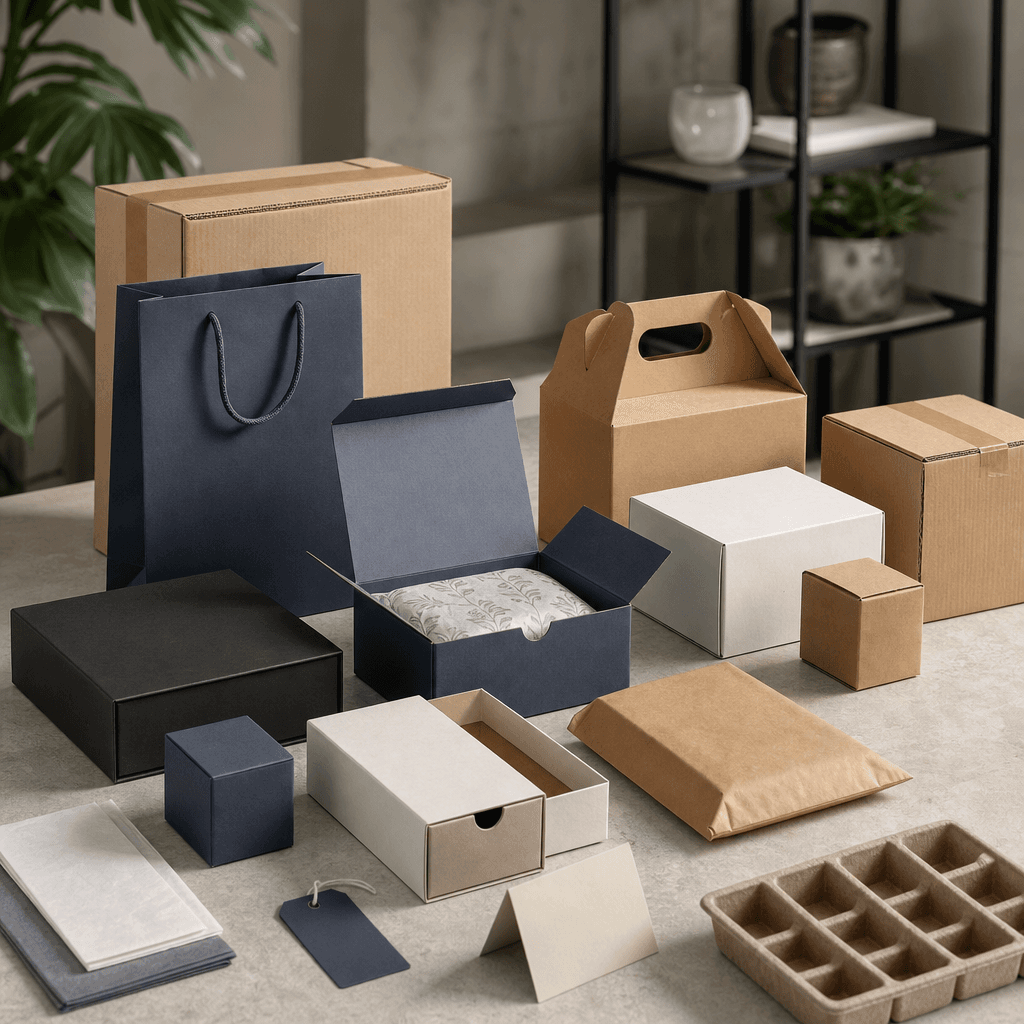
Cardboard box is an umbrella term that covers both shipping cartons made from corrugated board and shelf packaging produced from thin cardboard, as well as luxury gift boxes made from thick rigid cardboard. In other words, choosing the right cardboard box for your brand is not about a single product, but about matching one of three main structural families to your product, positioning, and logistics. As Kosapack, while working with more than 500 brands, we approach this choice as a question of balance that ranges from the weight of the product to shelf impact and the unboxing moment.
Contents
- What a cardboard box is and how it works
- Cardboard box types and the features that distinguish them
- Why the cardboard box type makes a difference for your brand
- Criteria to evaluate when choosing the right cardboard box
- Common misconceptions
- The next step for your brand
- Frequently Asked Questions
What a cardboard box is and how it works
In everyday language, when people say “cardboard box,” most think of a shipping carton, but the scope of the term is far broader. The cardboard box entry on Turkish Wikipedia notes that this expression covers both shipping containers made from corrugated fiberboard and retail packaging produced from thinner cardboard. The same entry also mentions small rigid cardboard packaging such as cigarette packs, and large corrugated boxes such as archive boxes, all under the same umbrella.
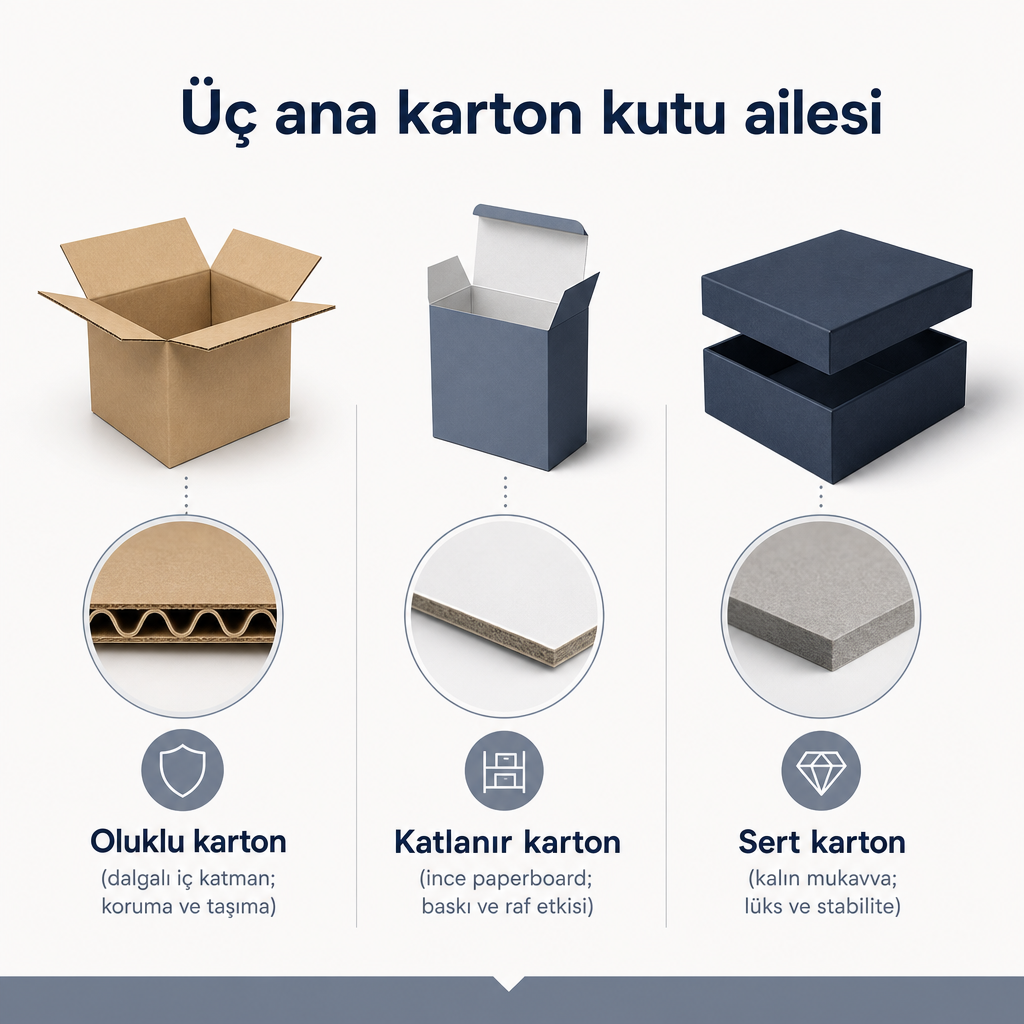
Mechanically, the job of a cardboard box seems simple: to create a surface, enclose the product, and build a barrier against external factors. What makes the difference is which material and construction is used to do this job. In a corrugated box, a wavy inner layer is pressed between two flat layers; this wave structure absorbs impact and gives the box a rigidity suitable for transport. In thin folding cardboard, however, the material is shipped flat, takes form by being folded around the product, and its primary duty is not protection but carrying the brand identity on the shelf with high print quality. In rigid cardboard, the thick paperboard body gives the box a weight and stability that can be felt when held in hand.
Being paper-based gives the cardboard box three practical advantages: while providing sufficient protection it stays lightweight and lowers the logistics burden, its surface is suitable for printing and finishing so it carries brand identity strongly, and it is compatible with widespread recycling infrastructures. These three features allow a box to be, at the same time, a protector, a communication tool, and a sustainability decision.
Cardboard box types and the features that distinguish them
In industry practice, cardboard boxes are divided into three main material families: corrugated board, folding carton (paperboard), and rigid cardboard. The corrugated cardboard boxes, folding cardboard boxes, and rigid boxes in our portfolio correspond exactly to these three families; in addition, branded mailers and gift boxes form a special category built with structural design on top of one of these structures.
| Box type | Structure and material | Main advantage | Typical use |
|---|---|---|---|
| Corrugated cardboard box | Wavy inner layer with flat outer layers | High impact absorption, protection during transport | E-commerce shipments, stock boxes, B2B shipping |
| Folding cardboard box | Thin paperboard, shipped flat, takes form by folding around the product | Very good print quality, economical production, tidy shelf appearance | Cosmetics, food and snacks, medicine boxes |
| Rigid cardboard box | Thick paperboard body, generally not folded | Luxury perception, structural stability, premium brand value | Jewelry, perfume and candles, corporate gift boxes |
| Custom mailer / gift box | Reinforced structural design over cardboard or corrugated board | Unboxing experience, inner layout and brand story | DTC brands, subscription boxes, PR kits |
The distinction between these four structures is not just thickness, but a difference of intent. The priority of a corrugated box is to complete the journey safely. The priority of a folding carton is to be chosen on the shelf. The priority of a rigid box is to make the product feel as valuable as a gift. Mailer boxes, meanwhile, combine most of these priorities: sturdy enough to withstand transport, and designed enough to carry the brand narrative when opened.
Why the cardboard box type makes a difference for your brand
Choosing a box seems like a technical detail, but for most brands this is the customer’s first physical contact with the product. In e-commerce and DTC brands, the box is not a means of transport but a stage that represents the brand the moment it is opened. That is why the wrong structure for the same product means either unnecessary cost or a weak first impression.
Looking at concrete examples makes the distinction clearer. While a rigid box or a well-designed corrugated box with an inner separator makes sense for a perfume set with a heavy glass bottle, a folding cardboard box is more than enough for a lightweight cream tube. While luxury and premium brands move toward rigid boxes with high-grammage cardboard, matte or soft-touch surfaces, and finishes such as hot foil stamping, a young, sustainability-focused DTC brand may prefer kraft-look cardboard and minimal printing. In products such as jewelry and candles, a rigid box supported by inner foam or separators turns the unboxing moment into a ritual; in subscription boxes, a corrugated mailer with brand printing and an inner protection solution builds an experience that repeats every month.
We build this matching not with a single box, but with an entire system. As much as the box itself, tissue paper, thank-you cards, labels, and inner dividers are also part of the experience; because we produce them all under one roof, these touchpoints of the brand come out consistent with one another. We discuss in more detail how this consistency translates into shelf impact in the cosmetics vertical in our cosmetics packaging production and shelf impact guide.
Criteria to evaluate when choosing the right cardboard box
The right structure is reached not by a single rule but by weighing several criteria together. The headings below are not a sequential procedure, but axes of thinking that frame the decision.
- Physical properties of the product: Weight, fragility, size, and whether the product is a single item or a set. Heavy or fragile products require a protection-focused structure and inner layout; lightweight products can make do with print-focused thin cardboard.
- Brand positioning: A premium perception is supported by rigid cardboard and high grammage, an accessible and natural perception by kraft-look sustainable material. The box material must confirm what the brand says.
- Experience and unboxing: Elements such as cover type, inner arrangement, cards, and tissue paper. Especially in e-commerce and DTC, since the box is the first point of contact, this layer should not be neglected.
- Logistics and operations: The space it occupies in the warehouse, whether it arrives flat-packed or pre-formed, ease of handling, and reuse potential. In corrugated boxes, the flute type and cardboard thickness are evaluated together with the transport distance.
- Sustainability: Recyclable material, the compatibility of the varnishes and foils used with recycling, and carbon footprint. Our use of recyclable materials and our carbon footprint reporting are a concrete value proposition under this heading.
In food, cosmetics, and pharmaceutical packaging, material safety requires separate attention; on topics such as ink migration and contact suitability, we recommend evaluating the selection of regulation-compliant materials together with your manufacturing partner. You also don’t have to be alone when deciding on the right structure: with our packaging consultancy, structural and graphic design, and prototype and physical sample processes, we clarify these criteria together on your product. You can read step by step how this approach turns into brand-specific packaging in our custom box production guide.
Common misconceptions
The three misconceptions we encounter most often about cardboard boxes often lead to unnecessary cost or the wrong first impression.
The first is regarding a cardboard box as nothing more than a carton. Yet the same concept covers shelf packaging and luxury gift boxes too; limiting a brand’s box needs to a “shipping box” means overlooking the most visible touchpoint.
The second is the belief that the thickest cardboard provides the best protection. Protection works not through thickness alone; it works together with box construction, inner separators, and additional protective elements. The right structural design can raise the level of protection while reducing unnecessary material use; the prototype and sample stage exists precisely to make this visible.
The third is the belief that sustainable cardboard compromises aesthetics. High print quality and premium surface finishes are entirely possible on recyclable cardboard. Sustainability and a premium brand goal are not a contradiction, but an opportunity solved with the right design.
The next step for your brand
The right cardboard box is determined at the point where your product’s weight and fragility, your brand positioning, the unboxing experience you aim for, and your logistics conditions intersect. The choice between corrugated, folding, and rigid structures naturally narrows once you weigh these variables together.
If you would like to deepen the types and decision criteria on your own product, you can take a look at our cardboard box guide explaining the ways to choose the box suited to your brand. When you are ready to make the decision concrete, we clarify the right structure for your product together through our process that offers a price quote within 24 hours and a physical sample within 7–15 business days.
Frequently Asked Questions
Does a cardboard box just mean a shipping carton?
No. A cardboard box is an umbrella term covering corrugated shipping cartons, shelf packaging made from thin cardboard, and luxury gift boxes produced from thick rigid cardboard.
What is the fundamental difference between a corrugated and a folding cardboard box?
In a corrugated box, the wavy inner layer absorbs impact during transport and protection is the priority. A folding carton, on the other hand, is produced from thin paperboard; its priority is print quality and a tidy appearance on the shelf.
Which cardboard box is more suitable for a premium product?
For heavy products or those aiming for a premium perception, a rigid cardboard box is generally preferred with high grammage and surface finishes such as soft-touch or foil. For lightweight products, folding cardboard is often sufficient.
Does a sustainable cardboard box compromise the premium look?
It doesn’t have to. High print quality and premium surface finishes can be applied on recyclable cardboard; sustainability and a premium goal can be built together with the right design.
Should I decide on the box type myself?
No need. We clarify the right structure by evaluating your product features, brand positioning, and logistics conditions together through our packaging consultancy, structural design, and physical sample processes.