
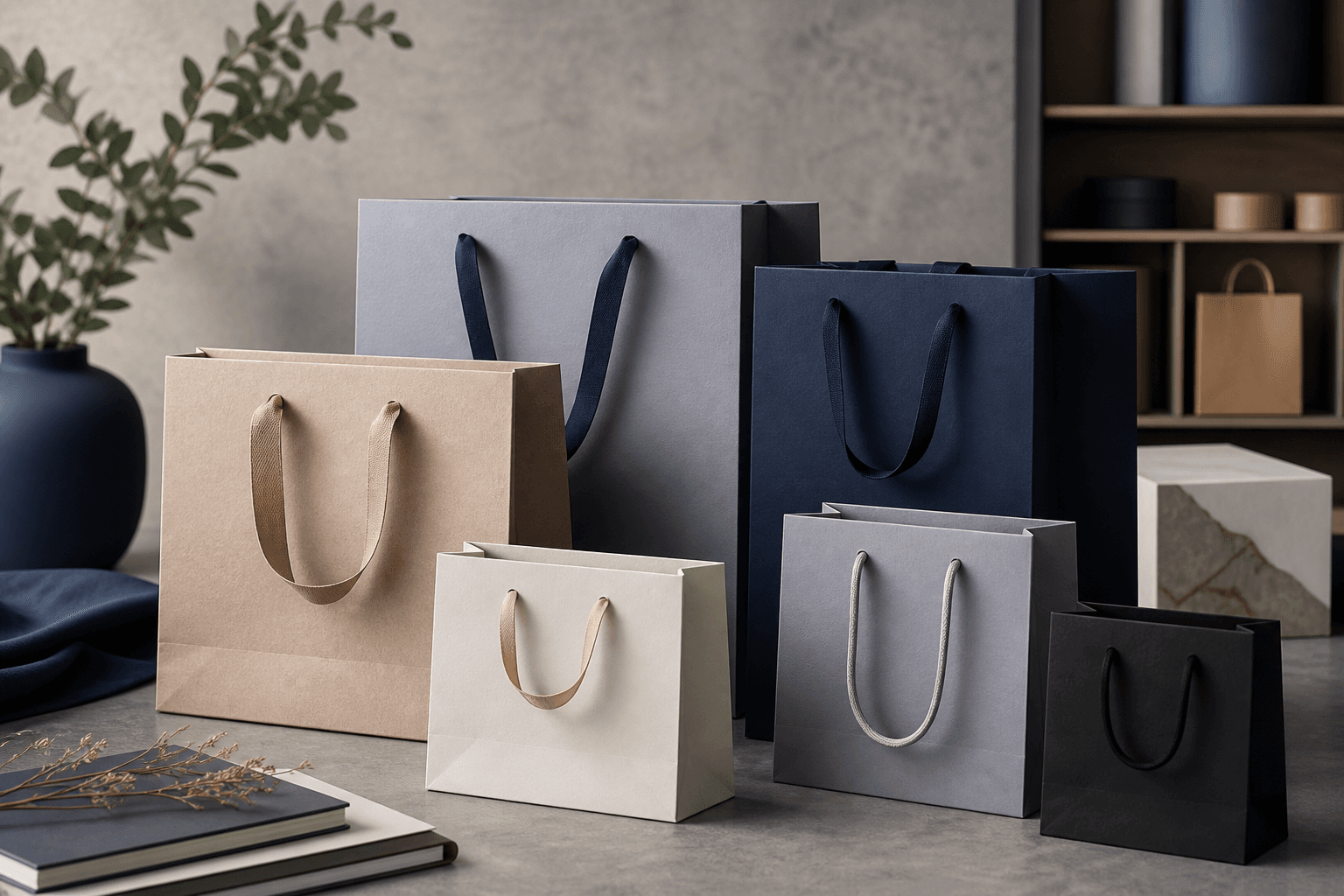
You have three different supplier quotes open on your desk. One says "200 gsm coated, twisted handle," another says "kraft, string handle," and the third has written "matte laminated, grosgrain handle." You don't know which one actually matters for your product weight, shelf impact, and unit cost target. A wrongly chosen cardboard bag makes you pay three concrete costs: it tears off at the handle at the checkout or during delivery, telling the customer that your brand is careless; it pushes your unit cost far above what you planned with unnecessarily high grammage or exaggerated finishing; it makes the premium product you put inside look cheap next to it. All three are expensive mistakes to reverse.
This article is a decision shortcut. By the end, you'll know exactly which cardboard bag type to spec, for which use scenario, with which grammage and handle combination, and at which price level. Material, handle, grammage, industry matching, printing, sustainability, and cost — each is a separate decision node. We'll close with a brief checklist you can fill out before requesting a quote.
Table of Contents
- Cardboard Bag Types: A Complete Comparison by Material and Structure
- Handle Types and Grammage: The Two Factors That Determine Your Bag's Carrying Strength
- Cardboard Bag Selection by Industry
- Branding and Printing: Turning the Cardboard Bag into an Advertising Tool
- Sustainability and Recycling
- Cost, Quantity, and Delivery Time
- A Brief Preparation Guide for Ordering Cardboard Bags
- Frequently Asked Questions
Cardboard Bag Types: A Complete Comparison by Material and Structure
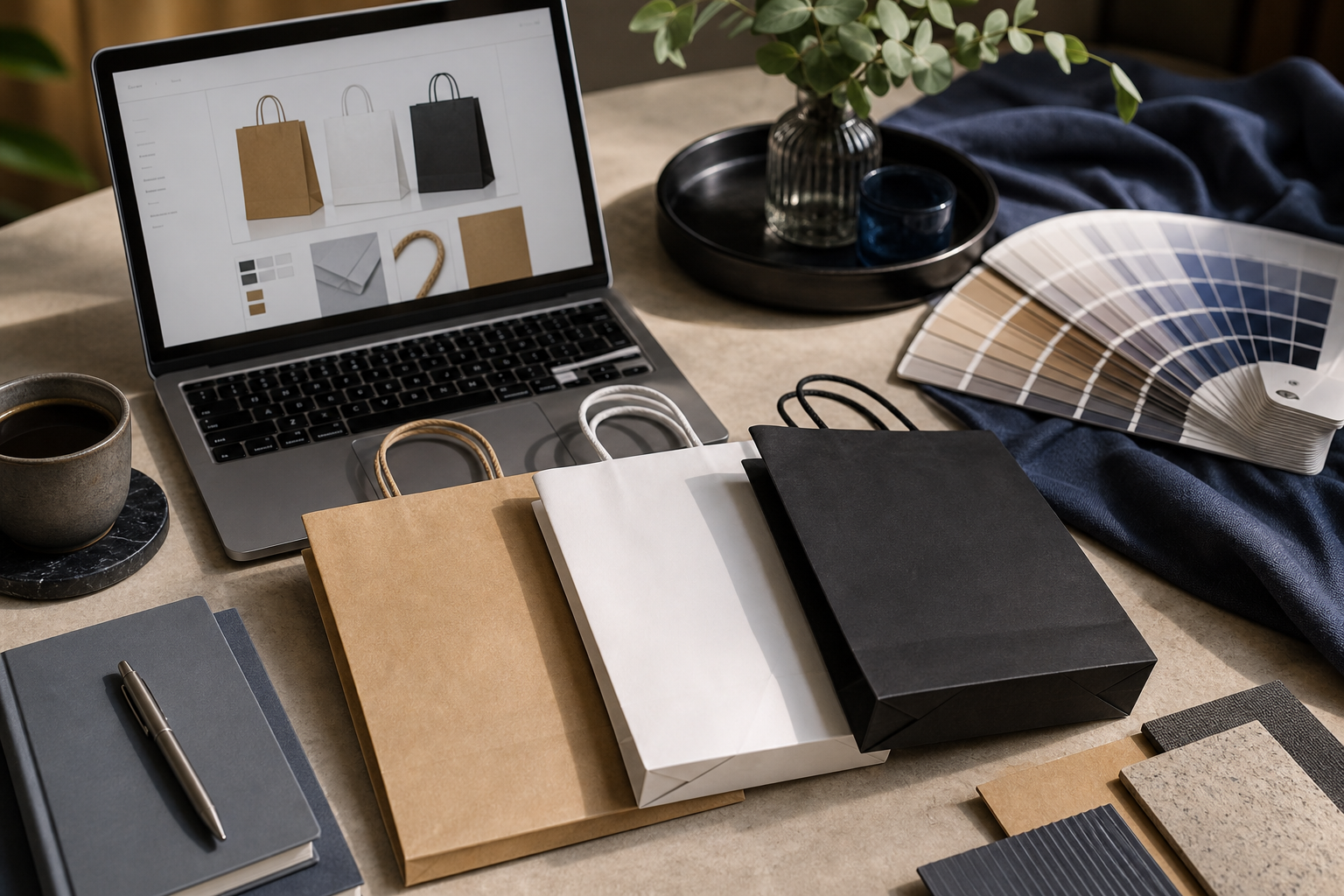
Cardboard bag varieties essentially diverge along a single axis: material. Manufacturers fundamentally divide cardboard bag types into three groups — coated cardboard bag, kraft cardboard bag, and luxury cardboard bags with various coatings (matte or glossy lamination). Structurally, there are two basic forms: gusseted (side-gusseted) models provide more volume, while handled models are open to different handle types. This classification is based on the product line logic of manufacturers like Jenerik Ambalaj / Bordo Ofset.
Each type has a clear position. Kraft cardboard bags are produced from 100% recycled kraft paper; Makromat Matbaa positions this as a "function-focused" economical solution that is both cheaper and has higher carrying performance than plastic bags. Coated or laminated cardboard bags offer glossier print quality and a luxury perception; the same source describes this as a "brand image-focused" solution. Bristol or high-grammage laminated bags are the choice of the premium segment — the type most open to exaggerated finishing such as foil, embossing, and spot varnish.
| Cardboard Bag Type | Typical Grammage Range | Carrying Capacity | Appearance / Premium Perception | Cost Level |
|---|---|---|---|---|
| Kraft cardboard bag | 170–200 g/m² | High (kraft fiber strength) | Natural / plain | Low |
| Coated cardboard bag | 200–250 g/m² | Medium-high | Glossy / corporate | Medium |
| Laminated luxury cardboard bag | 230–300 g/m² | High (reinforced base) | Very high / luxury | High |
| Gusseted model (in any material) | Depends on material | Volume advantage | Depends on material | +5–15% extra |
Recyclability also varies with material: kraft is 100% recyclable, coated offers high recyclability if there is no lamination, and this rate drops for laminated luxury bags because lamination makes fiber recovery difficult.
Keep one single balance in mind while reading the table: the durability ↔ cost ↔ aesthetics triangle. You cannot maximize all three corners of this triangle at the same time. Laminated luxury bags give you aesthetics and durability but raise the cost; kraft is strong in cost and durability but does not carry the "luxury" perception on its own. Coated sits in the middle. To understand which broad packaging category the bag falls into, the what is packaging and its types guide clarifies the general framework.
A common mistake is to automatically assume kraft is a "cheap look." It's not true. The kraft brown surface is an aesthetic language deliberately chosen for a natural and sustainable brand positioning — especially in verticals like food, boutique coffee, and organic cosmetics, kraft does not lower the premium perception, but rather supports it. When deciding, your question should not be "does kraft look cheap," but "is my brand's story natural or glossy." If you want to clarify this distinction, the properties and uses of kraft paper and the general packaging materials guide are two key references.
It's worth keeping the gusseted model separate. The side gusset gives the bag volume — it's preferred for boxed products, gift sets, and bulky textiles. This volume advantage can be applied in any material but typically adds roughly 5–15% to the unit cost. For lightweight products where a flat form is sufficient, spending money on a gusseted model is unnecessary.
Handle Types and Grammage: The Two Factors That Determine Your Bag's Carrying Strength
Whether a cardboard bag stays in your hand or tears off as it leaves the door depends on two things: handle type and grammage. Both must be solved separately.
Handle Types
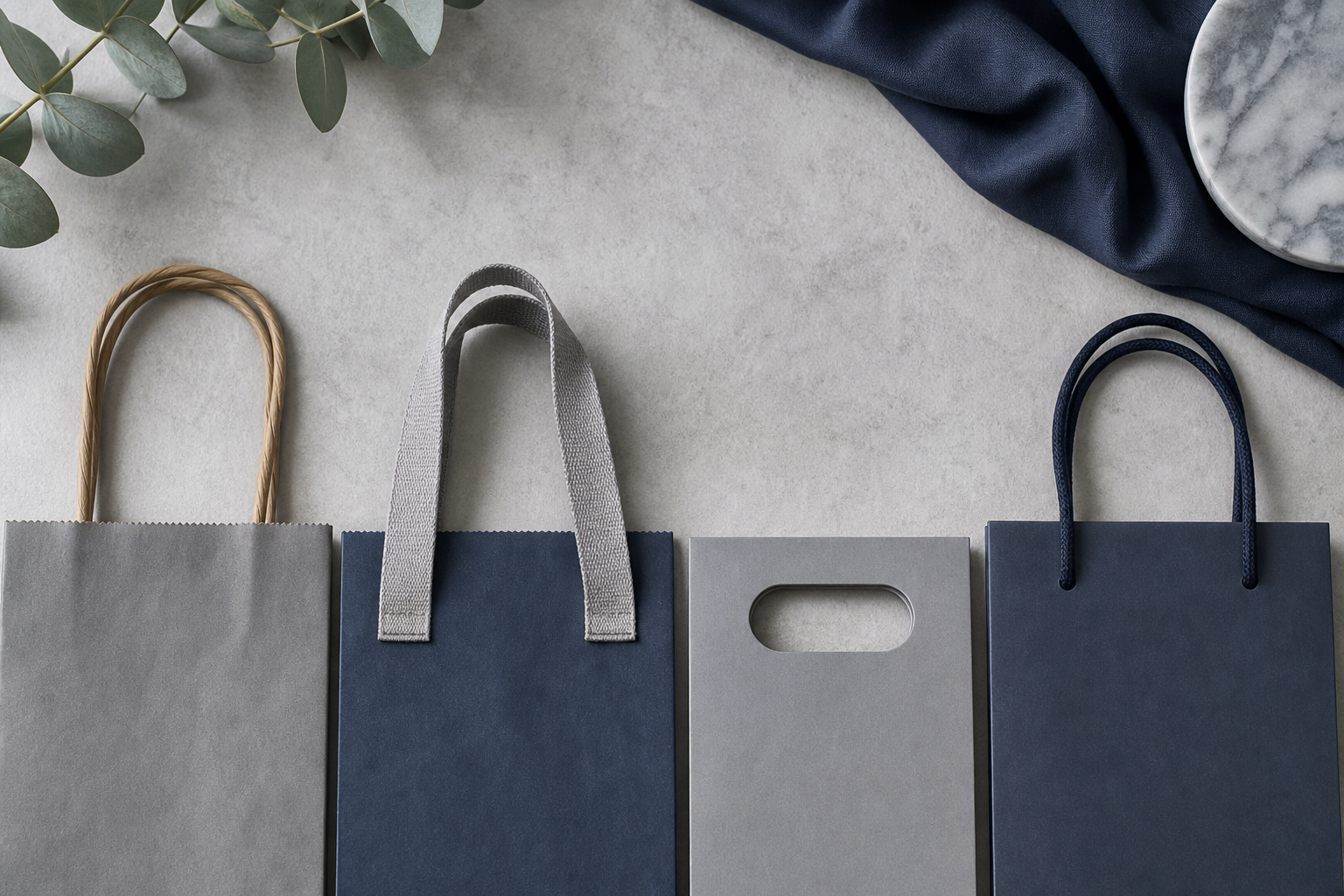
Twisted Paper Handle. On medium-grammage kraft or coated bags, it's an economical yet strong solution for daily retail shopping in the 2–4 kg band. It's common, quickly produced, and meets most standard retail scenarios. The default choice for high-volume jobs sensitive to unit cost.
Flat / Ribbon Handle (cotton, satin, grosgrain). The handle family that creates a premium perception. Marin Ambalaj emphasizes that bags with grosgrain handles produced from thick and stiff cardboard safely carry heavy products and do not deform easily — the stiff cardboard + grosgrain handle combination stands out especially in the premium segment. A woven handle adds both carrying safety and a hand-felt quality to the bag.
Die-cut Handle. A handle cut from the body of the bag. It's low-cost and suitable for lightweight products on thin-grammage bags. It's functional in scenarios like in-box carrying in e-commerce or event distribution; it does not carry heavy products.
String / PP Handle (self-clip). An economical premium intermediate solution. Miligram Paper states that woven, grosgrain, satin, or leather handle models create a more premium perception, while PP-handle, self-clip models offer a more economical solution. In other words, within the same "string" look, the material choice completely changes the perception.
The basic rule Gamgam Ambalaj emphasizes is this: the handle type and shape should be determined according to the bag's carrying capacity. The handle is not a decoration; it's a fundamental parameter of carrying safety.
The handle is not an accessory of the bag; it's an engineering decision that carries the product weight.
Grammage Logic
170–190 g/m². A range frequently used for products up to 1–2 kg such as lightweight textiles, cosmetics, and small accessories. Going above this band is a waste of money for lightweight products.
200 g/m² (reinforced base). Karton Çanta Bursa states that bags produced from 200 g/m² cardboard with a reinforced base have a carrying capacity of approximately 4–5 kg. A typical point for small and medium-volume retail products.
230–300 g/m². A high-strength range for heavy and bulky products such as luxury cosmetics, jewelry, glass bottles, and book sets. In this band, don't leave the grammage alone — spec it together with a laminated surface + twisted or woven handle combination. High grammage alone, combined with a weak handle, will still tear.
Practical rule: first measure the product's weight and the sharpness of its corners, then choose the grammage, and lastly match the handle to that grammage. The reverse order — choosing the handle first "so it looks stylish" — risks carrying safety.
Cardboard Bag Selection by Industry: Which Brand Should Use Which Bag?
For brands, cardboard bag selection is not an abstract preference; it's a concrete spec decision that changes according to your vertical's priority. Manufacturers' industry recommendations rest on a certain logic: sources like Soil Label, Bursa Ofset, and Bordo Ofset recommend coated + laminated + string/woven handle for cosmetics and fashion; kraft or laminated kraft for food and confectionery; and high-grammage coated + special finishing for corporate gifts.
| Industry | Recommended Material | Recommended Handle Type | Recommended Grammage | Key Criterion |
|---|---|---|---|---|
| Cosmetics | Coated + laminated | String / woven | 230–300 g/m² | Luxury feel + shelf impact |
| Fashion / Textile | Coated / laminated kraft | Twisted / ribbon | 200–250 g/m² | Brand image + carrying |
| Jewelry | Laminated luxury cardboard | Satin / woven | 250–300 g/m² | Premium perception + protection |
| Food & Confectionery | Kraft / laminated kraft | Twisted paper | 170–200 g/m² | Natural perception + food compatibility |
| E-commerce / DTC | Kraft / coated | Die-cut / twisted | 170–200 g/m² | Durability + pack-flat |
| Corporate Gift | High-grammage coated | Grosgrain / woven | 250–300 g/m² | Prestige + finishing |
Why do premium verticals deserve laminated + twisted or woven handles? Because in jewelry and luxury cosmetics, the bag is the customer's first physical contact with your brand. The bag carried in hand as they leave the display is perceived before the product itself. The feel a satin or woven handle leaves in the hand, the depth a laminated surface gives in the light — these are not "extras" but the visual counterpart of the premium price tag. The 300 g/m² and woven handle combination safely carries both a heavy glass bottle and a bulky jewelry box.
On the e-commerce and DTC side, the priority is entirely different. Here the bag often goes inside a box or passes through the shipping process. Durability and pack-flat logistics — meaning being able to be stored folded flat, taking up little space — come before unit aesthetics. 170–200 g/m² kraft or coated, with die-cut or twisted handles, meets this scenario economically. Excessive grammage here is both a cost and volume waste.
One of Soil Label's arguments completes the industry logic: the cardboard bag should be regarded as an outdoor advertising tool. Every bag carried on the street is a repeated brand touch entering the field of view of other people. Looking at it from this frame, the logo placement and color on the bag are not a cost item ending at the checkout, but a circulating visibility investment. To align your general packaging decisions with your brand, the comprehensive guide to packaging types and for brands is a good starting point.
The right cardboard bag doesn't carry your product; it carries your brand's first physical contact.
Branding and Printing: Turning the Cardboard Bag into an Advertising Tool
A printed cardboard bag, when set up correctly, turns into a walking billboard. For a result that deserves this, three technical axes must be solved separately: printing technique, finishing, and color accuracy.
Printing Techniques: By Quantity and Complexity
Offset. At high quantities — generally 500–1,000+ units — it's the most economical method because the plate cost is divided across the quantity. Color accuracy is high, and it's preferred for corporate Pantone colors. If your quantity is high and color consistency is critical, offset is the default choice.
Digital. Ideal for low-quantity (100–250 units) personalized jobs; it makes sense for small runs since there's no plate cost. As quantity increases, unit cost drops quickly, but at high quantities offset still remains more economical. Low-volume jobs such as capsule collections, limited product launches, and personalized campaigns are the domain of digital.
Screen Printing. For spot and tactile effects, and designs requiring limited colors but strong coverage. A single-color strong logo or certain surface effects come out more effectively with screen printing.
Perception-Enhancing Finishes
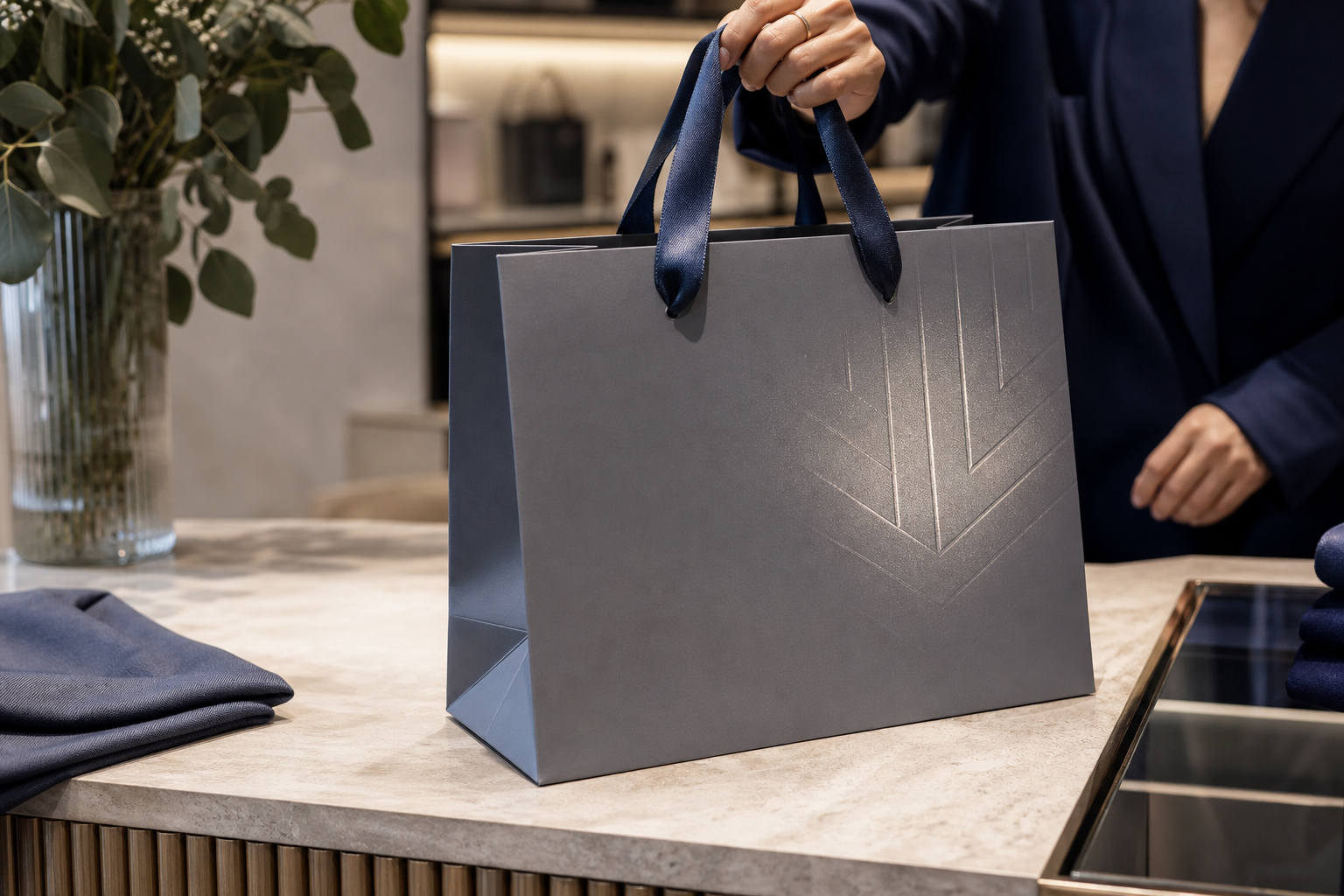
Finishing is the layer that carries the bag's "premium" feel. Matte lamination gives a sophisticated, calm luxury; it doesn't hold fingerprints and is tactilely soft. Glossy lamination brings the color to life and adds water resistance to the surface. Foil provides a metallic accent on the logo or brand name — gold foil works in jewelry and premium cosmetics, black or silver foil in minimalist luxury brands. Embossing creates a raised effect on the surface, making the logo felt by touch; it's a tactile, not visual, quality signal. Spot varnish creates contrast on a matte background by glossing only certain areas — it draws attention without covering the entire surface and is generally more economical than full-surface lamination.
The right finish depends on what you want to emphasize. If you want to highlight the logo, spot varnish or foil; if you want to give the whole bag a holistic luxury texture, matte lamination. Piling every finish on top of each other is right neither aesthetically nor cost-wise — an exaggerated layering looks "tried too hard" rather than premium.
Color Accuracy and Proofing
The warning independent print engineers most persistently repeat is about color. Taking a proof based on Pantone values for corporate colors and giving physical sample approval before printing is not negotiable. The color on the screen doesn't come out exactly the same as the color on the paper surface; coated and kraft show the same CMYK value differently. If you skip these steps, you'll experience color deviations that are hard to reverse in high-quantity printing — your brand's corporate blue will reach you shifted to turquoise across thousands of bags.
Proper proofing is not a cost, but insurance. A physical sample approved before printing prevents a reprint costing thousands. If the color comes out wrong on a run of 5,000, your loss is not just money; your delivery date also slips.
MOQ and unit cost reality must be connected at this point. ePoset clearly states that size, design, whether or not there's a string, and the cardboard type are the basic factors determining the unit price. In branded runs, low quantity pulls the unit cost up — plate and setup costs are divided across a small number of bags. That's why in a "personalized but low quantity" scenario, digital printing is the right economical decision, and in a "personalized and high quantity" scenario, offset is.
Every cardboard bag carried on the street is an unpaid outdoor advertisement.
Sustainability and Recycling: The Real Environmental Picture of the Cardboard Bag
The recyclable cardboard bag has become the visible face of sustainable packaging — but the assumption that "paper = automatically good" deserves to be tested with a critical eye. The real picture is more nuanced.
Recyclable Material. Kraft is produced from 100% recycled kraft paper (Makromat Matbaa). But the recyclability claim shouldn't be left hanging; the ISO 18601 ff. series (18602–18606) defines the requirements for packaging in terms of resource efficiency, reuse, recycling, and energy recovery (International Organization for Standardization). Saying "recyclable" means being consistent with this framework — not a marketing slogan. To examine these environmental properties of kraft paper in depth, what is kraft paper, its types and properties is a good reference source.
FSC / PEFC Certified Cardboard. FSC (Forest Stewardship Council) verifies that the fibers in cardboard and paper come from responsible forest management; the FSC Mix and FSC Recycled labels indicate the sustainability level of the raw material. PEFC International offers a similar traceability standard. The point FSC Director-General Kim Carstensen emphasizes is important: brands should make the switch to paper not just "because it's paper," but by making sure they use certified and traceable fiber sources. The FSC logo is visible proof of your sustainability claim to the consumer.
Water-Based Ink and Lamination-Free Surface. Many brands prefer the FSC cardboard + water-based ink + lamination-free surface combination as the technical package that least interferes with the recycling chain (FSC). This combination makes fiber recovery easiest at the end of the bag's life.
Lamination ↔ Sustainability Balance. Here's the caveat: lamination (film), heavy ink, and thick cotton/satin strings make fiber recovery difficult in recycling. The exaggerated coatings in the luxury segment often directly contradict the sustainability claim. When saying "eco-friendly luxury bag," laminating the entire surface means missing both goals at the same time.
Reuse = Real Environmental Advantage. Various life cycle analyses (LCA) show that paper/cardboard bags can consume more water and energy in the production stage compared to plastic. The environmental advantage emerges from reusing the bag multiple times. The essence of UCSB's Dr. Roland Geyer's LCA studies on single-use bag and packaging systems is exactly here: how many times it will be used determines the environmental impact more than the material type. The real question is not "kraft or coated," but "will this bag be used once or thirty times."
Regulatory Pressure. The EU Single-Use Plastics Directive 2019/904 is one of the important regulatory frameworks that limits plastic bags and directs retailers toward paper and cardboard alternatives (European Commission / EUR-Lex). For Turkish exporters, this means an indirect shift in demand — for brands selling to Europe, the cardboard bag is no longer a preference but increasingly an expectation.
The greenwashing warning must be stated clearly: in very thick, heavy, single-use luxury bags, prestige takes precedence over sustainability. If the product inside is low-priced or single-use, a heavy-grammage and densely printed bag is an example of "over-engineering in packaging." A real sustainability claim should be supported by certification + a simple technical package + reuse design; otherwise it's just perception management.
Cost, Quantity, and Delivery Time: The Variables That Affect Your Budget
Cardboard bag prices cannot be reduced to a single number; they're the product of several variables. As ePoset clearly states, size, design, whether or not there's a string, and the cardboard type are the basic factors determining the unit price. Collecting these variables and where each can be touched in a single table clarifies the budget discussion.
| Variable | Effect on Cost | Budget Optimization Tip |
|---|---|---|
| Grammage | High | Choose a grammage suited to product weight, don't go too thick |
| Size | Medium | A spec close to standard sizes lowers cost |
| Handle type | Medium-high | Woven/grosgrain premium; twisted paper economical-strong |
| Printing/coating | High | Spot finish can be cheaper than full-surface lamination |
| Order quantity | High (economy of scale) | Reaching the 500+ band for offset lowers unit cost |
| Printing technique | Medium | Low quantity → digital, high quantity → offset |
MOQ reality. For offset custom design, the typical minimum order is positioned in the 500–1,000 unit band for an economical plate cost. Digital printing is suitable for low-quantity jobs like 100–250 units. As quantity increases, unit cost drops quickly — that's why you should definitely ask your supplier "if I take 1,000 instead of 500, what would the unit price be"; often a doubled quantity lowers the unit cost disproportionately.
The balance of economy and image. Wholesale printed cardboard bags are positioned as "affordable manufacturing," in Marin Ambalaj's phrasing; the same manufacturer states that a brand-specific luxury and eco-friendly solution is also possible at high quantities. In other words, economy and image are not alternatives to each other; in the right quantity band, both can be achieved together.
Delivery schedule. For realistic planning, calculate by counting back three blocks: design finalization + proof 2–5 business days; mass production 7–15 business days (close to the upper band if there are additional finishes like lamination, embossing, foil); domestic logistics 1–3 business days. If your launch date is set, add up these three blocks and count backwards — an order placed at the last minute narrows both your finishing options and your color proof safety. To establish the right material and budget balance, the packaging materials guide: the right choice for your brand is a complementary resource.
A Brief Preparation Guide for Ordering Cardboard Bags
Before requesting a quote, fill out the seven items below. The order is not accidental — it's based on the "product requirement first, material selection second" approach of Prof. Susan Selke from the MSU School of Packaging. Factors such as product weight, sharpness of corners, and moisture risk should guide the right grammage, handle, and coating decision; aesthetics should be built on top of these requirements.
- Product weight and size. Weigh the heaviest product that will go in the bag, measure the largest size. 1–2 kg → 170–190 g/m²; 4–5 kg → 200 g/m² reinforced base; heavy or bulky → 230–300 g/m². This matching is based on Karton Çanta Bursa's grammage-capacity data and is the foundation of all other decisions.
- Purpose of use. Retail display, gift, or e-commerce in-box? Retail and gifts pull toward the premium side in handle and material, e-commerce toward the durability and pack-flat side. This clarity determines the handle and material selection.
- Brand perception goal. A natural and sustainable identity, or a glossy and luxurious identity? Natural → kraft, plain printing. Luxury → laminated + foil or emboss. Telling the supplier "make it stylish" without putting this goal into writing leaves the result to chance.
- Color values. Have the Pantone and CMYK equivalents of your corporate colors ready. The proof is taken based on these values; "use the blue in the logo" is not enough. A job that starts without clear color values incorporates the risk of color deviation from the very beginning.
- Estimated quantity range. ≤250 units → digital printing; ≥500 units → offset. Your quantity band determines the printing technique and therefore the unit cost. Give a low and a high scenario so the supplier can offer you quantity-broken-down pricing — clarify the minimum order threshold at this step.
- Sustainability requirements. Do you want FSC or PEFC certified cardboard? Is it necessary to avoid lamination or request water-based ink? Is reusing the bag a goal? Setting these preferences from the start shapes both the technical package and the cost.
- Delivery date. Count back from your launch or season start date: 2–5 days for proofing + 7–15 business days for production + 1–3 days for logistics. Also add the sample approval process to this schedule; a physical sample request requires a realistic buffer.
With a clearly spec'd brief, the process speeds up. With a properly prepared request, you can get a quote within 24 hours and a physical sample within 7–15 business days. Fill out the seven items above and send them along with the product weight, target quantity, and delivery date at hand — let the returned quote be not a guess, but a measurable decision document.
Frequently Asked Questions
What is the minimum order quantity for cardboard bags?
For offset-printed custom designs, the typical MOQ is in the 500–1,000 unit band due to the plate cost; digital printing is suitable for low-quantity personalized jobs like 100–250 units. As quantity increases, unit cost drops quickly, and at high volumes offset still remains the most economical option. Clarifying your quantity range from the start is the first step in determining the right printing technique and a realistic unit price.
Is a cardboard bag durable when wet or in a damp environment?
Standard kraft and coated cardboard lose strength in moisture; a matte or glossy film lamination surface provides significant protection against water and increases durability. However, lamination makes fiber recovery difficult in recycling. That's why a conscious balance must be struck between moisture risk and the sustainability goal — weigh both needs at the start of the project.
Can I place an order without seeing a sample?
Not recommended. Especially for corporate colors, a proof based on Pantone and physical sample approval before printing prevent color deviations that are hard to reverse in high-quantity production. A physical sample is typically provided within 7–15 business days. Although skipping this step may seem to save time in the short term, the money and schedule you'll lose on a faulty run will cost you much more.
Should I prefer a cardboard bag or a kraft paper bag?
Kraft paper bags are usually thinner and flat-bottomed, meant for light and daily use. A cardboard bag with a reinforced base and handles, on the other hand, offers higher carrying capacity and premium printing possibilities. For a premium brand theme and heavy products, a cardboard bag; for economical, light carrying, a kraft paper bag is suitable. The decision depends on the weight of the product you'll carry and your brand's perception goal.