

An e-commerce shipping box is a structural packaging product that ensures an online purchase reaches the customer complete and undamaged; it protects the product throughout the logistics chain. In common usage it is also referred to as a parcel, but a branded e-commerce shipping box performs two jobs at once: it keeps the product safe and carries your brand's first physical contact with the customer. In this guide, we explain how to consider both of these jobs together.
At Kosapack, we design all the packaging layers of e-commerce shipping under one roof, from folding carton inner boxes to corrugated shipping boxes, from tissue paper and thank-you cards to in-box dividers. That is why this article is designed not so much as a "parcel selection" list, but as a decision framework that protects your product and your brand together.
Contents
- What is an e-commerce shipping box and how does it work
- Box types and the points that distinguish them
- Why it is critical for premium and DTC brands
- Evaluation criteria when choosing the right box
- Your next step
- Frequently Asked Questions
What is an e-commerce shipping box and how does it work
The main task of an e-commerce shipping box is to carry the product from the warehouse to the customer's door without damage. That is why the primary criterion is durability; a box with insufficient sturdiness causes the product to deform on the way, and this is an undesirable outcome for both the seller and the buyer (the basic function and expectations of the e-commerce box).
Mechanically, protection mostly comes from the layered structure of corrugated cardboard. The wavy flute layer placed between flat paper surfaces both absorbs impact and gives the box stacking strength. As the weight, fragility and shipping conditions of the product increase, this structure needs to thicken and the grammage needs to rise. In our packaging materials approach, we position E-flute corrugated cardboard (~1.5 mm thickness) as typical use for cosmetics and small e-commerce products; this shows that a thin but durable shipping box is sufficient in most cases for light and premium products.
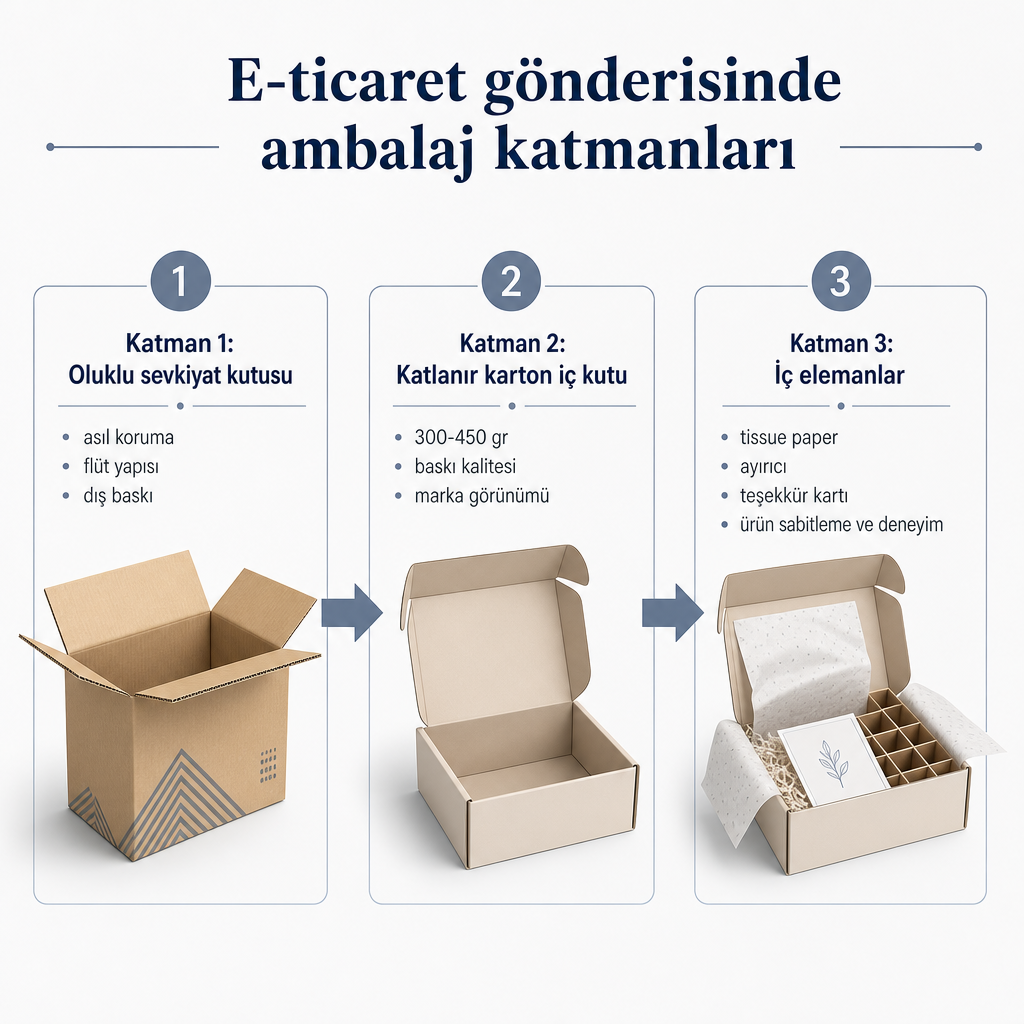
In an e-commerce shipment, two packaging layers usually work together: the product's own box and the outer shipping box. The product's own box is mostly folding carton and carries the brand print, shelf or gift appearance. The outer shipping box, on the other hand, is made of corrugated cardboard and provides the actual physical protection. This inner/outer distinction is the most practical way to determine which material to invest in and how much at each layer.
Box types and the points that distinguish them
E-commerce boxes vary structurally according to the product they protect; different sizes and materials are selected according to product characteristics. The following types meet the different needs of a shipment and are often used together.
Corrugated shipping boxes. They are the main carrying body of the shipment. Flute type and paper grammage are matched to product weight and fragility. While a thinner flute is sufficient for light textiles, heavy or glass-content products require a thicker structure. Print customization creates the brand's externally visible identity on this surface.
Folding carton inner boxes. The product's own box is usually made of folding carton in the 300–450 g range, shipped assembled. Substrates with high print quality such as coated or cover board are preferred for a premium cosmetic and retail appearance. This layer is the first surface opened at the moment of unboxing.
Mailer envelopes and durable postal packaging. They provide an alternative to corrugated boxes for non-fragile, thin and light products; they enable a more compact shipment by reducing volume.
Complementary inner elements. In-box dividers, tissue paper, thank-you cards and labels contribute to protection by securing the product while also designing the unboxing experience. In our portfolio, all of these elements can be designed under the same roof as the shipping boxes.
The main point that distinguishes these types is the balance between protection and brand visibility. The corrugated box carries durability, the folding carton carries print quality, and the inner elements carry the experience. The right combination is built according to the product itself and your brand's positioning.
Why it is critical for premium and DTC brands
The difference between a standard brown parcel and a fully branded e-commerce shipping box is not just about aesthetics but perception. The customer sees the box before holding the product; for premium and DTC brands, this is the moment when the purchase promise is physically confirmed. Positioning packaging as an extension of the brand is at the center of our extensive print customization and brand-specific design capabilities.
Weak protection, on the other hand, has direct financial consequences. A product that deforms on the way means returns, reshipments and dissatisfaction; therefore, the shipping box is not a cheap parcel but a critical component that affects return rates and customer experience. Durability tests and the right substrate selection are the way to reduce this risk from the very beginning.
The sustainability dimension is also becoming increasingly decisive. The conscious consumer segment expects recyclable material and low environmental impact. In our packaging solutions that prioritize sustainability, we focus on elements such as recyclable materials and carbon footprint reporting; this turns the e-commerce shipping box into a choice that contributes to brand value.
On the unboxing side, the inner and outer design of the box must be considered together. A printed inner surface, a divider that secures the product and a well-placed thank-you card turn the carrying medium into a brand stage. We handle this approach in more detail in our brand-specific box production guide, where we address the logic of turning the box into a marketing tool.
Evaluation criteria when choosing the right box
When determining which e-commerce shipping box is right for you, not a step-by-step procedure but a few decision axes will do the job. The following criteria help you find the right balance for your product and your operation.
| Criterion | What to look at | Factor affecting the decision |
|---|---|---|
| Protection level | Product weight, fragility, shipping conditions | Flute type and inner carton grammage |
| Brand visibility | Outer print, surface coating | Coated/cover board, print area |
| Volume and size | Inner dimension fit to the product | Empty space, filler need, volumetric weight |
| Experience | Inner structure, divider, card | Unboxing setup |
| Sustainability | Material recycling | Recyclable cardboard |
On the protection side, product weight, fragility and shipping conditions determine the flute type and inner box grammage; while heavy glass products require a thicker structure, light textiles are safely carried with a thinner flute.
Volume and size is the axis that most brands overlook. A correctly dimensioned shipping box can reduce both filler material consumption and volumetric weight cost by reducing unnecessary empty space. On the other hand, packing the product too tightly increases the risk of damage. Building this fine balance is one of the areas where our design consultancy makes the most concrete contribution.
Durability is verified not by guessing but by testing. In our packaging approach, we recommend methods such as the drop test (1 m), stacking test, folding test and closing cycle to simulate the real-world impacts the box will encounter during the warehouse and shipping process. These tests and the color-accuracy-focused sample process are part of our services; instead of setting up tests yourself, giving us the right brief ensures your box is designed according to these criteria.
If you want to examine the differences between carton types, grammage ranges and areas of use more closely, our carton box selection guide technically complements the relationship between the e-commerce shipping box and the product box.
Your next step
The e-commerce shipping box decision is based not on a single material choice, but on building the protection–visibility–experience triangle according to your product. Wherever your own product's weight, fragility and brand positioning sits in this triangle, that is where the right box structure emerges from.
The next logical step is to see how the box comes from idea to physical sample. If you are curious about how the design and production process works, take a look at our guide explaining our custom box production process. If you have a concrete project, it is enough to share your product, target dimensions and brand expectation; from here we will come up with a proposal and sample plan tailored to you.
Frequently Asked Questions
Are an e-commerce shipping box and a product box the same thing?
No. The product box is usually a folding carton inner box and carries the brand appearance; the shipping box, on the other hand, is the outer shipping packaging mostly made of corrugated cardboard that provides the actual protection. The two work together in a shipment.
Which box structure is suitable for small and light products?
For light and small e-commerce products such as cosmetics, E-flute (~1.5 mm) corrugated cardboard is typical use; it offers a thin but durable structure. The exact choice is made according to the product's fragility and shipping conditions.
Does branded printing affect the durability of the box?
Print and coating do not weaken durability when applied to the right substrate. Protection comes from the flute structure and grammage; the print, on the other hand, provides brand visibility on a separate layer. The two are designed together.
Is a sustainable option possible in an e-commerce box?
Yes. We offer solutions that prioritize sustainability with materials such as recyclable corrugated cardboard, and we focus on elements such as carbon footprint reporting. The suitable option is determined according to the product and print requirements.
How does the right box size affect shipping cost?
A box correctly dimensioned to its product can reduce volumetric weight cost by reducing empty space and filler need. Packing too tightly, on the other hand, increases the risk of damage; this balance is established during the design phase.