
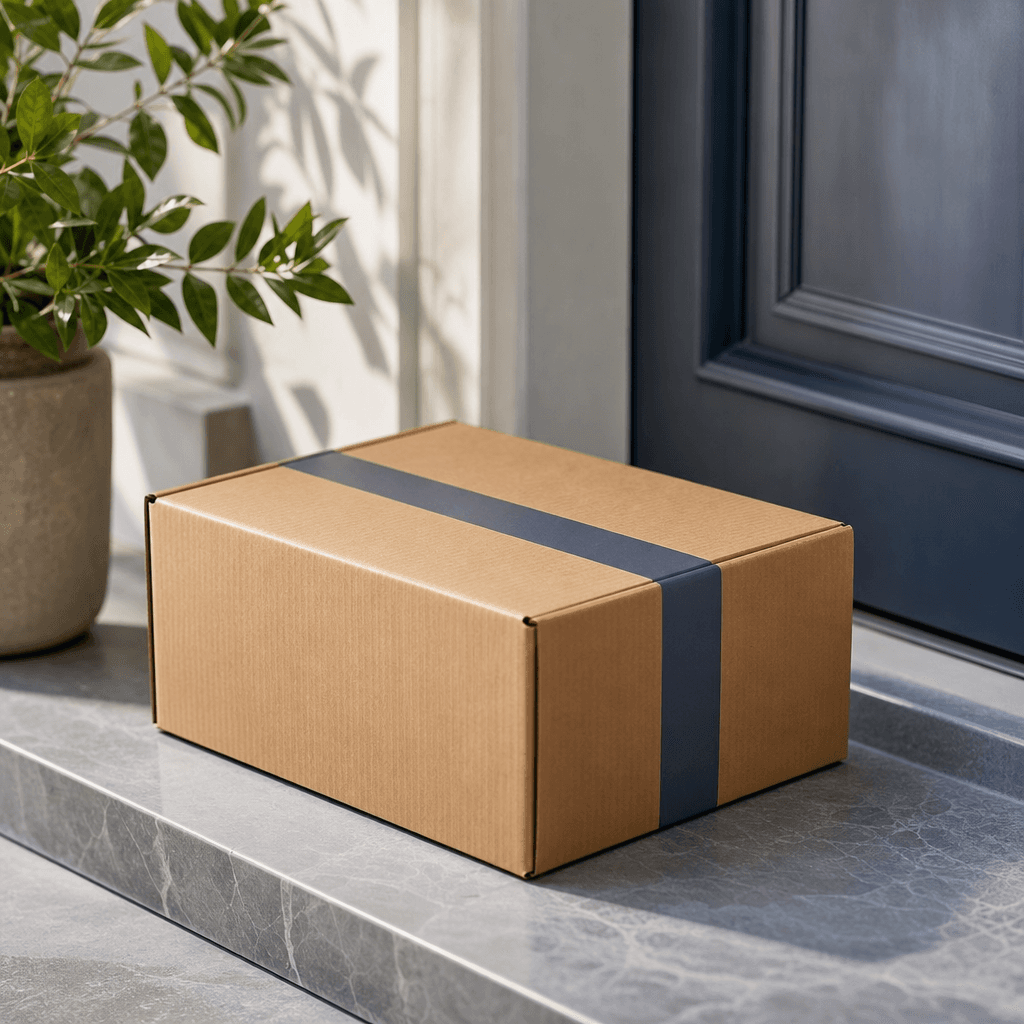
When an e-commerce order reaches your customer, the first thing that represents your brand isn't your website or your advertising campaign; it's the box standing at the door. This is exactly where custom-printed e-commerce shipping boxes transform an ordinary carton into a physical extension of your brand. At Kosapack, instead of the anonymous gray surfaces of standard stock boxes, we design a packaging concept that protects your product, optimizes your shipping costs, and speaks on your behalf during the unboxing moment. Every shipment is the physical first encounter you establish with your customer; we turn this encounter into a stage that works in favor of your brand.
In this article, we take a step-by-step look at why an e-commerce shipping box is not merely a means of transport, what custom printing adds to the unboxing experience and brand perception, which criteria you should consider when choosing the right box, and how our end-to-end service model manages this process.
Table of Contents
- The strategic role of the e-commerce shipping box for your brand
- Turning the unboxing experience into brand value with custom printing
- How to choose the right shipping box for your brand
- From consultation to shipping: the end-to-end process
- Sustainable and premium packaging strategy
- Frequently Asked Questions
The strategic role of the e-commerce shipping box for your brand
An e-commerce shipping box is technically most often manufactured from corrugated cardboard. Corrugated boxes are the main packaging type for e-commerce shipments worldwide thanks to their shock absorption capability, lightness, and cost balance. In other words, the structure that protects your order is actually an invisible piece of engineering: the wave layers distribute the pressure applied to the product, keep the box's own weight low, and provide resistance against crushing when stacked on shelves. These three properties together enable the box to keep the product intact both while stacked in the warehouse and while being jolted in the delivery vehicle.
However, the function of this box doesn't end with protecting the product. For an e-commerce brand, a shipping box must do three jobs at once: transport the product without damage, tell the brand's story, and keep the total logistics cost under control. A standard stock box handles only the first of these three tasks, and even that is often incomplete due to size mismatch. A stock box larger than your product requires you to add filler; this means both material cost and unnecessary air being transported. This invisible empty space carried in every shipment is a silent burden that, across thousands of monthly orders, is reflected in both your budget and your sustainability goals.
A custom-printed and custom-sized box, on the other hand, redefines this equation from the start. When we design the box according to the volume of your product, unnecessary empty space and the associated volumetric cost decrease, damage risk is reduced because the product moves less inside the box, and the exterior surface is covered with your brand's color, logo, and message. Thus every shipment becomes, at the same time, both a layer of protection and a portable brand touchpoint. This means solving three separate problems at once with a single design decision: protection, cost, and brand perception.
This perspective is especially decisive for premium and growth-stage brands. In products with high perceived value such as cosmetics, jewelry, candles, and chocolate, the quality and printing of the box are directly reflected in the product's value perception. It is a finding frequently emphasized in consumer behavior literature that the design and printing quality of packaging significantly influences a product's premium perception. The moment your customer picks up the box, they form a judgment about your brand based on the texture of the box, the clarity of its printing, and the consistency of its color. In short, the box is a silent but effective brand ambassador.
Turning the unboxing experience into brand value with custom printing
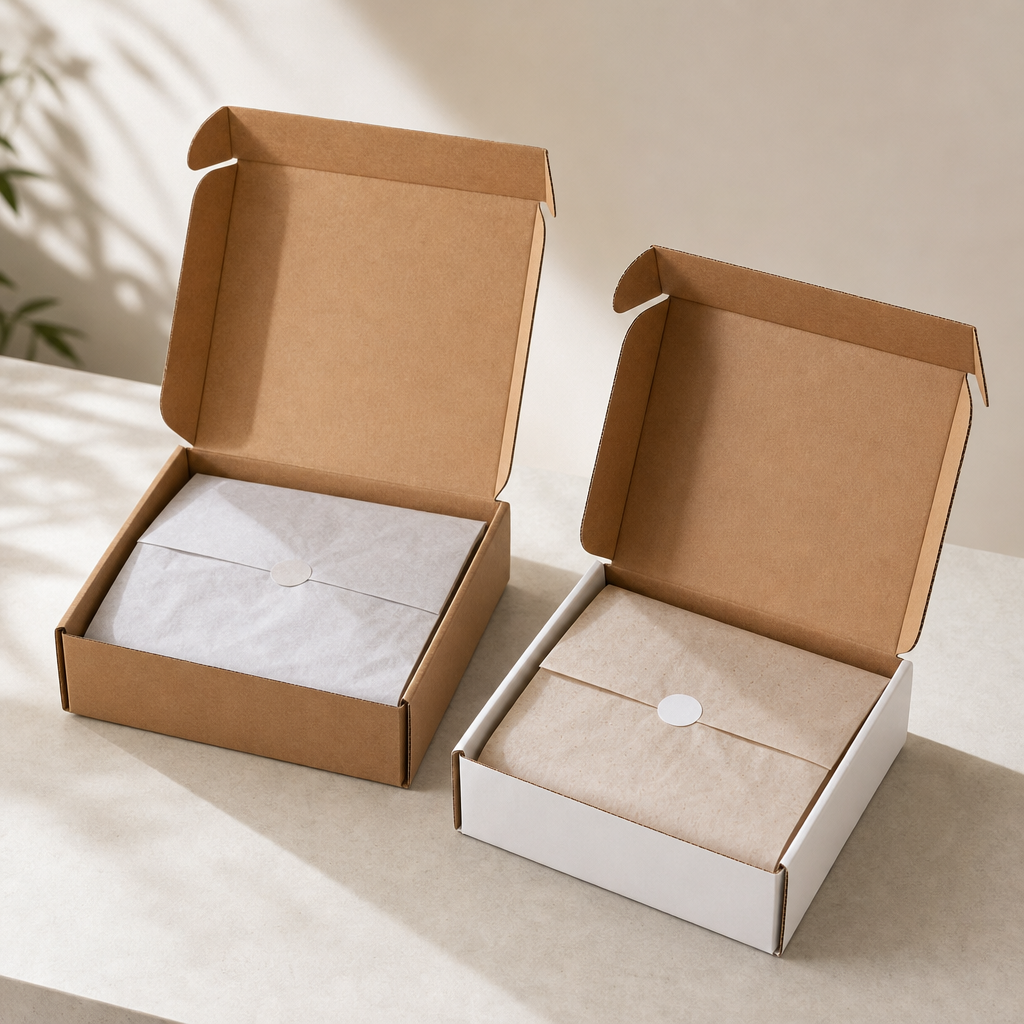
Unboxing, that is, the box-opening moment, is one of the most powerful marketing moments that brands underestimate in e-commerce. Unboxing videos and posts create measurable impact on brand perception and customer loyalty, especially for premium consumer brands. The experience your customer has while opening the box directly affects whether they will place another order and whether they will share this moment on social media. Unlike paid advertising, a well-crafted unboxing moment can turn into organic promotion that the customer spreads to their circle of their own accord.
Custom printing here is not a layer, but a composition. An unboxing scenario thought out from the outside in generally combines the following elements:
- Corporate logo, brand color, and a short welcome message on the exterior surface of the corrugated shipping box
- A layer wrapping the product with kraft or specially designed thin wrapping paper on the inside
- A brand label or seal affixed to the product
- A personalized thank-you card
- Securing products with in-box dividers for fragile items
We design and produce all of these elements under one roof. Thus all parts, from the outer box to the inner detail, carry the same color language and brand tone. For example, in the composition we designed for a cosmetics brand, while the outer shipping box remains plain and minimal, the inner wrapping paper and thank-you card can carry the brand's signature color. Such a gradual opening gives the customer the feeling of moving from one layer to another while opening the box, and transforms the experience from a single moment into a small ceremony. For cosmetics brands' expectations of combining aesthetics and function in e-commerce packaging, you can explore our cosmetic packaging production solutions.
The quality of the printing is the second axis that determines the quality of the experience. The consistency of corporate colors, the logo appearing clear and sharp, the typography remaining legible—these are the details that save the box from looking cheap. Our color-accurate proofing process, that is, our color-accuracy-focused proofing process, minimizes the difference between how the design appears on screen and the printed box. The blue you see on screen being the same as the blue on the box that arrives at your door is not a coincidence, but the result of a controlled proofing process. Especially if you use a corporate color that repeats across many products, this consistency ensures that your brand leaves the same impression with every shipment.
For premium brands, unboxing is sometimes not limited to a single box. A multi-layered composition using a protective shipping box on the outside and a rigid gift box that leaves a lasting impression on the inside elevates both the product and the brand experience. In such multi-layered packaging scenarios, our rigid box production approach can be designed as a single whole together with the shipping box. Thus, while the outer box takes on the harsh conditions of the shipping journey, the inner rigid box turns into a lasting brand object that the customer keeps and reuses.
How to choose the right shipping box for your brand
The right e-commerce shipping box is a design decision that has no single standard answer. Your product, your shipping process, and your brand positioning must be evaluated together. The main decision criteria we clarify together during the consultation phase are as follows.
Product type and fragility. Glass candles, jewelry, electronics, cosmetics, and textiles require very different structures in terms of fragility. For fragile products, we determine the in-box clearance allowance, the necessary protection layers, and the need for dividers during the structural design phase. For soft textile products, a thinner but aesthetics-focused solution may be sufficient. Discussing the typical damage scenarios of your product group upfront allows us to foresee which points require additional protection.
Shipping company rules and volumetric weight. In e-commerce shipping in Türkiye, volumetric weight, that is, dimensional weight, directly affects cost. A box unnecessarily larger than your product costs you extra money on every shipment. When designing a custom-sized box, our aim is to reduce the volume to the smallest possible level while protecting the product sufficiently. This balance lowers both the damage rate and the unit transport cost at the same time. When we optimize the box size according to the shipping types you frequently use, you achieve cumulative savings on repeat shipments.
Material and wave type selection. Single-wall corrugated boxes are suitable for light and economical products, while double-wall corrugated boxes are suitable for heavier or more fragile products. Surface preference is also a decision: while a kraft surface gives a natural and sustainable look, a white surface offers a cleaner printing base. Grammage selection is also determined at this stage based on the internal filler need. You can find details about the durability and recyclability aspects of kraft paper in our article what is kraft paper and its uses in packaging.
Printing and design preference. A minimalist, single-color print and a densely patterned, full-coverage design require different printing techniques and costs. We can adapt your existing corporate identity to the box or design an unboxing concept from scratch. We take into account the manufacturability dimension of the decision as much as the aesthetic dimension from the start; we adapt the design to production conditions so that a design that looks impressive on screen also comes out flawlessly in printing and cutting.
Order quantity and scalability. A brand may first want to try the unboxing concept with a low-volume test production; then, as demand grows, it needs to increase quantities. Because we manage mass production through our verified factory partners, we can support growing e-commerce brands with scalable capacity. This way, you can increase volume without losing the initial design language. It is also possible to reflect the feedback you obtain during the test phase into the design before moving to mass production.
We handle these criteria not one by one, but as an interconnected whole. For example, a smaller box lowers the volumetric cost but also reduces the product's protection allowance; we establish the balance between these two requirements specifically for your product. Similarly, a thicker wave type increases durability but raises both weight and cost; the right choice is the combination of these variables best suited to your product.
From consultation to shipping: the end-to-end process
A custom-printed e-commerce shipping box is, rather than a single product, a project that needs to be managed. Our end-to-end service model carries out this project on your behalf from a single source; instead of struggling to coordinate suppliers, you work with a single point of contact.
A typical project flow proceeds as follows:
- Brief and consultation. We discuss your product, your shipping process, your target audience, and your brand positioning, and determine the packaging strategy together.
- Structural design. We design the box's dimensions, wave type, durability, and locking system according to the product and shipping conditions.
- Graphic design. We prepare a print design suited to your brand identity and bring color management into play at this stage.
- Digital proof and approval. We present the design and colors for your approval and make the necessary revisions.
- Physical sample. We produce a physical sample within 7-15 business days; we enable you to hold the box in your hands and evaluate its texture, printing, and durability.
- Mass production and quality control. We manage mass production according to the approved sample; we systematically check printing, cutting, gluing, and durability.
- Consolidated shipping. We centrally manage the shipping of all parts such as the box, wrapping paper, label, and thank-you card.
The most visible advantage of this process is speed and predictability. Upon your request, we prepare a price quote within 24 hours and, following your approval, produce the physical sample within 7-15 business days. This way, you make your decision by looking at the real box in your hand, not at abstract visuals. When you hold the sample in your hands, you can directly evaluate the weight of the box, the opening feel, and the texture of the printing, and clarify every necessary detail before moving to mass production.
Its least visible but most valuable contribution is that we take on the coordination burden. Instead of negotiating separately with different suppliers, chasing color consistency, and matching up shipments, we bring all parts together under a single brand language. As a result, the kraft surface of your box and the tone of your thank-you card become the product of a single design composition, not of independent decisions. This single-source execution reduces your operational burden while also ensuring the consistency of the result.
Sustainable and premium packaging strategy
Sustainability is no longer just a preference, but a purchasing criterion for many corporate and international brands. Recyclable materials with high fiber strength, such as kraft paper, therefore stand out in sustainable packaging solutions. The fact that the e-commerce shipping box has a large surface area and high-volume use makes the environmental impact of your material selection even more decisive. Even a small material improvement made on each box, at high order volumes, turns into a meaningful difference on an annual scale.
Our sustainability commitments take concrete form on two axes. The first is the use of recyclable materials; corrugated cardboard and kraft-based surfaces are suitable for e-commerce boxes in terms of both durability and recycling. The second is the possibility of carbon footprint reporting that meets the reporting requirements of corporate and international brands in particular. This makes your packaging decision not just an aesthetic one, but part of your corporate responsibility framework, and turns it into concrete data you can use in your supply chain reporting.
Sustainability and premium perception often reinforce each other. A plain, recyclable box can attain a luxurious appearance with the right printing and touches. A box that avoids over-packaging and is optimized for the product leaves both a more environmentally consistent impression and a more conscious brand impression in the customer's eyes. The optimization of box size and weight in e-commerce logistics also contributes to total profitability by lowering transport costs and damage rates. In other words, less material often means both lower cost and a stronger brand; here, sustainability and profitability become not opposing but mutually supporting goals.
We also take your industry's packaging and labeling requirements into account within this strategy. In areas such as food and cosmetics, packaging that comes into contact with the product may be subject to additional requirements; since the e-commerce shipping box is generally outer packaging, these requirements mostly concern the inner packaging. Nevertheless, the durability, marking, and protection performance of the box are taken into account from the start so that your product reaches the customer undamaged. When definite legal obligations are involved, we recommend verifying the current regulations for your own industry; while we manage the design and durability side of the box, it is sound for you to confirm industry-specific mandatory marking and compliance requirements in your final decision.
Frequently Asked Questions
What material is used for the e-commerce shipping box?
E-commerce shipping boxes are mostly manufactured from corrugated cardboard. The corrugated structure is the standard solution for e-commerce shipments thanks to its shock absorption capability, lightness, and cost balance. Depending on the product's weight and fragility, single-wall or double-wall options are used; kraft or white can be preferred as the surface. We determine the material selection together according to your product and shipping conditions; while single-wall is sufficient for light products, it is safer to opt for double-wall for heavy or fragile products.
Why is a custom-printed box advantageous compared to a standard stock box?
A standard stock box generally does not fit your product's dimensions exactly; this means unnecessary empty space, filler cost, and extra volumetric weight. A custom-sized and printed box reduces volume while better protecting the product, and turns its exterior surface into a touchpoint for your brand. Thus the same box takes on both protection and marketing jobs together. Ultimately, while both your unit transport cost and your damage risk decrease, every shipment turns into a surface that carries your brand.
How long are the price quote and sample lead times?
Upon your request, we prepare a price quote within 24 hours. Following your approval, we produce the physical sample within 7-15 business days. This way, you can make your decision not through screen visuals, but through a real box that you can hold and evaluate. We clarify the mass production and delivery plan together according to the project scope; quantity, design complexity, and the breadth of the unboxing set are the main variables that shape this plan.
Will the color of the box come out the same as the tone I designed?
Our color-accuracy-focused proofing process exists precisely to minimize this difference. With the color-accurate proofing approach, we keep the color difference between the digital appearance of the design and the printed box under control. Before approval, we evaluate the colors through the proof and make the necessary corrections before moving to mass production. This ensures consistency between the corporate color you approved on screen and the color of the box that reaches your customer's door.
Do you design only the box, or the entire unboxing set as well?
Along with the shipping box, we design and produce all unboxing elements such as thin wrapping paper, labels, thank-you cards, in-box dividers, and, when needed, rigid gift boxes under one roof. Thus all parts, from the outer box to the inner detail, carry the same brand language and color tone. This integrity eliminates the burden of coordinating different suppliers and offers the customer a consistent opening experience.
Can I start with small quantities and then grow?
Yes. Many brands first try the unboxing concept with a low-volume test production, then increase their quantities as demand grows. Because we manage mass production through our verified factory partners, we can scale up production volume while preserving the initial design language. This way, you can carry the feedback you collected during the test phase into mass production and maintain your brand consistency while growing.