

An e-commerce order passes through dozens of touchpoints—from vibration to stacking pressure, from handling to weather conditions—before it reaches the customer. At every stage of this journey, the single physical element that keeps the product intact and represents the brand is usually the box. That is why choosing the right e-commerce shipping box is both a logistical durability decision and a design decision that shapes brand perception. As a premium custom packaging manufacturer based in Zeytinburnu, Istanbul, Kosapack produces solutions that bring together these two needs of over 500 brands under one roof; from the corrugated shipping box to the inner filler paper, from the label to the thank-you card, it handles all components within the same design discipline.
In this article, we discuss the criteria by which a durable and branded shipping box is selected, the questions that premium and growth-stage brands should seek answers to, and how Kosapack's service model—spanning from consultancy to mass production—simplifies this decision.
Table of Contents
- What is an e-commerce shipping box and why is a corrugated structure preferred
- Criteria that define a durable shipping box
- The role of a branded box in unboxing and the customer experience
- The relationship between correct sizing and logistical efficiency
- End-to-end e-commerce packaging process with Kosapack
- Frequently Asked Questions
What is an e-commerce shipping box and why is a corrugated structure preferred
An e-commerce shipping box is a cardboard packaging solution specifically designed for the packaging and safe transport of orders placed online. Its main purpose is to deliver the product leaving the online store to the customer in a safe, economical, and brand-appropriate manner. This definition is important because it transforms the box from being merely a transport container into an extension of the brand. The box is the first physical touchpoint the order establishes with the customer, and for this reason it simultaneously fulfills both a protection and a communication function.
The vast majority of these boxes are produced from corrugated cardboard. The corrugated structure consists of a wavy middle layer placed between two flat paper layers, and thanks to this geometry it absorbs impacts and withstands the pressure that occurs during transport. When the vibration, stacking load, and handling impacts in the shipping process are considered, it becomes clear why corrugated boxes are safer than standard flat cardboard boxes. E-commerce boxes are designed and optimized precisely to withstand this vibration and pressure. The gaps created by the wavy middle layer disperse the energy coming from outside, weakening the impact reaching the product; this means that a sudden load falling onto the product is distributed across a wide surface rather than at a single point.
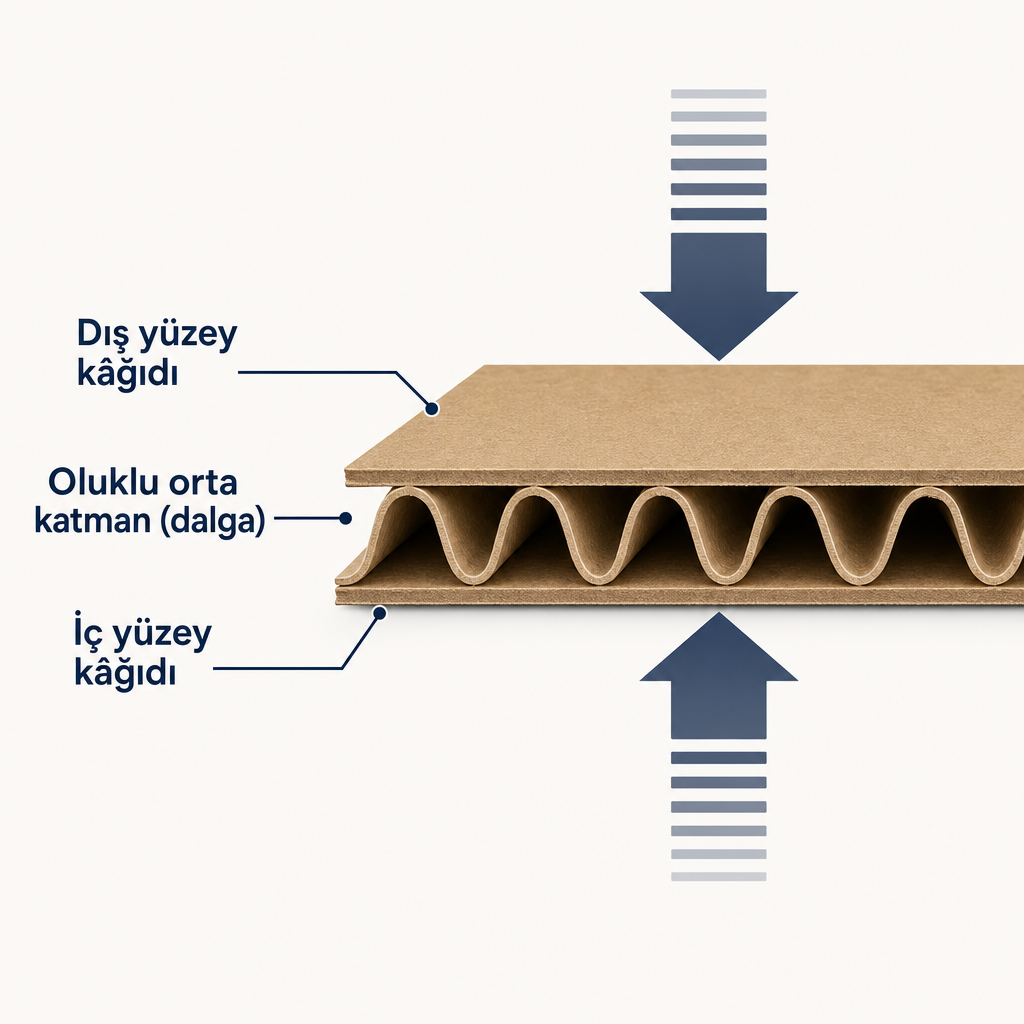
Another advantage of the corrugated structure is that it is a recyclable material. Since e-commerce customers increasingly expect environmentally friendly packaging, corrugated cardboard offers a preferred foundation both functionally and in terms of sustainability. At this point, Kosapack positions the use of recyclable materials and carbon footprint reporting as part of its service model; thus, durability and environmental responsibility meet in the same product. Environmentally friendly packaging is also a signal that supports the customer's trust in the brand; especially for brands selling to conscious consumers, this becomes a factor that positively influences the purchase decision.
In practice, the durability of corrugated boxes varies according to the flute type, the number of layers, and the quality of the cardboard used. While single-wall structures are sufficient for lightweight and medium-weight products, double-wall structures come into play for heavier or fragile products. The double-wall structure increases both stacking strength and puncture resistance by placing two separate flute layers on top of each other. Deciding how to make these technical choices for which product is an area that is difficult for a brand to decide on its own and requires professional consultancy; a wrong structural choice unnecessarily raises either the damage rate or the unit cost.
Criteria that define a durable shipping box
Durability is not an abstract concept but the sum of measurable decisions. The level of protection a brand expects from its shipping box is shaped by the weight, fragility, and shipping volume of the product being transported. Clarifying these criteria both lowers the damage rate and prevents the use of unnecessarily expensive packaging. For the right decision, there are three fundamental questions a brand should ask itself: How heavy and fragile is the product? What handling conditions will the box pass through? How critical does the shipping volume make packaging speed?
The first determinant is the compatibility of the product weight with the box structure. The carrying capacity of corrugated boxes varies depending on the flute type, the number of layers, and the cardboard quality. While heavy products require thicker or double-wall structures, thinner and more economical solutions are sufficient for lightweight textile and accessory shipments. Wrong matching carries a two-way risk: an inadequate structure leads to damage, while an excessive structure leads to unnecessary cost. The practical way to strike this balance is to determine a durability baseline using the heaviest and most fragile product as a reference, then classify product groups around this baseline.
The second criterion is the box's closing and locking design. Among the boxes used for e-commerce, locking structures that can close without requiring tape and auto-bottom designs are common. These designs increase packaging speed and reduce the risk of the box opening during transport; they also lower labor costs, especially for businesses making high-volume shipments. Reduced tape consumption streamlines both operational costs and the margin of error at the packaging station. Kosapack's structural design team can recommend such ergonomic locking mechanisms according to the brand's product range and can optimize the box form according to the packaging flow.
The third criterion is the internal protection and filling strategy. As much as the box itself, the dividers, filler papers, and thin paper layers that keep the product from moving inside the box also determine the damage rate. A well-designed internal protection keeps the product in place throughout transport, limiting the acceleration that occurs at the moment of impact. Since Kosapack's portfolio also includes in-box dividers and tissue paper, protection can be designed as a whole. For consistency on the label side, it is also possible to carry brand integrity to every layer of the packaging by reviewing label design rules for premium brands.
The common point of these three criteria is that there is no universally valid single answer. The scenario in which a cosmetics brand ships a glass bottle and the scenario in which a fashion brand ships knitted textiles require completely different structural decisions. While a double-wall structure and a snug-fitting divider are priorities for a glass bottle, a thin-flute structure or a mailer envelope may be sufficient for knitted textiles. For this reason, the durability decision is a product-specific engineering matter rather than choosing a ready-made model, and it needs to be reconsidered as the brand's product range grows.
The role of a branded box in unboxing and the customer experience
While durability protects the product, brand printing establishes the relationship. Brand printing applied to e-commerce boxes transforms the box from being a protective packaging into a promotional and communication tool. Boxes personalized with logos, color palettes, and design elements strengthen brand recall and the sense of perceived value in the customer. Especially for brands that sell directly to consumers and are positioned as premium, this effect lies at the center of the post-purchase experience. The customer seeks the value of the amount paid not only in the product but also in the presentation accompanying the product.
The unboxing experience is no longer a passive box-opening moment but a touchpoint shared on social media and spreading the brand narrative. While the printing on the outer corrugated box determines the first impression, the layers emerging from inside create the depth of the experience. Here, the issue premium brands are most sensitive about is print quality: color accuracy, surface clarity, and the design's consistency with the brand's other touchpoints. Even a slight deviation in color can lower the perceived quality by creating inconsistency with the brand's identity across other channels. Kosapack's high-color-accuracy proofing process and strict quality control approach secure this sensitivity at the production stage.

A single box is rarely enough to complete the branded experience. In segments such as premium cosmetics, jewelry, candles, or chocolate, the outer corrugated shipping box works together with the rigid or foldable cardboard gift box inside it: one takes on protection, the other presentation. When tissue paper, labels, thank-you cards, and in-box dividers are added to this combination, the package reaching the customer turns into a consistent brand narrative. Each layer is a sequential scene the customer encounters while opening the box, and the harmony of these scenes with one another determines the integrity of the experience. To construct this integrity from a single source, it is useful to review how custom box production for your brand is planned.
For lightweight products, the experience does not necessarily have to be established with a box. In textile and accessory shipments, branded mailer envelopes or paper bags offer solutions that can be used instead of or alongside the shipping box. These solutions lower both the transport volume and the unit cost while continuing to offer a branded experience. To understand the place of these options in brand positioning, looking at cardboard bag types and their areas of use makes it easier to choose the format suitable for the product range.
The relationship between correct sizing and logistical efficiency
The most overlooked aspect of packaging decisions is that box size is directly related to shipping cost. Choosing the correct size compatible with the product both prevents the product from moving inside the box and keeps the unit shipping volume under control. These two benefits work together: a well-fitting box both reduces the need for filling and eliminates unnecessary empty space. The reduction of empty space also indirectly lowers the damage rate, since it prevents the product from being tossed around during transport.
Overly large boxes create a two-way cost. First, more filling material is needed to fill the empty space around the product; second, the increased volume is reflected in shipping tariffs. Since most shipping companies charge based on volumetric weight, a lightweight but voluminous box can result in a higher shipping cost than expected. In contrast, a box of insufficient size strains the product and increases the risk of damage. The ideal is a form factor optimized according to the product's geometry.
Here, the difference between ready-made standard sizes and custom sizes becomes clear. Although ready-made box sets such as S, M, L that are commonly offered in the market provide a quick start, not every product fits these standard molds exactly. Trying to fit a product into a standard mold usually means either extra filling or extra volume. Kosapack's standout difference is its ability to perform fully compatible custom sizing according to the product and shipping scenario. This approach makes it possible to design the size according to the product, instead of trying to fit the product into a standard size.
Size optimization is not a one-time decision but a process that needs to be revisited as the product range grows. A new product line may create a need for boxes of different weights and dimensions; this requires reviewing the existing sizing logic. Kosapack's consultancy role gains value precisely at this point: by analyzing the brand's product range and sales channels, determining which size and durability combination is suitable for which product group. Thus, brands proceed with a structured sizing logic instead of conducting separate trial-and-error for each product, and do not have to make packaging decisions from scratch continuously as they grow.
End-to-end e-commerce packaging process with Kosapack
The most exhausting part of packaging management for e-commerce brands is that different components come from different suppliers. When the outer corrugated box comes from one place, the inner gift box from another, and the label, thank-you note, filler paper, and paper bag come from entirely different suppliers, color consistency, delivery timing, and quality control become fragmented. Ensuring color matching among different suppliers alone creates a serious coordination burden. Kosapack's model, which offers all these products under one roof, aims to eliminate this operational complexity.
The process begins with consultancy. The Kosapack team analyzes the brand's product, sales channel, and shipping scenario to recommend the right material and structure combination. Then comes the structural and graphic design stage; here, the box form, locking mechanism, and print design are constructed according to the brand identity. After the design is approved, a prototype and physical sample are produced; this stage allows the color, surface, and structure to be seen on an actual sample before proceeding to production. The physical sample eliminates surprises before mass production by showing how the on-screen design behaves on real material.
Production proceeds with mass production managed through verified manufacturing partners, and strict quality control is applied throughout the process. High-color-accuracy proofing secures the print quality that premium brands are most sensitive about. In the final stage, consolidated logistics comes into play: combining different product groups in a single shipment both simplifies delivery and reduces the coordination burden. This consolidation significantly simplifies process management by enabling the brand to track all packaging items through a single point of contact.
Durability protects the product, branded design establishes the relationship; combining the two in the same process transforms e-commerce packaging from a cost item into a brand investment.
In terms of timing, Kosapack offers a quote within 24 hours and a physical sample within 7-15 business days. Since the unit price, minimum order quantity, and total production times vary according to the project and segment, the most accurate route is to request a quote with a short brief containing the brand's product range and expectations. In regulated product groups such as food or cosmetics, it should also be noted that the label and information content on the packaging must comply with the relevant legislation; in such cases, project-based consultancy is the safest approach.
Frequently Asked Questions
Which material is the most durable for an e-commerce shipping box?
The most common and safe choice for e-commerce shipments is corrugated cardboard. The corrugated structure absorbs impacts thanks to its wavy middle layer and withstands the pressure that occurs during transport. Durability varies according to the flute type, the number of layers, and the cardboard quality. Double-wall structures are suitable for heavy or fragile products, while thinner economical options are suitable for lightweight products. The right combination is determined according to the product; determining a durability baseline using the heaviest and most fragile product as a reference is a practical starting point.
Should I prefer a standard-size box or a custom size?
Ready-made standard sizes provide a quick start, but not every product fits these molds exactly. Sizes incompatible with the product increase both the risk of damage and the filling and shipping costs; overly large boxes can cost more than expected due to shipping companies' volumetric weight charging. Kosapack offers fully compatible custom sizing according to the product and shipping scenario; thus, the box is designed according to the product, and the product is not forced into a standard box.
Does a branded box really contribute to sales and the customer experience?
Brand printing transforms the box from protective packaging into a communication tool. Boxes personalized with logo, color, and design elements strengthen brand recall and perceived value. Especially for brands that sell directly to consumers and premium brands, the unboxing experience is an important touchpoint that is shared on social media and spreads the brand narrative. The customer seeks the value of the amount paid not only in the product but also in the presentation accompanying the product.
What solutions can I use instead of a box for lightweight products?
For lightweight shipments such as textiles and accessories, branded mailer envelopes or paper bags can be used instead of or alongside the shipping box. These solutions lower both the volume and the unit cost while continuing to offer a branded experience. For products that do not require protection as sturdy as a box, these formats provide an advantage in terms of both cost and sustainability. The selection of the format suitable for the product range is evaluated during Kosapack's consultancy stage.
How long does it take to get a quote and sample from Kosapack?
Kosapack offers a quote within 24 hours and a physical sample within 7-15 business days. Since the unit price, minimum order quantity, and total production time vary according to the project and segment, exact figures are clarified on a project basis. The most accurate route is to get in touch with the team with a short brief containing the product range and expectations; the clearer the brief, the faster the quote and sample process proceeds.
How is sustainability ensured in e-commerce packaging?
Since corrugated cardboard is a recyclable material, it forms the foundation of sustainable packaging. Kosapack offers the use of recyclable materials and carbon footprint reporting as part of its service model. In this way, durability, brand quality, and environmental responsibility can be combined in the same product; environmentally friendly packaging also supports the conscious consumer's trust in the brand. The scope and details are evaluated on a project basis.
The right e-commerce shipping box is a decision that strikes the balance between your product arriving safely, your brand being remembered, and your logistics costs remaining under control. The most efficient way to establish this balance is not through trial-and-error alone, but through a design process that analyzes your product range and channel structure. By preparing a short brief summarizing your product, shipping volume, printing expectations, and sustainability goals, and sharing it with the Kosapack team, you can take the first step toward a solution that is both durable and branded.