
Table of Contents
Your brand's first physical contact with the customer does not pass through your advertising campaign nor your storefront window — it happens through packaging. The moment the shipping company delivers the parcel, the moment the customer takes the box in hand, the moment they open the lid: this three-second sequence of contact leaves a more lasting impression on your brand perception than months of advertising investment. That is why, when the question what is packaging is brushed off by most brands with the answer "the box that protects the product," a critical strategic gap emerges.
According to the definition of the Packaging Manufacturers Association, packaging is "a valuable material that protects the product placed inside, ensures it reaches the consumer in the cleanest and most reliable conditions, and facilitates its transport and storage" (Packaging Manufacturers Association). The technical definition on Wikipedia is even more comprehensive: "a coordinated system of preparing goods for transport, storage, logistics, sale, and end use." In other words, packaging is not a single object but an infrastructure that extends across the entire supply chain.
The Five Core Functions of Packaging
Global literature and Turkish industry sources converge on the five core functions of packaging: to contain, to protect, to transport, to inform, and to sell. This set of five should be treated not as an academic taxonomy, but as a decision framework that directly affects brand strategy.
Containment. Physically holding the product together — a fundamental necessity for liquids, granular products, and multi-component sets. In a perfume set, the bottle, spray head, and sample vial cannot move around freely on their own; packaging organizes them as a single unit. This function appears technical, but it determines all the structural design decisions.
Protection. Protection against physical impacts such as wetting, shock, damage, and vibration; especially decisive during the shipping process. In industry definitions, this stands out as the "primary role" of packaging (source: Unipak, Pro-Pak). In premium categories, protection is not just "arriving intact" but preserving the product's cosmetic perfection — even if the product arrives undamaged, brand perception is harmed when the box arrives crooked.
Transport. Standardization for logistics, storage, and palletization; sizing that directly affects unit transport cost. A dimensional optimization of a few millimeters changes the number of units on a pallet, creating a noticeable difference in annual shipping cost. As Pro-Pak also emphasizes, ease of transport is an inseparable part of packaging design.
Information. Ingredient list, usage instructions, expiration date, and regulatory compliance — a legal requirement especially in food and cosmetics. In the industry association's definition, the phrase "reaching the consumer in the cleanest and most reliable conditions" is not coincidental; information is the visible proof of the promise of hygiene and safety.
Selling (Marketing). Attracting attention on the shelf, reflecting brand identity, creating an unboxing experience. As Doypack states, packaging is the first visual stimulus that stops the consumer in front of the shelf and the carrier of brand perception.
Within these five, the vast majority of brands focus only on the first three — containment, protection, transport. When the packaging purchasing decision is delegated to the operations team, the procurement function tries to minimize cost, and as a result packaging becomes a "functional but uncommented" expense line item. What differentiates premium and growth-stage brands is that they use the last two functions — information and selling — as a strategic lever.
While in food and cosmetics categories the element of hygiene and safety stands out as the primary technical requirement (Saydaş Plastik), in luxury and DTC brands packaging increasingly becomes an "experience interface." Here the primary question is not "is the box sturdy enough?" but "what does it make you feel in the first three seconds?"
Packaging is not a protection problem to be solved; it is a brand message to be conveyed.
This framework positions packaging not as a cost item on the balance sheet, but as infrastructure that grows brand value. The Packaging Manufacturers Association's phrase "a valuable material" points in the same direction: it creates value, it does not merely carry.
Primary, Secondary, and Tertiary Packaging
Packaging is not a single object, but a system consisting of three distinct layers. Industry sources define these three layers as primary, secondary, and tertiary. One of the most critical mistakes a brand makes is treating these three layers as a single "packaging decision" rather than as separate strategic decisions.
Primary packaging (sales packaging) is the layer that comes into direct contact with the product: the cream jar, the perfume bottle, the chocolate foil. In the industry association's definition, the role of this layer is described as "protecting the product especially against contamination, containing it, and forming the sales unit." The consumer picks this up from the shelf or online cart; this is where they experience the first direct sensory contact with the product.
Secondary packaging is the layer that surrounds the primary packaging and forms the SKU. The cardboard box the cream jar sits inside, the rigid box of the perfume bottle, the outer package of the chocolate. Shelf preparation, brand identity communication, and retail presentation play their main role in this layer. Pro-Pak and Morpack position the secondary layer as the intermediate layer that "forms the sales unit" — that is, the physical ground for most of the brand's visual decisions.
Tertiary packaging is the logistics layer: corrugated cartons, pallet stretch wrapping, mailer envelopes. It brings together multiple secondary packages and is designed for long-distance shipping and storage. The consumer often does not see this layer; however, in e-commerce it is the opposite — the mailer box serves as both a tertiary layer and an "unboxing surface."
LayerContact With ProductPrimary FunctionTypical ExampleVisibilityPrimaryDirectContainment + hygieneCream jar, perfume bottleHighSecondaryIndirectBrand communication + SKURigid box, folding cartonHighTertiaryNoneLogistics protectionCorrugated carton, mailer, palletLow*
*In e-commerce the tertiary layer is also the unboxing surface — this exception creates a strategic decision.
This layering also has practical consequences for production planning. Each of the three layers requires a different MOQ, a different supplier, and a different stock strategy. Making a design change to primary packaging is often as costly as reformulating the product; secondary packaging can be seasonally refreshed; and tertiary packaging can be standardized together with the logistics partner.
For e-commerce brands, the merging of the secondary and tertiary layers requires a special decision. The mailer box works as both protection and an unboxing surface; therefore, investment in print quality and content design is justified. Even single-color printing on a kraft surface transforms the feeling of "I'm opening a shipping box" into "I'm meeting my brand."
For retail-focused brands, the balance is reversed. Brand communication on the shelf takes place in the secondary layer; the tertiary layer should be functionally adequate but does not require visual investment. Here, graphic investment made for the tertiary layer goes straight into the trash at the distribution center.
The waste management dimension, on the other hand, should be evaluated independently. According to Bereketsan, tertiary packaging is often removed at the point of sale and turns into waste; this situation makes the choice of recyclable corrugated cardboard stand out both as a regulatory responsibility and in terms of brand values.
The Six Main Types of Packaging
Packaging formats span a wide range such as boxes, bottles, pouches, sacks, jars, bags, and crates (Wikipedia). The six most strategic formats in this range for premium brands are below. Each has a different material structure, production process, MOQ profile, and brand narrative.
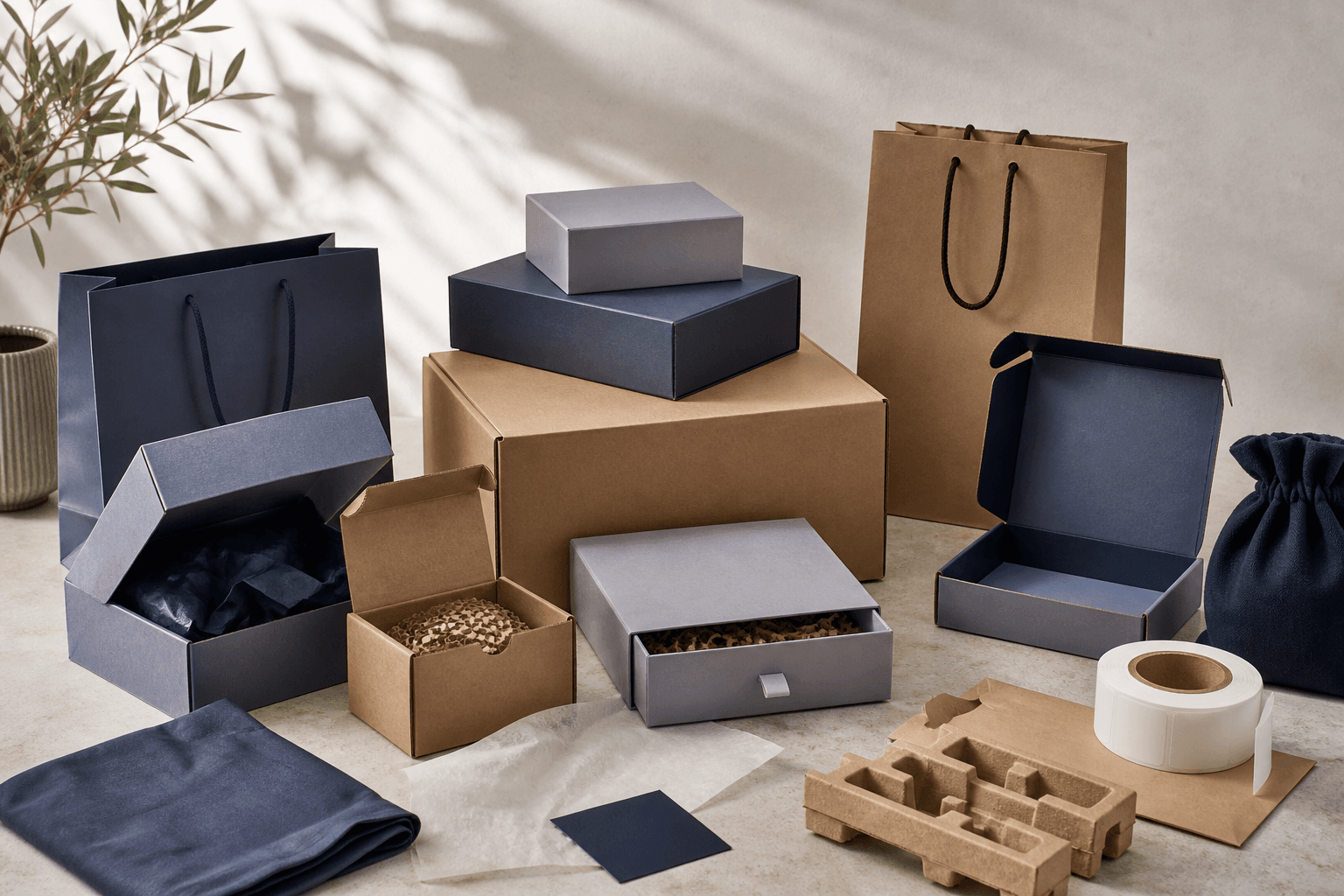
Rigid Box (Set-Up Box). Coated or specialty paper laminated over a hard cardboard core; magnetic lid, drawer, or book-style opening options. The standard format for luxury positioning — jewelry, premium cosmetics, high-end electronics, perfume sets. Its only disadvantage is high setup cost and relatively high MOQ; in return, its shelf impact and unboxing weight are unmatched. A customer who takes a rigid box in hand has received the "this is something expensive" signal before even deciding about the product inside.
Folding Carton Box. Thin cardboard (usually in the 300–450 gr range), foldable, shipped flat. The most cost-effective format for e-commerce and retail. Widely used for cosmetics, food, and small electronics. Print quality is high, but for a premium touch, finishes such as embossing, foil stamping, and UV coating are needed. If the brand is in a growth stage, folding cartons are the way to test visual differentiation on a sensible budget.
Corrugated Box. Kraft with a wavy inner layer; different flute structures such as B, E, F are selected according to the transport load. The main format for tertiary packaging and B2B shipping. For sustainability-focused brands, a directly printable kraft surface is preferred — unbleached kraft is the visual shortcut of the "natural" narrative. In e-commerce, the corrugated mailer box combines both the protection and unboxing roles.
Paper Bag. Flat or twisted handle, kraft or coated paper. It maximizes brand visibility at the retail exit point; it works as a "walking advertisement." A basic format for fashion, cosmetics, and gift retail. Details such as the handle structure, mouth thickness, and bottom cardboard reinforcement determine the difference between looking cheap and looking premium.
Fabric Bag. Cotton, linen, or recycled polyester; reuse-oriented. In luxury fashion and corporate gifts, it carries brand contact beyond the purchase. Its unit cost is higher than a paper bag, but when you calculate the "brand visibility value" the consumer provides through a bag they use for weeks, the math reverses.
Auxiliary Components (Label, Tissue Paper, Divider, Thank-You Card). The consistency layer that complements the main packaging. Premium brands use, on average, 3–5 auxiliary components together; this is the layer where brands win not shelf impact but unboxing consistency. A thank-you card alone makes a mailer box "cute"; the combination of tissue paper + label + divider, however, creates the feeling of a "curated experience."
Packaging Type Ideal Brand CategoryTypical Layer Rigid Box Luxury cosmetics, jewelry, premium electronicsPrimary/SecondaryFolding CartonE-commerce, retail cosmetics, foodSecondaryCorrugated BoxDTC shipping, B2B, sustainable brandsTertiaryPaper BagFashion retail, gift, cosmetics storeExit/presentationFabric BagLuxury fashion, corporate giftReusable outerAuxiliary ComponentsAll premium brandsSupport/consistency
The vast majority of brands start with a single type of packaging, but during the growth stage they transition to hybrid combinations. The combination for a typical premium cosmetics brand: rigid box (secondary) + tissue paper + thank-you card + corrugated mailer (tertiary). For an e-commerce-focused DTC brand, it simplifies to: folding carton + tissue paper + mailer. Here the correct query should not be "which single type?" but "which combination, with what budget?"
The right question is not "which packaging type should I choose?"; it is "which combination should touch my customer, and at which moment?"
The Four Levels of Customization
The term "custom packaging" is not a single thing. Printing a logo on a standard box is customization too; so is structural design from scratch. When deciding among the four tiers in between, the question a brand should really ask is not "how different do I want to look?" but "which level is necessary for my brand narrative, and which level is a luxury?"
LevelDefinitionDesign TimeSetup CostIdeal Brand Situation1. Standard SizeReady-made box + label1–2 daysVery lowTest phase, MVP, pop-up2. Graphic DesignStandard structure + full print5–10 business daysLow-MediumGrowing DTC, launch3. Structural DesignCustom size, divider, die-cut2–4 weeksMedium-HighPremium launch, gift set4. Full BespokeStructure + graphics + material + custom finish4–8 weeksHighLuxury brand, limited collection
The transition from Level 1 to 2 is where most brands start. Low risk, high visual gain; applying your brand graphics to a standard-size box from the supplier's stock is measured in days rather than weeks. However, because the structure remains standard, the "premium feel" stays limited — it opens like every other brand's box. The right starting point for brands wanting to run launch tests and quickly bring a limited number of SKUs to market.
The transition from Level 2 to 3 is where the real brand differentiation begins. Structural decisions such as a custom inner divider, magnetic lid, or drawer structure transform the moment of opening the product. Setup cost increases roughly 30–40% (due to tooling + structural prototype + additional assembly tests), but shelf and unboxing differentiation grow many times over. For premium cosmetics or jewelry brands, this level is usually the minimum standard; otherwise, standing out from competitors depends on the power of graphic design.
The place where Level 4 is warranted is narrow. Full bespoke is only reasonable for limited collections, luxury gifts, or key brand marker products. Trying to produce the entire SKU portfolio at the bespoke level creates two problems: MOQ bottleneck (custom tooling and custom material stock for each SKU) and obsolescence risk (with a design change, all the investment goes into the trash). The correct usage, as luxury brands do, is to make flagship products bespoke and manage the rest with level 2 or 3.
The transition from a standard box to a custom structural design is roughly 30–40% more expensive; but shelf and unboxing differentiation grow exponentially.
Prototyping and sampling process is a stage that should not be skipped at any of the four levels. As Wikipedia also states, packaging is "the coordination of the design, evaluation, and production process." If the physical sample stage is skipped in this process, print color deviation, material texture turning out different than expected, and structural integrity problems are only noticed in mass production — that is, after millions of liras have been shipped. Pantone-matched color proof, material texture sample, and assembly test: these three steps must absolutely be completed at every customization level. Even at Level 1, at least a physical color proof should be requested; the color prints differently than what you see on screen — this is the rule.
Standards such as Kosapack's physical sample delivery within 7–15 business days provide a reference point regarding how long the prototyping cycle can stretch. Suppliers who extend this period to 30 days make your launch schedule unpredictable.
Sustainable Packaging Materials
While Turkish packaging industry sources frequently present cardboard and plastic packaging as "economical and cost-friendly" options, they also point to versions that can be produced "entirely from recyclable raw materials" (Morpack). The tension between these two narratives is where brands must make their real choice: economical conventional packaging, or verifiable sustainable packaging?
Paper/Cardboard or Plastic? Standard packaging materials are paper/cardboard, plastic, metal/tin, and glass (Unipak, Saydaş Plastik). For the vast majority of premium brands, cardboard is the priority choice both in terms of recycling infrastructure and premium touch. Plastic should only be preferred when waterproofing or transparency is mandatory — before testing the idea of a window box for a cosmetic set, question whether the same visual effect can be created with die-cut kraft.
Choosing Thickness and Grammage. While 300 gr folding carton is sufficient for a standard cosmetics box, above 400–450 gr is preferred for a premium perfume box. Higher grammage means higher shipping cost and a higher carbon footprint; however, it is often necessary for premium perception. Here the decision is to find the "minimum adequate grammage" — choosing 500 gr just to be thick harms both the wallet and the environment.
Water-Based and Soy-Based Inks. Water- or soy-based alternatives instead of conventional solvent-based ink increase printing cost by about 5–15% but improve recycling compatibility and VOC emissions. It is a line item that should not be negotiated away for brands making a sustainability claim. Ask your supplier to state by name which ink system they use — the word "eco-friendly" alone provides no specification.
Tissue Paper, Divider, and Filler Materials. Recycled kraft, cork-based filler, or starch foam instead of plastic foam; it changes the unboxing texture and strengthens the brand narrative. The cost difference is small but consumer perception is high. Plastic bubble wrap air pockets undermine, in three seconds, all the brand building the premium brand has worked on for hours.
Reusability Design. A fabric bag, a magnetic storage box, a rigid box with a second life — packaging that extends beyond the product's lifespan prolongs brand contact. This is the dimension of sustainability that is felt, not measured. Every day a consumer uses the cosmetics brand's rigid box to store makeup, the brand name remains visible on the bathroom shelf.
Carbon Footprint Reporting and Certifications. Forest certifications such as FSC, PEFC and carbon footprint reports are the provable part of a sustainability claim. Uncertified claims run the risk of greenwashing and create regulatory problems especially in European exports. Writing "recyclable" is cheap; providing an FSC number is a contractual obligation.
Waste dimension warning. When packaging's role is over, according to Bereketsan, it moves into "packaging waste" status. Especially because tertiary packaging turns into waste at the point of sale, the choice of recyclable corrugated cardboard is not just a matter of brand communication but a regulatory responsibility. Extended Producer Responsibility (EPR) frameworks are becoming binding in the EU market; this direction is inevitable for Turkish brands too.
The Hidden Line Items of Packaging Cost
The vast majority of brands negotiate with packaging suppliers on unit price. Yet the real cost is often roughly 1.5–2 times the unit price; the difference comes from setup, MOQ, logistics, revisions, and quality risk. In Wikipedia's definition, packaging is "the coordination of the design, evaluation, and production process"; and the cost accumulates at every stage of this coordination.
Setup and Tooling Costs. Die-cut tooling, print plate, embossing matrix — these are one-time investments but they reflect harshly on the unit cost in small production volumes. Especially at the structural design level, tooling cost can constitute a significant proportion of the production batch. If tooling cost appears "hidden" within the unit price in the supplier's quote, then when you pay the same price in your second production batch, the supplier is making an unfair profit. Insist that the tooling cost be shown as a separate one-time line item.
MOQ and Inventory Burden. Suppliers set a minimum order quantity for economical production. If the brand cannot forecast 3 months of consumption, the warehouse fills up, storage fees increase, and stock obsolescence occurs with a design change. Each of the primary, secondary, and tertiary layers comes with a different MOQ — that is, if the MOQs of the three layers are not synchronized, when one runs out the other sits idle. Synchronized order planning is the most overlooked discipline of packaging operations.
Logistics and Consolidation. Packaging size directly affects shipping cost. A dimensional optimization of a few millimeters seriously changes shipping cost on an annual basis by increasing the number of units on a pallet. Kolisan and Pro-Pak sources emphasize that transport and storage cost is an inseparable part of the packaging decision. During the structural design phase, an hour of negotiation between "the aesthetically optimal size" and "the pallet-optimal size" can create a noticeable saving on the annual shipping bill.
Quality Control and Sample Cycles. A batch that goes into production before the color proof is approved, if it comes back with print deviation, means weeks lost and re-production cost accumulating doubly. Pantone-matched proof, physical sample, and assembly test — each should be a separate budget line item. A supplier saying "samples are free" is either lowering the quality or has absorbed the cost into another line item; in both cases, there is a lack of transparency.
Time-to-Market. Supplier design revision cycle, sample delivery, production, and shipping — the total time can range from 4 to 10 weeks. A packaging project started 6 weeks before the launch date incurs a rush premium or the launch slips. The moment the marketing team shares the launch date with the product development team, the packaging brief should also be put on the table.
Supplier Dependency. Single-factory dependency, long lead times, and difficulties in tooling transfer eliminate your annual negotiation leverage. Partners with a verified multi-factory network reduce this risk; a supplier dependent on a single factory cannot offer an alternative when its machine breaks down or capacity fills up.
Most brands negotiate unit cost; experienced brands negotiate total cost of ownership — including MOQ flexibility, revision allowance, and schedule risk.
An eight-step action list to control total cost of ownership:
Clarify the total cost of ownership — not the unit price, but the total of setup + unit + logistics + inventory.
Account for the 3-month inventory space and its cost; warehouse square-meter fees are a silent expense line item.
Match the supplier lead time with your product launch schedule; plan backwards.
Request a color-matched proof before full production; do not give mass-production approval based on a digital proof.
Verify sustainability certifications before your marketing claims; ask for the FSC number.
Get a written quality guarantee — print tolerance percentage, structural defect coverage, re-production conditions.
Reserve roughly 30–40% of your budget for mid-run revisions; the first batch never comes out 100% correct.
Document all approvals in writing; verbal approvals create scope creep and invoice surprises.
Supplier Evaluation Framework
The technical part of the packaging decision ends with supplier selection. This selection should be made with a three-layered evaluation: basic qualification check, deepening with critical questions, and red-flag screening.
Basic Qualification Checklist
☐ Does it offer end-to-end service? Are design, prototype, production, and logistics managed under one roof, or are you bridging between different suppliers? Single-source management provides clarity in revisions and responsibility.
☐ Does it transparently share its verified factory partners? Knowing where the production is done is fundamental for quality control ownership. "We have a solution partner" is an inadequate answer; the name and location should be requested.
☐ Does a price quote come within 24–48 hours? A fast quote process is an indicator that the supplier's internal processes are functioning. A supplier that keeps you waiting a week for a quote will also be slow during the production stage.
☐ Does it deliver a physical sample within 7–15 business days? Sample time directly signals the supplier's production capacity and prioritization discipline.
☐ Does it offer a Pantone-matched color proof? For premium brands, color deviation is directly a brand identity problem. Ask whether it references the Pantone Coated/Uncoated library.
☐ Can it do custom sizing, or is it limited to "standard tooling"? Structural design flexibility is a precondition of brand differentiation.
☐ Does it publish sustainability metrics? FSC certification, recyclable material percentage, carbon report — provable data.
☐ Does it have reference work in your vertical? Portfolio depth in your category such as cosmetics, e-commerce, fashion resets the learning curve; the answer "we do everything" usually means being deep in none of them.
Six Critical Questions You Should Ask the Supplier
1. "Do you manage the production, or do you only broker the price?" Expected answer: Full factory visibility, on-site quality control inspection, physical visit during the production process. The answer "we source, the factory is a separate business" shows that the supplier will transfer responsibility at the moment of a problem.
2. "What is your MOQ flexibility for new brands?" Expected answer: A tiered pricing structure; openness to smaller batches for startup brands, but with a clear price difference. The answer "MOQ is 10,000 units, no other way" tells you the negotiation door is closed.
3. "How do you handle a design revision mid-production?" Expected answer: A clear cost structure, documented approval gates, a written description of after which stage a revision will require re-setup.
4. "Can you guarantee your brand Pantone color?" Expected answer: Yes, together with a physical proof step; they should name the offset, digital, or flexo printing method and explain which printing method is right for your job.
5. "What happens if the first production batch does not meet the specification?" Expected answer: A written rework clause, quality guarantee, specifying with a percentage value which tolerance will be considered "acceptable."
6. "How transparent are you about sustainability?" Expected answer: FSC or PEFC certificate number, recyclable ratio, carbon reporting; willingness to provide a report. The answer "all our materials are eco-friendly" is empty calibration.