

Packaging Materials Guide: How to Make the Right Choice for Your Brand?
A brand manager places the box returned by the customer on the table. 300 gsm folding carton, crushed at the corners. The matte finish is covered with friction marks that occurred during transit. The customer's note is short: "The box was in bad condition, I couldn't trust the product." This is the final state of the first order — and brand perception has been damaged before the product was even opened.
This story repeats itself for a significant portion of growth-stage brands in Turkey. According to Sealed Air field data, returns arising from product damage due to inadequate packaging make up 20–30% of total returns in many categories. This number directly cuts into profit margin — and it also reduces the likelihood of repurchase. The choice of packaging materials is not a cost decision but a brand decision; while the complete list and classification of packaging categories is a separate topic in itself, the truly critical point is making four fundamental decisions in the correct order.
The wrong substrate, wrong grammage, or wrong finish leads to both physical damage and erosion of brand perception. This guide explains four critical decision points, from paper type to closure mechanism, with industry benchmarks and questions you should ask your supplier. At the end, you'll find a single-page specification brief you can send to three suppliers at once.
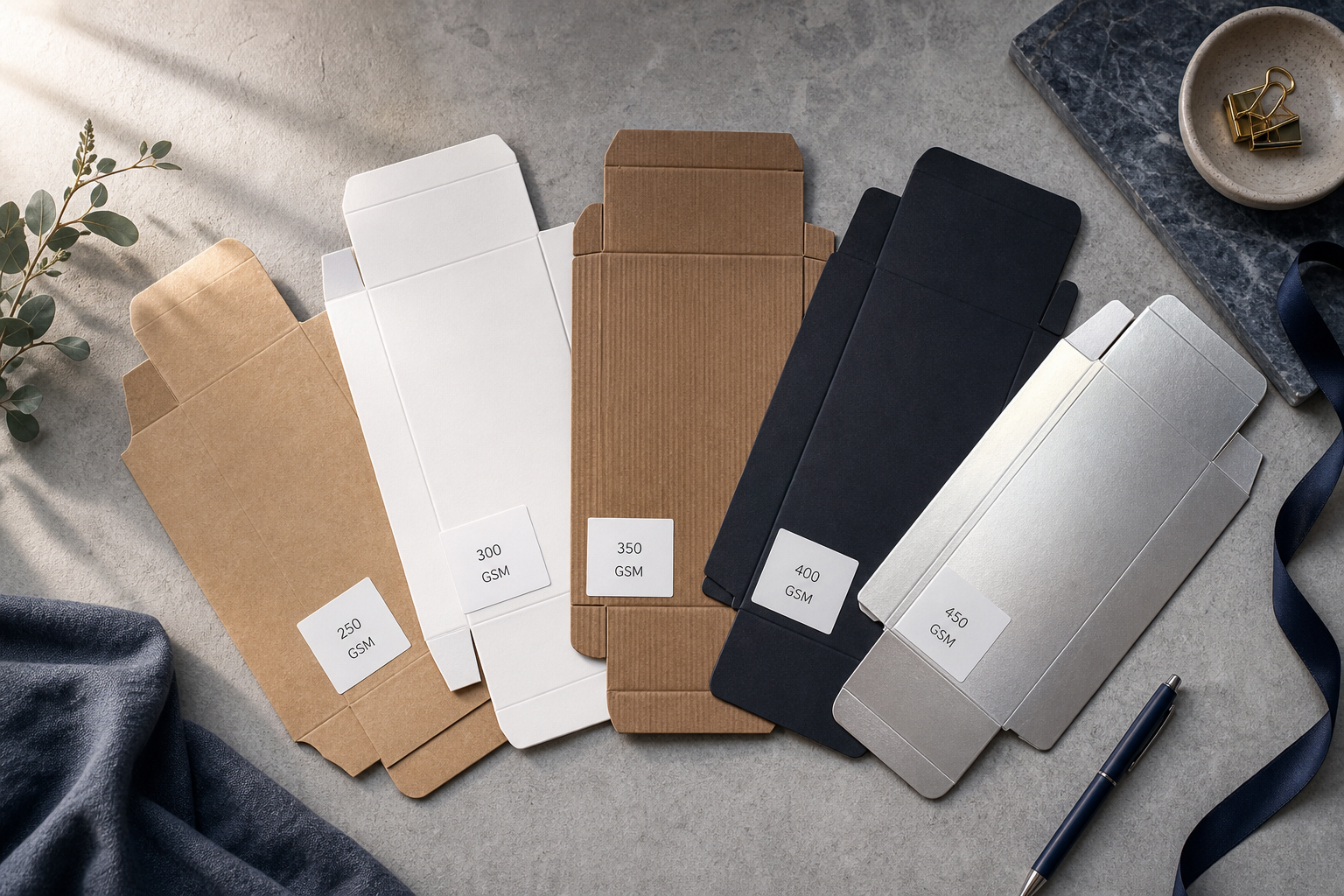
Table of Contents
Four Main Decisions When Choosing Packaging — Substrate, Grammage, Finish, Closure
How Does Material Choice Affect Your Production Schedule and Budget?
Packaging Materials by Your Industry — Category-Based Matches
Sustainability Claims and Packaging Materials — Hidden Trade-Offs
Sample, Color Proof and Approval — A 10-Step Quality Gate Before Mass Production
7 Questions to Ask Your Supplier Before the Price Conversation
Four Main Decisions When Choosing Packaging — Substrate, Grammage, Finish, Closure
Most brands ask the wrong question in their first meeting with a supplier: "Carton or plastic?" This is an overly general framework that substitutes for four decisions that have a real impact on cost and brand perception. The correct order is: substrate type, grammage, finish, closure. When these four are locked in sequence, the price quote becomes meaningful; if one is missing, each supplier interprets differently and incomparable quotes come back.
Substrate type is the first decision because it frames the other three decisions. According to the Packaging Manufacturers Association technical bulletin, five main carton classes are used in the Turkish packaging industry: grey board (the most economical, recycled fiber, for non-visible inner surfaces), chromo board (single-side coated, print-friendly, pharmaceutical and food standard), coated/bristol board (premium whiteness, cosmetic standard), lining board (80–150 gsm for rigid box outer lining), and corrugated cardboard (in the protective category with E, B, C, BC flute options).
Grammage is the second decision. According to the Packaging School technical reference, the 250–400 gsm range is standard for folding carton boxes; 300 gsm is shown as a common benchmark for most FMCG boxes, and 350 gsm for premium/retail shelf boxes. For corrugated cardboard, the FEFCO classification is used as reference: E flute is approximately 1.5 mm (for cosmetics and small e-commerce), B flute ~3 mm, C flute ~4 mm, and BC combination for heavy products.
Finish and coating is the third decision: matte, glossy, soft-touch, metallic, or uncoated. According to industry data, glossy finish is generally 8–15% more expensive per unit than matte finish; soft-touch requires an extra lamination line and extends the timeline. Closure and structural integrity is the fourth decision: tuck-flap (standard), auto-bottom (requires die investment), magnetic (premium perception, manual assembly), ribbon/handle (fashion category), sleeve (perfume, gift).
These four decisions are not independent — the substrate choice determines finish compatibility, grammage determines closure type, and closure determines shipping durability.
Comparison of Substrate Types
Substrate | Typical Grammage | Print Quality | Typical Use | Source |
|---|---|---|---|---|
Grey board | 250–400 gsm | Low (inner surface) | Rigid box inner layer | Packaging Mfrs. Assoc. |
Chromo board | 250–350 gsm | Medium-high (single side) | Pharmaceutical, food folding box | Packaging Mfrs. Assoc. |
Coated/bristol | 250–400 gsm | High (double side) | Cosmetics, retail premium | Packaging School |
Lining board | 80–150 gsm | High | Rigid box outer lining | Packaging Mfrs. Assoc. |
Corrugated cardboard (E) | ~1.5 mm | Medium (printed) | Cosmetics, small e-commerce | FEFCO |
Corrugated cardboard (B/C) | ~3–4 mm | Low-medium | Heavy product, logistics | FEFCO |
To put the table into practice, two scenarios: A cosmetics brand chooses a combination of coated board 350 gsm outer layer + E flute corrugated inner protection for a premium serum box; this combination provides both print quality and shelf impact resistance together. A DTC e-commerce brand, on the other hand, chooses a chromo board 300 gsm folding carton + B flute corrugated mailer; the inner box takes on brand communication, and the outer mailer takes on shipping durability.
Substrate choice directly determines finish compatibility. Soft-touch lamination on grey board is a nonsensical cost — grey board is most efficient when positioned as a non-visible inner layer; applying an expensive finish on it means investing in an invisible surface. Conversely, metallic foil or embossing on coated board is a "natural match" — the surface supports both ink and foil adhesion. Your supplier telling you "every finish works on every substrate" is technically incorrect; it works, but the balance between cost and result becomes unbalanced. Doypack.net's Turkey-focused review also emphasizes that plastic, paper/cardboard, glass, aluminum, and composites offer different performance profiles — that paper/cardboard stands out on the print and sustainability side, and plastic on the barrier and lightness side.

How Does Material Choice Affect Your Production Schedule and Budget?
You sent the same brief to three suppliers. One said 3 weeks, one 5 weeks, one 7 weeks. And prices were scattered within a 30% range. The problem is not the suppliers' inconsistency — the problem is the domino effect that the four decisions create downstream. Even under the same brief, the material supply chain, machine compatibility, and finishing steps end up differently at each supplier.
Substrate sourcing → sample and mass production time. According to Packaging World industry interviews, a 7–15 day sample time is considered standard for complex printed boxes; this is followed by a mass production time of 3–6 weeks. Virgin fiber is usually kept in stock and procured quickly; cartons with high recycled content (80%+) may experience supply delays. According to CEPI technical notes, as recycled content increases, both the supply time and burst strength are affected — a sustainability claim can conflict with your time plan.
Grammage → machine compatibility. Some printing machines struggle to process carton over 400 gsm; some small folding machines require adjustment for under 250 gsm. The 450 gsm coated board you chose for your "premium" concept may require the supplier to route to a specific partner factory — the lead time extends, the price changes. That's why grammage changes can mean a production line change, not a "small adjustment" during production.
Finish → hidden cost and time. Here are a few typical items:
Soft-touch lamination: Additional lamination line; typically 2–3 days extra time.
Metallic ink or foil: Extra proof for color accuracy; roughly 10–20% cost increase.
Uncoated finish: Risk of staining and abrasion during shipping — a protective varnish layer becomes essential.
Glossy finish: Roughly 8–15% unit cost increase compared to matte finish.
Closure mechanics and die investment. For tuck-flap closure, the standard die is sufficient, with no additional cost. Auto-bottom requires a special die; a one-time setup cost may arise in the range of about 8,000–25,000 TL and this cost is amortized from the first order. Magnetic closure brings roughly 1.5–3 TL additional load per unit because the magnet integration is manual or semi-manual. Ribbon and handle closure extends the time per unit because it is a manual labor item. Structural additions — corner protectors, separators, tissue wrap — each is a separate SKU and assembly step; the price is not consolidated into a single item.
Moving from 300 grammage to 350 grammage increases the unit cost by eight percent but seriously reduces damage returns — the math pays for itself quickly.
That's why even suppliers who can offer a price quote within 24 hours cannot deliver a physical sample before 7–15 business days — because a real sample is hand-assembled with real production materials. Firms that only send a PDF mockup or 3D render skip this step; and because they skip it, the risks of color shift, grammage deviation, and finish inconsistency in mass production reach all the way to the consumer.
Prof. Susan Selke, director of Michigan State University School of Packaging, defines packaging as "a bridge between logistics, product protection, and brand communication" — meaning material decisions affect all three dimensions at once. In practice, this means: reducing grammage may reduce the shipping carbon footprint, but if it increases the breakage rate, the total carbon load of the lost product exceeds the savings from packaging. The right balance is between product protection and material savings; optimizing either one alone backfires.
Packaging Materials by Your Industry — Category-Based Matches
Each category defines the consumer's "quality packaging" expectation differently. The cosmetics consumer evaluates through weight and texture, the e-commerce consumer through shipping durability, and the fashion consumer through reusability. The following six industry matches allow you to calibrate your packaging materials decisions according to category benchmarks.
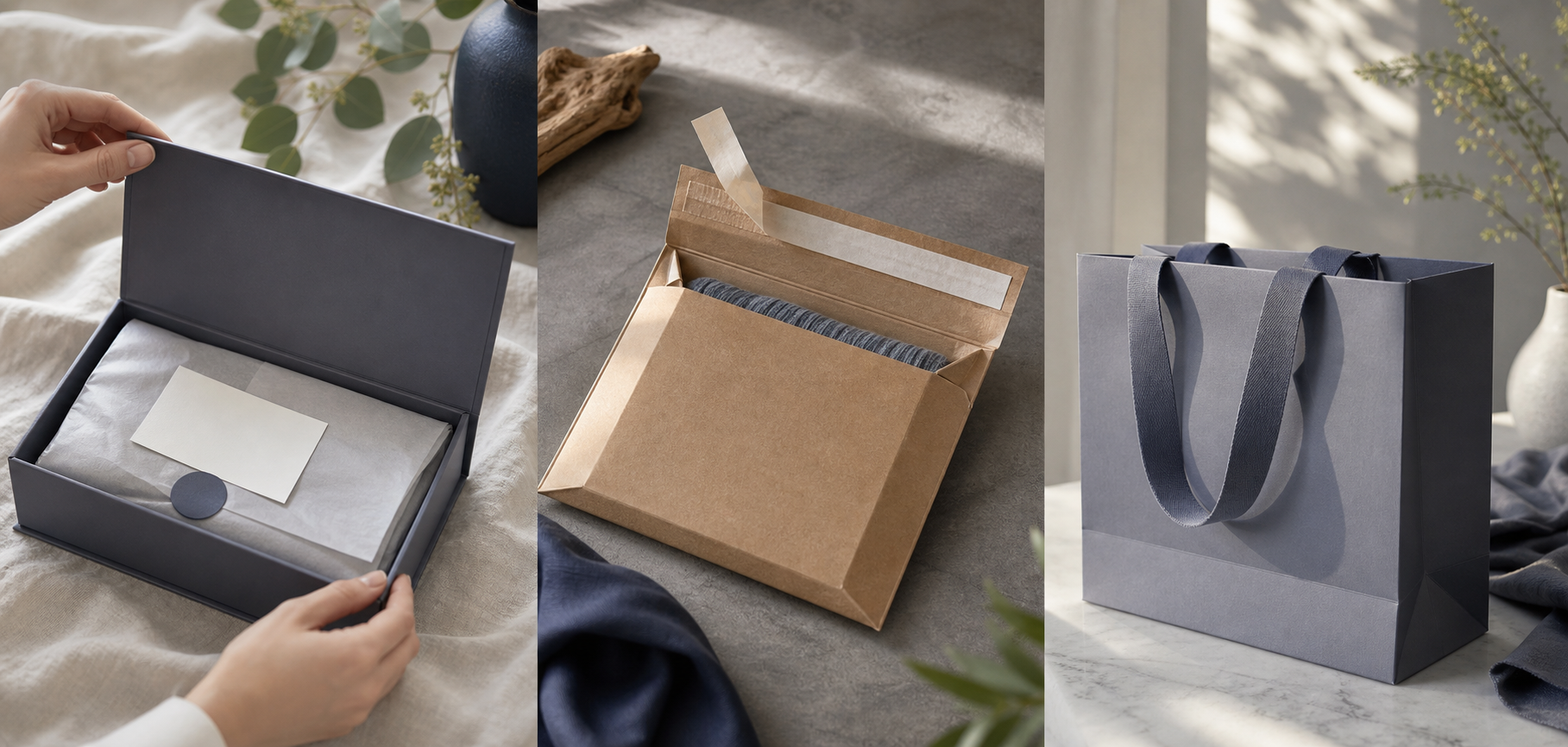
Cosmetics and luxury care. Substrate: coated board 300–350 gsm or coated rigid box (1.5–2 mm grey board inner + coated outer lining). Finish: matte + soft-touch common; metallic foil accents complement premium perception. Closure: magnetic or premium tuck-flap. The consumer builds quality perception through "weight" and "texture" — Packaging School confirms the 350 gsm benchmark in the premium segment. Within the comprehensive guide to packaging types, the cosmetics category stands out as the vertical with the highest finish variety.
E-commerce and DTC. Substrate: chromo board 280–320 gsm or E flute corrugated cardboard. Finish: matte or uncoated — surfaces resistant to staining and abrasion in shipping. Closure: tuck-flap or auto-bottom (packing speed is critical). The unboxing video era + the reality of the package passing through 10+ hands makes the FEFCO E flute class the standard for this category. Against cargo crushing, the outer mailer works as a second layer protecting the brand box.
Fashion and apparel. Substrate: coated board or linen-textured specialty paper; also tissue paper + kraft bag combinations. Finish: mostly matte — glossy finish shows abrasion marks and weakens premium perception. Closure: ribbon or handle. When the bag and box signal "reusable," brand visibility extends; the user carrying the bag again creates free media.
Food and beverage. Substrate: food-contact certified carton (chromo or virgin fiber); corrugated cardboard or leak-proof composite containers in the take-away category. Finish: glossy (for appetite-stimulating colors) or food-safe matte. Closure: window + structural integrity together. EU (EC) No 1935/2004 regulation sets migration limits — ink and coating choice is restricted. Wikifarmer's food packaging analysis emphasizes that the microorganism/oxygen/light/moisture barrier must be evaluated together. Unipak's take-away guide adds that temperature, sauce ratio, and carrying time are the three variables that determine packaging choice.
Jewelry and watches. Substrate: rigid box (lining board outer, grey board inner structure) + inner cushioning (foam or fabric). Finish: soft-touch + foil engraving common. Closure: magnetic or sleeve. Product size is small, the packaging must create the perception that it is "as expensive as the product" — in this category, the ratio of packaging cost to product price is kept higher than other categories, and this is intentional.
Corporate gifts and promotions. Substrate: 350 gsm coated or rigid box. Finish: matte + embossing (perceived quality). Closure: premium tuck or magnetic. It signals to the gift recipient that the brand "made an investment" — embossing is the differentiating detail with the lowest per-unit cost increase; when used together with metallic foil or soft-touch, the premium perception multiplies. Paketleme-Rehberi's notes on choosing the right packaging recommend evaluating the relationship between product weight and material durability on a category basis.
Sustainability Claims and Packaging Materials — Hidden Trade-Offs
According to Eurostat data, the recycling rate of paper/cardboard packaging in the EU in 2020 was approximately 82% — the fraction with the highest recycling rate among packaging waste. But according to OECD's Global Plastics Outlook report, approximately 40% of global plastic demand still comes from the packaging sector. When the two statistics are read together, the picture becomes clear: the paper/cardboard side is ahead in the sustainability discourse, but the majority of the global packaging flow is still plastic-dominant.
At this point, the trap brands fall into also becomes clear: claims like "100% recyclable" or "compostable" are used for marketing — but the technical basis for these claims is often lacking. UNEP Champion of the Earth award-winning sustainable designer Dr. Leyla Acaroglu emphasizes that claims like "100% recyclable" are misleading when the actual waste infrastructure and ink/coating types are not disclosed; and that brands must support their environmental claims on packaging with concrete evidence and transparency.
Sustainability Claims: Marketing vs. Reality
Claim | Production Constraint | End-of-Life Reality | Verification Source |
|---|---|---|---|
100% recyclable | Ink must be soy/water-based; metallic foil disrupts the process | Actual carton conversion in the EU 82% | Eurostat |
Carbon neutral | Supplier LCA + certified offset required | Offset quality varies widely | UK WRAP |
Plastic-free | Barrier loss in oily/moist products | Net positive (enters the paper stream) | OECD |
Compostable | Industrial infrastructure essential; home composting insufficient | Infrastructure limited in TR | Hottle et al. (ACS) |
80%+ recycled | Burst and edge crush strength decrease | Risk of technical unsuitability in heavy products | CEPI |
Reusable | Roughly 2–3x unit cost | Depends on consumer behavior | UK WRAP |
The critical reading of the table converges on four points.
First, the "compostable" fallacy. Hottle et al.'s Environmental Science & Technology study shows that in regions where industrial compost infrastructure is inadequate, compostable plastics mostly end up in landfills, and there they can be as persistent as conventional plastics. In Turkey, industrial compost infrastructure is limited; the "compostable" claim looks environmentally friendly but is not operationally realistic.
Second, the recycled content and durability trade-off. CEPI technical notes show that the burst and edge crush strength of carton with 80%+ recycled content decreases to a certain extent. A premium cosmetics brand preferring "100% recyclable carton" may fail the shelf impact test — the sustainability claim can conflict with product protection.
Third, glass or metal is not always better. UK WRAP's life cycle analyses show that glass, due to its high weight and energy-intensive production, can have a higher carbon footprint than lightweight plastic packaging in some usage scenarios. Material choice must be made not by a single criterion but by the entire life cycle.
Fourth, regulatory constraints. EU (EC) No 1935/2004 regulation requires migration tests and traceability in packaging that comes into contact with food; this limits the inks and coatings that can be used on carton. When the "100% recyclable + food contact" claim is made together, both constraints must be proven with test documents.
The same warning is repeated from a different angle in Dr. Roni Neff's food waste studies at Johns Hopkins Bloomberg School of Public Health: strategies that focus only on material reduction can increase the total environmental impact through product damage and food spoilage. The right packaging stands at the balance point between protection and material savings.
The "100% recyclable" claim collapses at a plastic window you didn't disclose — sustainability credibility is lost faster than it is built.
Conclusion: your sustainability claim is only as valuable as the verification documents your supplier can provide. Carbon footprint report, ink safety data sheet, recycled content certificate — without these three, a claim is marketing copy, not evidence.
Sample, Color Proof and Approval — A 10-Step Quality Gate Before Mass Production
The gap between the "approved sample" and "mass shipment" is where material specifications fail. Brands approve a two-piece sample; then in mass production, color shift, grammage deviation, or finish inconsistency emerges — and at this point, the correction cost rises to 5–10 times that of upfront planning. UCSA Ambalaj's industry benchmark emphasizes that testing should be done at every stage; that intermediate controls during production after sample approval and final tests are conditions for "high quality." The 10-step quality gate below is distributed across three phases within Packaging World's 7–15 business day industry benchmark.
Pre-Sample Briefing (Days 1–2)
Lock the substrate in writing. Carton type (chromo/coated/corrugated), grammage (250/300/350/400 gsm), color (natural, bleached, cream). "Premium carton" is not enough — the supplier interprets this expression, and the result changes.
Specify the finish and gloss level. Matte / glossy (80, 120, 150 gloss value) / soft-touch / uncoated. If you say glossy, write which level it is; otherwise, the most common gloss level the supplier has comes, which may not be what you expected.
Approve the ink type. Soy-based, water-based, or UV. This choice determines both color saturation and your sustainability claim — soy and water-based inks are cleaner in the recycling stream.
List the closure and structural additions. Is it tuck-flap or magnetic; are corner protectors, separators, tissue needed? Each addition is a separate SKU and assembly step.
Sample Production (Days 3–7)
Request 2–3 samples hand-assembled with real production materials. Not a PDF mockup or 3D render — a physical sample. The Packaging World standard gives this time as 7–15 business days; a quote that shortens this time either uses the closest material in stock or skips a step in the process.
Apply durability tests. Drop test (1 m), stacking test, folding test, closure cycle (50+ open/close for magnetic closure). Keep the pass criterion for each test in writing.
Check color accuracy against the Pantone reference. Look in daylight + office fluorescent + LED — metamerism differences (perceiving different colors in different lights) emerge. Before approval, it must be acceptable in all three lighting conditions.
Approval and Production Gate (Days 8–9)
Approve the sample in writing + with a photo. A "This sample is approved" email + a photo of the sample; it prevents a future "we didn't approve this" dispute. Verbal approval provides no legal basis in a dispute.
Fix the mass production start date only after written approval. No exceptions. Permission to start production early "to save time" is paid back to you when a surprise arises.
Request random QC sample pulls during production. 5–10 units per 10,000 units — UCSA Ambalaj industry recommendation. These samples should reach you and be compared with the base sample.7 Questions to Ask Your Supplier Before the Price Conversation
Price and delivery time are the output of how well the supplier understands your category, your sustainability constraints, and your production risks. So there are questions that must be asked before learning the price; these filter supplier maturity and enable you to get comparable quotes. The following seven questions give you data on the same axis no matter which supplier you work with — Kosapack or someone else.
"Which grammage do you recommend for my category and why?" A general "300 gsm is suitable" answer is a red flag. A mature supplier answers with the category benchmark + product weight + shipping scenario. CRD Box's scientific carton selection reference defines this approach as "compatibility of product, printing technique, and logistics chain."
"Does your 24-hour price quote include a physical sample and color-accurate proof, or just a PDF mockup?" A fast quote usually skips the sample step; a real physical sample requires 7–15 business days according to the Packaging World benchmark. A quote that doesn't clarify this difference carries surprise costs.
"Can you provide a carbon footprint report for my specification?" Most suppliers in Turkey cannot. A supplier who can offers the capability to document your sustainability claim — this is not marketing copy but a data sheet supporting the purchasing decision.
"What is your QC process during mass production? Will you do sample pulls from my batch?" UCSA Ambalaj defines intermediate control and final tests as the industry standard. A "we do sampling" answer is not enough; frequency and sample size should be asked.
"Is the custom die cost included in the quote or separate? What happens if I change the specification after production starts?" For auto-bottom or custom closure forms, a setup cost in the range of about 8,000–25,000 TL may arise. A quote that doesn't clarify this item at the start turns into a surprise in the second month.
"Do you consolidate my shipment with other customers, or ship directly?" Consolidated shipment reduces the unit transport cost and carbon footprint but makes the delivery date somewhat more flexible. Saying which you prefer guides you to the right solution. Sealed Air's protective packaging field analyses also show that reducing the damage rate must be designed not with packaging alone but together with the logistics flow.
"If my brand identity changes and I reorder, what is the cost and time for the color/size change?" This question reveals whether the supplier sees you as a one-time customer or a long-term partner. New die, new color profile, new dimension brief — if the change cost of these is not discussed now, you lose your negotiating position in the sixth month.
Most fast price quotes skip the sample step — a real physical sample is produced within 7 to 15 business days because material quality cannot be evaluated on a PDF.

Frequently Asked Questions
"We're in a hurry. Can we skip the physical sample and approve the digital proof?"
No. A digital proof does not show the soft-touch texture, the color shifts in different light, and the closure feel/stacking soundness cannot be evaluated digitally. An express 3–4 day accelerated sample costs roughly 15–25% extra but pays back the risk. Brands that skip the sample and go directly to mass production typically write off a loss on the first order due to either color shift or closure incompatibility — and this loss is usually 10–20 times the cost of an express sample."How much does the transition from matte to glossy really cost?"
According to Packaging World industry data, roughly 8–15% per unit. Glossy finish requires additional processing and special ink. The decision logic is this: if catching the eye in shelf competition is important, glossy; in the luxury segment where unboxing is special, matte + soft-touch creates a stronger perception. If you make this decision without knowing the category consumer behavior, product positioning conflicts with the finish."Is recycled fiber really cheaper, or is this marketing?"
It can be 5–10% cheaper as raw material, but according to CEPI, high recycled content (80%+) reduces mechanical strength, and if your supplier doesn't have a reliable recycled mill connection, the supply time can extend by 2–5 weeks. For a DTC brand with a 30-day delivery time, virgin fiber is safer; for bulk orders with a flexible timeline, recycled provides savings. Your sustainability claim and your timeline must be consistent."Can we print fine graphics on linen or ribbed textured paper?"
Yes, but text under 8 point and fine lines bleed into the texture and become illegible. Your actual design textured